Before you even think about writing the first question, you need to get crystal clear on one thing: why are you doing this survey? A truly effective parent survey isn't about collecting data for data's sake. It's about gathering specific, actionable insights that you can actually use to make the school better.
This means you need to define exactly what you want to learn and how it ties back to your school's bigger goals.
Define Your Purpose Before You Ask a Single Question
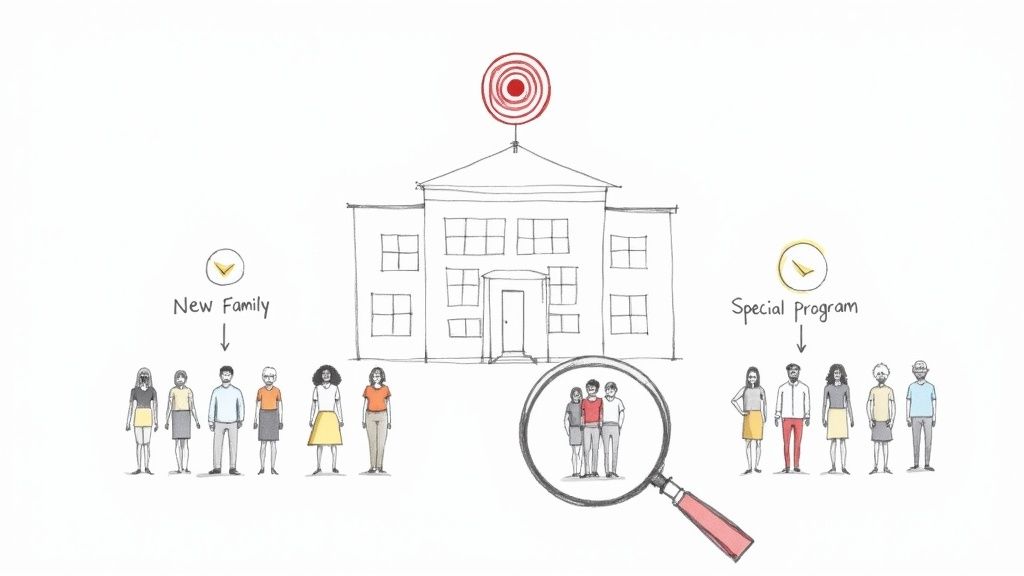
I've seen it a hundred times: a school sends out a survey, gets a pile of responses, and then… nothing happens. The results get filed away. The difference between that and a survey that sparks real change is having a sharp focus from the very beginning.
Without a well-defined purpose, you're just casting a wide net, hoping to catch something interesting. You’ll end up with vague feedback that’s hard to act on. The most important question you can ask your team at this stage is, "What specific decisions will this feedback help us make?"
Answering that question forces you to get specific. A generic goal like "improve parent satisfaction" is a dead end. It’s too broad to guide your questions or tell you what to do next. You need goals that are focused enough to drive action.
Start With Your School's Core Priorities
Your survey shouldn't exist in a vacuum. It needs to be directly connected to your school's strategic plan or your biggest priorities for the year.
Are you trying to boost enrollment? Maybe you're focused on enhancing academic programs or improving student well-being. When you align your survey with these critical initiatives, the data you get back is instantly relevant and much more powerful.
Think about it in these terms:
- Solving a Problem: "We've seen a real drop in attendance at parent-teacher conferences. Our survey needs to figure out the main reasons families aren't coming."
- Launching an Initiative: "We're about to roll out a new 1:1 laptop program. We need to survey parents to gauge their feelings and see what kind of tech support they'll need at home."
- Driving Improvement: "A key part of our strategic plan is to build a stronger school community. This survey will benchmark how parents feel about our current communication and find out how they really want to hear from us."
This kind of alignment makes it so much easier to get buy-in from leadership to actually act on the results.
Your purpose is the ultimate filter. For every question you consider adding, ask yourself: "Does this directly help us meet our core objective?" If the answer is no, cut it.
Identify Your Key Parent Segments
Let's be honest: not all parent feedback is created equal. A "one-size-fits-all" survey often gives you diluted, generalized insights. You'll get much richer information if you think about specific parent groups, or segments, whose perspectives are most important for your particular goal.
Tailoring questions to their unique experiences is a game-changer.
For instance, if your goal is to make your onboarding process better, you should be laser-focused on families who have been at your school for less than two years. Their memory of the enrollment process, their first few communications, and the welcome events is still fresh. Their feedback is gold.
Here are a few common segments you might consider targeting:
- New Families: Perfect for feedback on admissions and the whole "welcome to our school" experience.
- Grade-Level Groups: The worries of a 12th-grade parent getting ready for college applications are worlds away from those of a kindergarten parent.
- Parents of Students in Specific Programs: Need to know how your athletics program is doing? Or your special education services? Survey those specific parents for targeted insights.
- Disengaged Parents: This one is tough but incredibly valuable. Figuring out how to survey parents who rarely participate can uncover hidden frustrations or communication breakdowns.
Once you’ve locked in your primary goals and identified the right parents to talk to, you've built a solid foundation. You’re no longer just sending out a generic "parent survey." You're deploying a strategic listening tool designed to capture the exact feedback you need to make meaningful, lasting improvements.
Designing Questions That Elicit Honest Feedback

The insights you get from a parent survey are only as good as the questions you ask. It’s the difference between collecting a pile of meaningless clicks and gathering genuinely useful feedback. The secret is to move beyond simple yes/no questions to really understand the nuances of the parent experience at your school.
Your goal here is to make parents feel heard, not interrogated. That means using a thoughtful blend of question types that get at both the "what" and the "why." You're looking for clear, unbiased questions that are easy for parents to answer and give you data you can actually trust.
Balancing Quantitative and Qualitative Questions
A truly effective survey strikes a perfect balance between two kinds of questions: quantitative and qualitative. Think of quantitative questions as the skeleton of your survey—they give you the hard numbers and measurable data points that are easy to chart and compare.
Qualitative questions, on the other hand, are the heart of your feedback. These are the open-ended prompts that uncover the stories, feelings, and specific examples behind the data.
- Quantitative Questions: These use scales (like a Likert scale from "Strongly Disagree" to "Strongly Agree"), multiple-choice options, or numerical ratings. They're fantastic for quickly gauging overall sentiment and spotting broad trends across your parent community.
- Qualitative Questions: These are your "Tell us more…" or "What suggestions do you have?" questions. While they take more effort for parents to answer, they deliver rich, detailed context that numbers alone simply can't capture.
A classic mistake is to pack a survey with too many open-ended questions. This almost always leads to survey fatigue, and parents will just click away. A much better approach is to use a quantitative question to identify an issue, then follow it up with a single, targeted qualitative question to understand it better.
The Art of Phrasing Unbiased Questions
The way you word a question can completely change the answers you get. The most common traps are leading questions, double-barreled questions, and school-specific jargon. Nailing the phrasing is absolutely critical for getting honest, reliable data.
A leading question is one that subtly nudges the respondent toward a certain answer by baking an assumption or opinion right into the question itself.
- Poor Example: "Don't you agree that our new after-school clubs are a wonderful improvement?"
- Better Example: "How satisfied are you with the new after-school clubs?" (paired with a scale from Very Dissatisfied to Very Satisfied)
A double-barreled question is a sneaky one—it asks about two different things in a single query, making it impossible to answer accurately. What if a parent loves your communication but dislikes the events? Their answer becomes useless.
- Poor Example: "Are you satisfied with the school's communication and the variety of events?"
- Better Example: Just split it up. Ask two separate questions: "How satisfied are you with the school's communication?" and "How satisfied are you with the variety of school events?"
Always aim for simplicity and clarity. Each question should focus on a single idea, use plain language, and be completely neutral. The goal is to measure parent opinion, not to influence it.
Finally, watch out for insider jargon. Terms and acronyms that are second nature to your staff can be totally confusing to parents. If you have to use a specific term, always spell it out or provide a quick, clear explanation.
Uncovering Deeper Parent Concerns
Sometimes, the most valuable feedback you can get is about the challenges families face outside of school, because those issues almost always impact a child's education. Crafting questions that gently explore these areas can reveal incredibly important context.
For instance, the 2025 American Family Survey discovered that 7 in 10 Americans now find it unaffordable to raise children. It also showed that while 43% cited a lack of money as a barrier to having more kids, an overwhelming 90% supported banning phones in classrooms. This is a perfect example of how a well-designed survey can uncover deep economic anxieties while also finding strong consensus on specific school policies.
Asking about practical barriers to participation—like transportation issues, inflexible work schedules, or childcare costs—shows you care about their reality. The answers can point you toward simple, practical solutions that make your school more accessible for everyone.
If you’re looking for more inspiration, you can find dozens of examples you can adapt in our guide on parent survey questions for school improvement.
To help you get started, here's a practical guide to different question formats, what they measure best, and examples you can adapt for your own school.
Choosing the Right Question for Your Parent Survey
| Question Type | Best For Measuring | Example Question |
|---|---|---|
| Likert Scale | Sentiment, agreement, or satisfaction levels. | "To what extent do you agree with this statement: My child feels safe at school." |
| Multiple Choice | Preferences, demographics, or specific choices. | "What is the primary way you prefer to receive news from the school?" |
| Rating Scale | Overall performance or satisfaction on a numerical scale. | "On a scale of 1-10, how likely are you to recommend our school to another family?" |
| Open-Ended | The "why" behind an answer; gathering detailed suggestions. | "What is one thing our school could do to improve the car line experience?" |
Ultimately, picking the right mix of questions ensures you get a complete picture—the data tells you what parents are feeling, and the narrative feedback tells you why.
How to Get More Parents to Actually Take Your Survey

Let’s be honest: even the most well-crafted survey is pointless if nobody fills it out. Getting busy parents to hit pause on their day and give you thoughtful feedback is probably the biggest hurdle you'll face.
Success here isn't about luck; it's about a proactive, multi-channel game plan. You have to meet parents where they are. Sending a single email and crossing your fingers is a surefire way to get a disappointing response rate. You need to think more like a marketer and create a mini-campaign to build awareness and drive people to participate.
Your Invitation Is Everything
Think of your survey invitation as your pitch. It has to immediately answer the question on every parent’s mind: “What’s in it for me?” A generic “Please take our survey” is destined for the trash folder.
Your message has to be all about the why. Tell them exactly what you plan to do with the information and how their feedback will make a real difference for their kids and the school. Frame it as a partnership, not a chore.
A strong invitation always includes:
- A Punchy Subject Line: Ditch "Parent Survey" for something like, "Have a Say in Our School's Future."
- The Purpose, Front and Center: Start with the "why." For instance, "Your input will directly help us improve our after-school programs."
- A Realistic Time Estimate: Be upfront. "This 5-minute survey…" sounds much more manageable than an unknown commitment.
- A Promise of Confidentiality: Reassure them that responses are anonymous. You'll get much more honest feedback this way.
- An Unmistakable Call to Action: A big, clear button or link that says "Share Your Thoughts Now" works wonders.
When you communicate the value, you're not just asking them to fill out a form; you're giving them a genuine voice. This is a cornerstone of effective school communication with parents.
Go Beyond a Single Email Blast
To really get the numbers up, you need to use every tool in your communication toolbox. A layered approach ensures your message cuts through the noise of a parent’s busy week.
Map out all the ways you connect with parents and use each one. A QR code is brilliant for a flyer in a take-home folder or a poster in the car pickup line—parents can scan and respond right on their phones while they wait. An SMS reminder is one of the most powerful tools for that final push, since texts have incredibly high open rates.
A classic mistake is to stay entirely digital. Don't forget the power of a quick, in-person mention at the school play or a reminder from teachers during parent-teacher conferences. Every touchpoint counts.
This multi-channel strategy ensures you reach families who prefer different methods of communication. It can even be helpful to look at how businesses use different strategies to boost feedback and response rates for inspiration.
Master the Gentle Art of the Reminder
Reminders are non-negotiable, but there's a fine line between a helpful nudge and becoming a nuisance. A smart, well-timed sequence of follow-ups can dramatically boost responses without overwhelming anyone.
For a typical two-week survey window, this schedule works like a charm:
- Launch Day (Tuesday): Send the first invitation email and post the link on your primary social media pages.
- First Nudge (Friday): Send a follow-up email with a fresh subject line. Something like, "In case you missed it…" works well.
- Mid-Week Check-in (Following Tuesday): Switch channels. Post in the parent portal or include a section in the weekly e-newsletter thanking those who have already responded.
- Final Push (Thursday): This is the time for urgency. Send a final email and an SMS message with a clear deadline: "Last chance! The parent survey closes tomorrow."
This rhythm respects parents' time while keeping your request on their radar, helping you capture a truly representative sample of voices from your community.
How to Analyze and Make Sense of Parent Feedback
Once the responses from your parent survey start rolling in, the real work begins. You've successfully gathered the data, but now it's time to turn that raw feedback into a clear, compelling story that can drive real change at your school.
This isn't just about crunching numbers. It's about listening for the narrative hidden within the responses. The goal is to move beyond simply reporting that "75% of parents are satisfied with teacher communication." You need to dig deeper to understand why the other 25% are not, what satisfaction looks like for different groups, and what specific suggestions are bubbling up in the open-ended comments.
This process transforms a pile of data into a strategic asset. The next critical step is to analyze it effectively, much like understanding data-driven insights from reports in other analytical contexts.
Starting with the Quantitative Data
Your first pass should always focus on the quantitative, or closed-ended, questions. This is where you'll get a high-level view of parent sentiment and spot the most significant trends at a glance.
Most survey tools like Google Forms or SurveyMonkey will automatically generate charts and graphs, giving you an instant snapshot of your results. Look for the big picture first. What were the highest and lowest-scoring areas? Did one particular topic—say, school safety or academic rigor—receive overwhelmingly positive or negative feedback? These initial findings act as signposts, pointing you toward the areas that need a closer look.
This is where you can start forming hypotheses. If you see a surprisingly low score on "parent-teacher communication," for instance, you can flag that as a key area to explore more deeply when you dig into the written comments.
The Power of Segmenting Your Data
Looking at your survey results as one giant, aggregated block is a huge missed opportunity. The real magic happens when you start segmenting your data—that is, breaking it down and comparing responses from different subgroups of parents. This is where the demographic questions you asked at the beginning become incredibly valuable.
Filtering your results this way can uncover hidden patterns that tell a much more detailed story.
- Grade Level: How do the concerns of middle school parents differ from those of elementary school parents? Are there specific transition years, like 6th or 9th grade, where satisfaction suddenly dips?
- New vs. Returning Families: Are new families feeling welcomed and well-informed? Comparing their feedback to that of established families can reveal critical gaps in your onboarding process.
- Program Enrollment: Do parents of students in the athletics program have different communication needs than parents of students in the arts program?
This kind of segmented analysis can reveal crucial trends you’d otherwise miss. For example, the UK's National Parent Survey 2025 found that school unhappiness dramatically jumps from 12% in primary school to 25% in secondary school. Without segmentation, that critical insight about the changing student experience would be lost in the overall average.
The goal of segmentation is to find the exceptions. While the overall average might look fine, a specific subgroup could be waving a red flag that you would otherwise miss.
Tackling the Qualitative Feedback
Now it's time to roll up your sleeves and dive into the open-ended questions. This is where you'll find the rich context, the personal stories, and the brilliant suggestions that numbers alone can't provide. This process, often called thematic analysis, involves reading through the comments and grouping them into recurring themes.
Don't get overwhelmed by the sheer volume of text. Start by reading through a random sample of responses to get a feel for the common topics that are emerging. Are parents repeatedly mentioning the car pickup line, the school lunch menu, or a specific teacher?
Create a simple system for categorizing these comments. A spreadsheet works perfectly. Just start bucketing the feedback into logical groups.
Common Parent Survey Themes Might Include
- Communication: Feedback related to newsletters, teacher emails, or the school website.
- Academic Support: Comments about tutoring, homework load, or curriculum.
- School Culture: Mentions of bullying, inclusivity, or community spirit.
- Facilities: Notes about the playground, classroom technology, or cleanliness.
As you categorize, keep a tally. This simple act helps you quantify your qualitative data. Soon, you'll be able to say something much more powerful, like, "While overall communication scores were high, 32% of all open-ended comments mentioned a desire for more timely updates on student progress."
This blend of quantitative trends and qualitative evidence creates an undeniable story, giving you a solid foundation to present your findings and build a truly data-informed action plan.
Turning Insights into Action and Building Trust
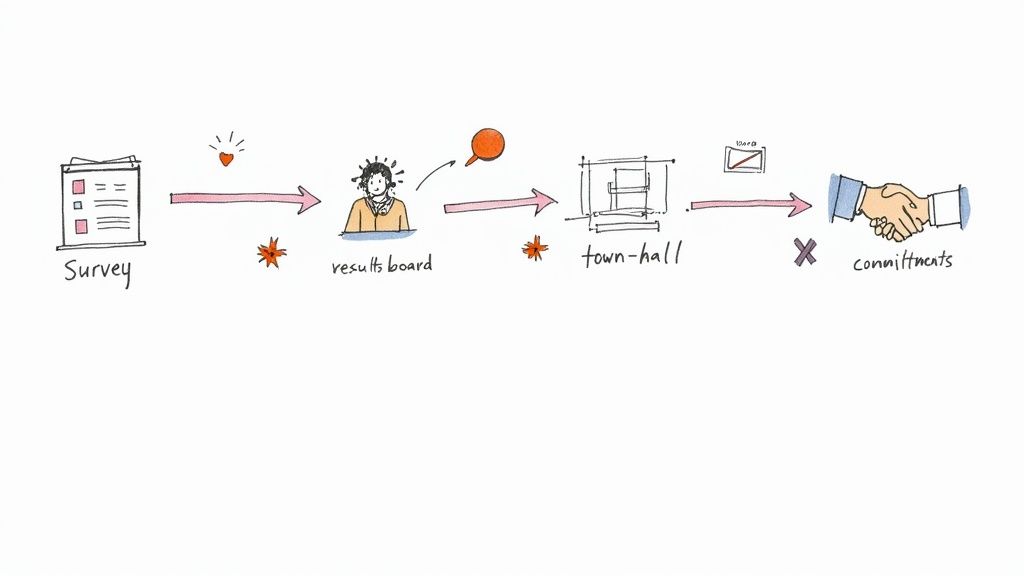
So, the survey is closed and the data is in. It’s easy to breathe a sigh of relief, but the truth is, the most critical part of the entire process is just getting started. What you do next with all that feedback is the real test of your school's commitment to its community.
Taking action and communicating your plans openly is what separates a routine data-gathering exercise from a powerful trust-building initiative.
If you drop the ball here, you’re practically guaranteeing a dismal response rate next time. Why? Because parents who feel their time was wasted simply won't bother sharing their thoughts again. This is your chance to show them you were actually listening.
Sharing Your Findings with the Community
Before you jump into creating action plans, your first move should always be to close the feedback loop. Share a summary of the survey results with everyone who took the time to respond. It’s a simple act of transparency, but it goes a long way in building goodwill.
You don't need to release a massive, granular data dump. A high-level overview is perfect. Just make sure it feels balanced.
A good summary should always:
- Celebrate the Wins: Start with the good news. Highlight the areas where parents gave you high marks. This is a great way to acknowledge what your team is doing well and give them a much-deserved morale boost.
- Own the Challenges: Don't shy away from the tough stuff. Address the key areas for improvement head-on. The key is to avoid defensive language and instead frame these points as exciting opportunities for growth.
- Say Thank You (And Mean It): Genuinely thank parents for their honesty and for partnering with you to make the school a better place for their kids.
Push this summary out through all your channels—a dedicated section in the weekly newsletter, a standalone email blast, and a permanent page on the school website. If the findings are significant, consider discussing them at a town hall or PTO meeting to really drive the conversation forward.
The goal here isn't just to inform; it's to validate. When parents read your summary and see their own concerns reflected back, they feel seen and heard. That feeling is the bedrock of any strong school-home partnership.
This process has a measurable impact. Take KinderCare's 2025 Parent Confidence Index, for example. It found that parent confidence scores climbed to 67%, a rise they partly attributed to taking action on parent feedback to improve program quality. It’s clear proof that when parents see their input lead to real change, their trust in the institution grows. You can dig into the numbers yourself in their full report on parent confidence trends.
From Feedback to a Public Action Plan
Sharing the results is a great first step, but it’s not the last. Now it’s time to show parents what you're going to do. This is where you translate what you learned into a public-facing action plan with concrete, measurable commitments.
An action plan proves you’re not just listening—you’re ready to get to work.
Keep it simple and direct. The plan should clearly outline the specific steps the school will take in response to the major themes that emerged from the survey.
A Simple Action Plan Framework
| Area of Feedback | Our Commitment | Timeline |
|---|---|---|
| Car Line Congestion | We will conduct a traffic flow study and test a new staggered dismissal system. | Pilot program to launch by October 15. |
| After-School Clubs | We will survey students directly to gauge interest and add two new clubs based on their top choices. | Student survey in September; new clubs start in January. |
| Teacher Communication | We will standardize a weekly email update from all homeroom teachers. | Implemented by the start of the next grading period. |
A straightforward format like this is easy for busy parents to scan and understand. It sets clear expectations and, just as importantly, holds your school accountable for following through.
When you publish a plan like this, you’re showing your community a genuine commitment to data-driven decision-making and continuous improvement. By thoughtfully analyzing feedback, sharing it openly, and creating a public plan, you complete the survey cycle. You’ve successfully transformed the survey for parents from a simple questionnaire into a meaningful dialogue that makes your entire school community stronger.
Answering Your Top Parent Survey Questions
Even with the best-laid plans, a few practical questions always come up when you’re about to hit 'send' on a parent survey. Let's walk through some of the most common ones we hear from school leaders. Getting these right can make all the difference.
How Often Should We Be Surveying Parents?
This is all about striking the right balance. You need timely, relevant feedback, but you absolutely want to avoid overwhelming parents and creating "survey fatigue." If you ask too often, you'll see your response rates plummet.
For most schools, the sweet spot is one big, comprehensive annual survey. Think of this as your yearly check-up. It gives you a fantastic baseline to measure progress on your strategic goals, year after year.
Then, you can sprinkle in shorter, more focused surveys when you need specific feedback.
- Your Main Annual Survey: This is your deep dive into school climate, overall satisfaction, and communication effectiveness.
- Quick Event Feedback: A super-short poll (just 2-3 questions) after big events like curriculum night or parent-teacher conferences can give you immediate, actionable insights.
- Targeted Check-ins: Consider sending a brief survey to a specific group, like new families after their first 90 days, to see how their transition is going.
How Do We Guarantee Anonymity?
This one is critical. If you want parents to be truly honest—especially about sensitive topics—they have to trust that their feedback is completely anonymous. They need to feel 100% safe sharing their thoughts without any fear of it coming back to them or their child.
You have to be direct about this. State your commitment to confidentiality right in the survey invitation and at the very top of the survey itself. Thankfully, most modern survey platforms are built to handle this securely.
Our Pro Tip: Start your survey with a clear, unambiguous statement. Something like: "All of your responses are completely anonymous. We value your honest feedback, and we are committed to protecting your privacy."
That single sentence does a lot of heavy lifting. It builds immediate trust and signals that you're ready to hear the truth, good or bad.
What Are the Best Tools for Creating Surveys?
You don't need to break the bank on a complex, enterprise-level platform to get great results. There are several fantastic, user-friendly tools out there that work perfectly for schools.
Here are the ones we see used most effectively:
- Google Forms: It’s free, easy to use, and the data flows right into Google Sheets, making analysis a breeze. It’s the perfect starting point.
- SurveyMonkey: A household name for a reason. Its free plan is quite powerful, and paid versions offer more advanced question logic and reporting features if you need them.
- Typeform: If you want a more polished, conversational feel, Typeform is a great choice. Its one-question-at-a-time format can feel less like a test and more like a conversation, which can boost completion rates.
The best tool is the one you'll actually use. Don't get stuck trying to find the "perfect" platform. Pick one that fits your needs now and just get started.
At The MarCom Society, we help K-12 marketing professionals tackle challenges just like this every day. We offer the resources, expert guidance, and peer support you need to turn parent feedback into a powerful engine for school improvement. Learn more and join our community of school marketing leaders.