Let's be honest: parent surveys often feel like just another box to check on an endless to-do list. But what if they could be your most powerful tool for building real trust and making changes that families actually notice? Too many of us in school communications get caught in a cycle of sending out surveys because we feel we should, without a clear strategy for what comes next.
Why Parent Surveys Are Your School's Secret Weapon
Think about it. Imagine discovering that a simple tweak to your after-school pickup system—an insight you pulled from a single survey question—could erase daily stress for hundreds of parents. Or learning that families are genuinely confused about where to find information, allowing you to clarify your communication channels and see engagement soar.
These aren’t just nice ideas. They're the real-world results that come from listening intentionally.
It’s About More Than Just Collecting Data
The magic of a great parent survey isn't in the data itself. It's in the commitment to a feedback loop that proves you're listening and, more importantly, acting. When parents see their input lead to tangible change, they shift from being spectators to becoming invested partners in their child's education.
A survey is more than a questionnaire; it's a conversation. It's an invitation for parents to share their world and a promise from the school to listen.
This guide is designed to get you past the theory. We'll walk through the entire process, step-by-step, with practical advice and examples to help you turn your next survey from a routine task into a strategic win.
Here’s what we’ll cover:
- Plan with a Purpose: Start with a clear goal so you know you're asking the right questions.
- Design for Honesty: Write questions that encourage candid, useful feedback.
- Distribute for Maximum Reach: Use a smart, multi-channel approach to get the highest possible response rate.
- Analyze for Real Insights: Turn raw numbers into a clear story that points toward what to do next.
- Act and Follow Up: Close the loop with parents to build incredible trust and credibility for the long haul.
At the end of the day, this is all about gathering feedback that truly matters. By mastering the art of the parent survey, you can strengthen your school community from the inside out and create an environment where every family feels heard, valued, and respected.
Laying the Groundwork for a Successful Survey
A great survey is built on a solid foundation, and that starts long before you write a single question. I've seen it happen time and again: rushing this initial phase leads to confusing data and, frankly, a lot of wasted effort. Before you do anything else, you need to nail down a crystal-clear goal for your survey.
What, specifically, do you need to know? Are you trying to gauge sentiment about a new reading curriculum? Maybe you need to understand technology access for at-home learning or get a pulse on the overall school climate. An objective as vague as "improving parent engagement" is a trap—it will only lead to vague, unhelpful results.
Assemble Your A-Team
You can’t—and shouldn’t—do this alone. Pull together a small, dedicated team to bring different, crucial perspectives to the table. This isn't about forming a huge committee that gets bogged down in meetings; it's about strategic collaboration.
A lean, effective team often includes:
- An Administrator: They ensure the survey’s goals line up with broader school or district objectives.
- A Veteran Teacher: This person provides that essential, on-the-ground insight into what issues are genuinely impacting students and families.
- Your Communications Lead: That's you! You'll manage the whole process, from question design to getting the word out and reporting back what you found.
This core group will help you refine your objective and make sure the questions you ultimately ask are relevant to the people who matter most. Getting this buy-in early also makes it so much easier to act on the results later on.
Time It Right for Maximum Impact
When you send your survey is almost as important as what you ask. Sending a detailed survey during the chaotic first week of school or right before a major holiday is a surefire way to get a low response rate. Strategic timing is everything.
I recommend thinking about it as a cycle throughout the school year:
- Baseline Survey (August/September): A short survey at the start of the year helps you understand parent expectations and identify any early concerns. For example, you might ask about their preferred communication channels or what they're most excited about for the year.
- Mid-Year Check-in (January/February): This is the perfect time to get feedback on specific programs or initiatives that are already underway.
- End-of-Year Pulse (April/May): A more comprehensive survey near the end of the year can measure overall satisfaction and give you concrete data to inform planning for next year.
The most effective parent surveys aren't a one-off event. They're part of an ongoing conversation. By strategically timing your outreach, you show families that their input is a continuous and valued part of how the school improves.
This simple process flow sums it up perfectly. It's all about listening to parents, learning from their insights, and then turning that knowledge into meaningful action.
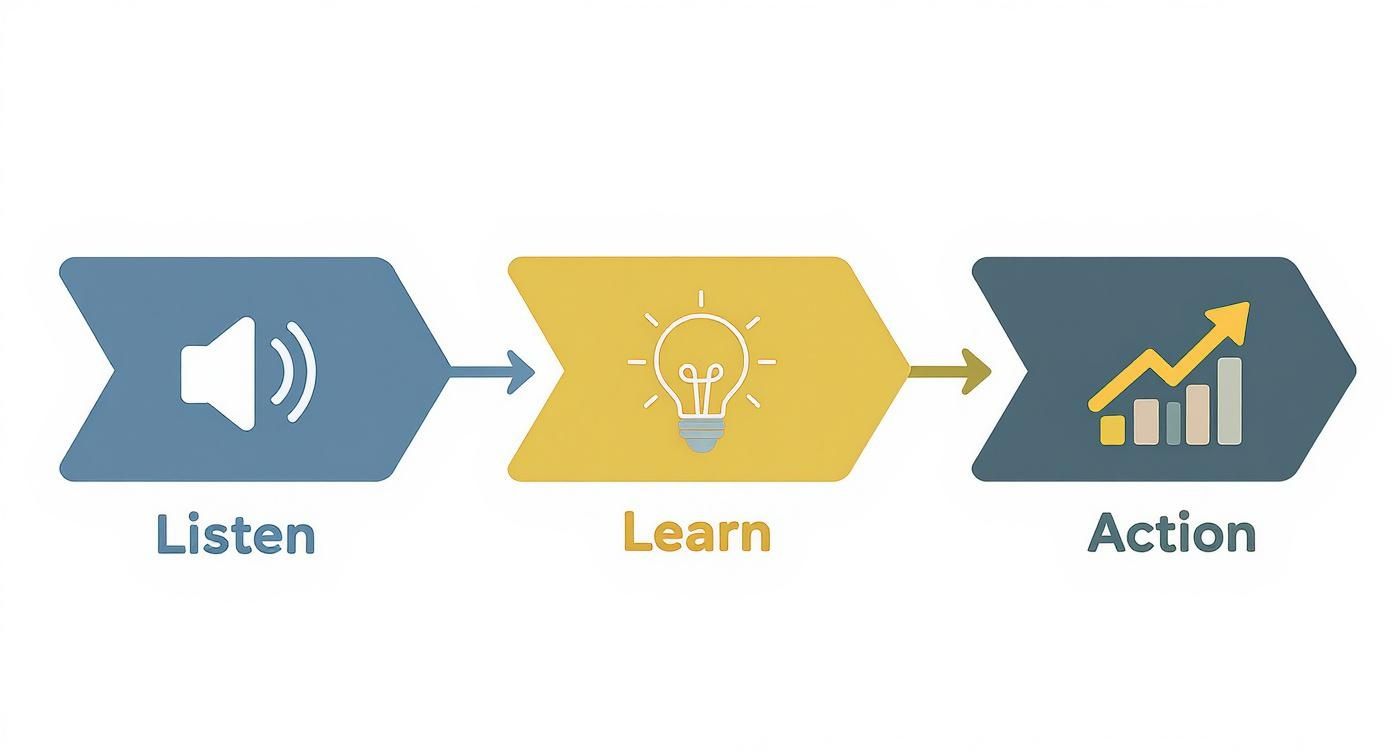
Think of it this way: parent feedback isn't just data you collect; it's the engine for real progress in your school community.
Build Trust from the Very Beginning
The final, and perhaps most critical, piece of groundwork is building trust. Parents are far more likely to give you honest, thoughtful feedback if they feel their privacy is respected and their information is secure. This isn't just a courtesy; it's an absolute requirement for gathering authentic data.
Before you send any surveys for parents, you have to be upfront about your intentions. Kick off the survey with a brief, straightforward privacy statement.
Be sure to cover these key points:
- Anonymity: State clearly whether responses are anonymous or confidential. If they aren't anonymous, be specific about who will see the responses.
- Purpose: Briefly explain why you're asking and how the data will be used. Something like, "Your feedback will directly help us improve our after-school programs and parent communication strategies."
- Time Commitment: Give them an honest estimate of how long the survey will take. Respecting their time is a powerful way to build goodwill right off the bat.
By getting informed consent and being totally transparent, you build a foundation of trust. This ensures parents feel safe enough to provide the candid feedback you need to make real, positive changes. It’s the essential first step toward turning a simple survey into a powerful community-building tool.
2. Crafting Questions That Actually Get Honest Answers
This is where the rubber meets the road. The quality of your questions will make or break your entire survey effort. Get them right, and you’ll unlock a goldmine of insights. Get them wrong, and you’ll end up with a pile of confusing, useless data.
The single most important skill to master is turning a generic, fuzzy question into a specific, actionable one.
For instance, asking something like, "Are you happy with our school?" is a complete dead end. What does "happy" even mean? A parent could love their child's teacher but be endlessly frustrated by the carpool line. A simple "yes" or "no" lumps it all together and tells you absolutely nothing you can act on.

The trick is to break down that vague feeling into its core components. Instead of one broad question, you could ask separate, targeted questions about academics, campus safety, and school-to-home communication. Now you’re getting specific data points you can actually do something with.
Choosing the Right Question Format
The format you pick for each question has a huge impact on the quality of the answers. It’s not a one-size-fits-all situation; mixing up your formats is key to getting a complete picture.
Here are the workhorses of any good parent survey:
- Likert Scales: These are your go-to for measuring feelings and opinions on a spectrum (e.g., from "Strongly Disagree" to "Strongly Agree"). They are perfect for gauging how parents feel about specific policies, the quality of communication, or the overall school climate.
- Multiple-Choice: Keep these for clear, distinct options. This format works best for straightforward demographic questions (“What grade is your child in?”) or when there are finite answers (“Which communication channel do you use most often?”).
- Open-Ended Questions: Use these sparingly but strategically. While they take more effort for parents to answer, they are fantastic for capturing the “why” behind a rating. A question like, "If you could change one thing about our parent-teacher conferences, what would it be?" can give you incredibly rich, actionable ideas you’d never have thought of yourself.
One of the most common mistakes I see is relying too heavily on one type. A survey packed with open-ended questions will exhaust parents and cause them to abandon it halfway through. On the other hand, a survey with only multiple-choice questions might miss critical context and nuance. Balance is everything.
For some great, road-tested examples you can adapt, check out this collection of parent survey questions for school improvement.
Side-Stepping Common Question Design Traps
Even with the right format, a poorly worded question can sink your survey. It’s surprisingly easy to accidentally introduce bias or confusion. You have to be on the lookout for these common pitfalls that can skew your results.
The goal of a survey question is to get an honest, unfiltered response. Any hint of jargon, bias, or confusion puts a barrier between you and the truth. Keep it simple, direct, and neutral.
Here are a few of the biggest offenders I run into:
- Leading Questions: These subtly nudge the respondent toward the answer you want to hear. For instance, “Don’t you agree that our new, improved school lunch program is a success?” is dripping with bias.
- Double-Barreled Questions: This is a classic mistake where you ask two things at once, making it impossible to answer accurately. Think of, “Do you find our weekly newsletter informative and timely?” What if it’s informative but always late?
- Using Jargon: You must avoid "education-ese." Terms like "pedagogy," "scaffolding," or "formative assessments" are meaningless to most parents. Always use plain, everyday language.
It’s often helpful to see how other industries handle this. Reviewing essential survey questions from fields like healthcare can offer great models for clarity and neutrality that you can adapt for your school.
From Vague to Valuable: Putting It All Together
Let’s get practical. A sharp question can uncover strong parental opinions on specific policies. Take cell phones, for example. A national poll found that a whopping 89% of U.S. parents believe removing phones from the classroom would improve learning, and 56% support a full ban.
This tells us that parents have very specific, strong feelings about school policies. You just have to ask the right way.
To help you avoid common mistakes, here’s a quick guide to transforming weak questions into powerful ones.
Common Survey Question Pitfalls and How to Fix Them
This table shows how a few simple tweaks can dramatically improve the quality of your questions and, ultimately, the data you collect.
| Common Mistake | Poor Question Example | Improved Question Example |
|---|---|---|
| Too Broad | How is our school communication? | On a scale of 1-5, how satisfied are you with the timeliness of communication from your child's teacher? |
| Double-Barreled | Are our teachers and staff welcoming? | 1. How welcoming do you find the front office staff? 2. How approachable is your child's teacher? |
| Leading Question | Don't you agree our anti-bullying program is effective? | How confident are you in the school's ability to address bullying effectively? |
| Uses Jargon | Do you feel our differentiated instruction meets your child's needs? | Do you feel your child is appropriately challenged by their schoolwork? |
See the difference? By focusing on one clear concept per question and using neutral, accessible language, you’re not just making the survey easier for parents. You’re ensuring you get clean, reliable data that you can use to make truly meaningful decisions for your school community.
Getting Your Survey in Front of More Parents
Let's be honest. Even a brilliantly designed survey is just a file on a server if it never gets seen. A "one-and-done" email blast just doesn't cut it anymore. If you want meaningful feedback, you have to meet parents where they are.
Think of your survey rollout as a full-blown campaign, not a single announcement. Some parents live and breathe by their email inbox. Others might only catch updates on the district's Facebook page or in the weekly folder their child brings home. A smart, layered strategy is the only way to reach them all.
Go Where the Parents Are
A great distribution plan uses every single tool in your communications toolbox. The goal isn't just to send the invitation, but to make sure it gets seen. Never assume one channel is enough.
Here are the essentials for a multi-channel push:
- Email: This is your foundation. A clean, up-to-date email list is your most direct line to families. If you're looking to improve your list-building game, we've got you covered with our guide on how to build an email list.
- SMS/Text Alerts: When you need a quick, can't-miss nudge, nothing beats a text. These are perfect for a final "last chance" reminder a day or two before the survey closes.
- Social Media: Create some eye-catching graphics and clear, concise posts for your school's Facebook, Instagram, or X (Twitter) accounts. A strong visual with a direct call to action works wonders here.
- School Newsletters: Feature the survey prominently. Don't bury the link! Add a QR code so parents reading a printout or a PDF can scan it with their phones instantly.
- Your School Website: A simple, impossible-to-miss banner on your homepage can grab the attention of parents who are visiting the site for lunch menus or event calendars.
By layering your approach like this, you account for the different ways your families consume information, which dramatically boosts the chances they'll see the survey and actually take it.
Mobilize Your Biggest Advocates
Never, ever underestimate the power of your community's natural influencers. The parents who are already deeply engaged are your most authentic and effective messengers. It's time to actively recruit them to get the word out.
Your best advocates are often:
- PTA/PTO Leaders: A personal request from them in their own newsletter or private Facebook group is pure gold. A recommendation from a trusted peer carries so much more weight.
- Room Parents: These folks have a direct line to every parent in their child's class and are fantastic for sending personalized, classroom-specific reminders.
- Booster Club Leaders: If your survey has questions about athletics or extracurricular activities, these leaders can help you target a very specific and passionate group of parents.
When you ask for their help, make it incredibly easy for them. Give them a simple "communications toolkit" with a pre-written email, a couple of social media post options, and the direct survey link. Remove all the friction, and they'll be happy to help.
The most successful survey promotions feel like a community-wide effort, not a directive from the district office. When parents hear about the survey from other parents, it creates social proof and a sense of shared investment.
Design for the Carpool Line
Here’s a non-negotiable truth about surveys for parents: most of them will be taken on a smartphone. They'll be tapping through answers while waiting for pickup, sitting on the sidelines at soccer practice, or in the few quiet minutes they get before bed. If your survey isn't mobile-friendly, you've already lost.
This isn't just a hunch; it's how modern families operate. The 2025 U.S. Family Travel Survey found that digital tools are central to family life, with 55% using them to find deals and 47% managing budgets on their devices. As the NYU School of Professional Studies points out in their insights on families' digital tool usage, this comfort with mobile is deeply ingrained. Your survey absolutely must be designed for a small screen.
What does a mobile-first approach look like in practice?
- Use a survey platform with a responsive design that automatically adjusts to any screen size.
- Write short, clear questions. No one wants to read a paragraph on a tiny screen.
- Use large, easy-to-tap buttons for multiple-choice answers.
- Avoid complex "matrix" style questions that require a lot of scrolling and pinching.
Finally, frame your invitation in a way that connects the survey directly to their child's experience at school. You have to answer the "what's in it for me?" question. A subject line that says, "Help us improve our after-school programs" is infinitely more compelling than, "Please take our annual survey." You're not just asking them for data—you're inviting them to be a partner in making their child's school even better.
Turning Survey Data into Actionable Insights
The responses are in. Now for the most important part: finding the story hidden within all that data. This is where you move past just collecting feedback and start creating a real roadmap for improvement. It can feel a little overwhelming at first, but with a solid plan, you can turn those raw numbers and comments into gold.
You're essentially working with two different kinds of information. First, you have your quantitative data—all the numbers from your multiple-choice and rating-scale questions. This is great for spotting the big-picture trends right away. Then there's the qualitative data, which is all the rich, detailed feedback from your open-ended questions. You need both to get the full story.
Start With the Numbers, But Dig Deeper
A great place to start is by slicing and dicing your quantitative results. Don't just look at the overall scores. Most survey tools let you filter responses by the demographics you collected, like a student's grade level, their specific school, or how long they've been in the district. This is where you find the real insights.
For example, an overall satisfaction score of 80% on communication looks pretty good on the surface. But what happens when you segment that data? You might discover that satisfaction among middle school parents is actually a dismal 45%. Suddenly, you’ve gone from a vague, positive metric to a crystal-clear problem with a specific audience. That’s an insight you can act on.
Finding the "Why" in Parent Comments
Once you have a handle on the numbers, it's time to dive into the parent comments. This is often where the most powerful "aha!" moments come from. I know it's tempting to skim, but reading through every comment is crucial for understanding the context—the why—behind the scores.
A simple but super effective technique is to pop open a spreadsheet and start categorizing comments by theme. Create a few columns for common topics you expect to see:
- Academics & Curriculum: Think homework load, teaching styles, or course variety.
- Communication: Anything related to newsletters, teacher emails, or the website.
- School Climate & Safety: Comments on bullying, campus security, or that feeling of belonging.
- Extracurriculars: Feedback on sports, clubs, and after-school opportunities.
As you go through each comment, just tag it. Before you know it, patterns will jump out at you. You might see a dozen parents suggesting a change to the carpool line or find consistent praise for a particular science teacher. For more on this process, check out this excellent guide on analyzing customer feedback.
Show, Don't Just Tell: Visualizing Your Findings
Let's be honest, raw numbers and a long list of quotes aren't going to capture the attention of busy administrators or board members. To make your findings impossible to ignore, you have to visualize them. Simple, clean charts and graphics are your best friends here.
Data doesn’t speak for itself. It needs a storyteller. Your job is to translate what you've found into a clear, visual narrative that points everyone toward what needs to happen next.
A word cloud, for example, is a fantastic way to quickly show what's on parents' minds based on their open-ended feedback.

This kind of visual immediately pulls out key themes, giving you an at-a-glance summary of parent priorities. It’s incredibly powerful in a presentation. The whole point of this analysis phase is to set the stage for genuine data-driven decision-making that's actually grounded in what your community is telling you.
Ultimately, your goal should be to boil everything down to a handful of key takeaways. Don't bury your stakeholders in an avalanche of data points. Instead, pull out the 3-5 most critical findings—the stories that demand attention and action. These insights are what bridge the gap between listening and doing.
Closing the Loop to Build Lasting Community Trust
https://www.youtube.com/embed/pr4OS_ManpQ
This is the one step I see most schools miss, and honestly, it's the single most important factor in whether parents will ever take another survey from you. Closing the feedback loop isn't just a nice-to-have; it's the final, crucial act that proves the entire effort was worthwhile.
Think of it this way: not reporting back on what you learned is like walking away from a conversation mid-sentence. Parents invested their time to share their thoughts. Silence is the quickest way to make them feel like that time was wasted. Get this part right, and you'll build incredible trust and credibility.
Make Your Findings Public and Accessible
Transparency is your best friend here. You need to share what you learned—both the good and the challenging—in a way that’s easy for busy parents to actually consume. A dense, 40-page report filled with crosstabs isn't going to cut it.
Instead, create digestible summaries and share them where parents already are.
- Visual Newsletter Summary: Design a simple infographic or write a few key bullet points highlighting the top 3-4 findings for your weekly email.
- Dedicated Website Page: Create a straightforward page on your school's website. It can house a more detailed summary, a few key charts, and a thank you message from the principal.
- Quick PTA Presentation: A five-minute overview at the next parent meeting can be incredibly powerful. Just focus on the main takeaways and what you plan to do next.
The goal is to make the results feel tangible and directly relevant to their family's experience.
From Feedback to Action We Can All See
Sharing the data is just the beginning. The most powerful part of closing the loop is clearly communicating what you’re going to do with the feedback. This is where you turn insights into tangible action and prove you were really listening.
The real magic happens when a parent can draw a straight line from a concern they shared on a survey to a positive change they see at the school. That's how you create true community investment.
Don’t be shy about being specific and direct. For example, a national survey by the Afterschool Alliance found that for every child in an afterschool program, three more are waiting to get in, often because of cost and access.
Imagine your survey uncovered similar concerns. Your follow-up message becomes so much more powerful when you can say something like this:
"You told us that finding affordable afterschool care is a major challenge for many families. Based on your feedback, we're launching a pilot program with tiered pricing and have expanded our capacity by 15% for the upcoming semester."
This "You said, so we did" framework is the gold standard for building trust. It celebrates the wins, acknowledges the areas needing improvement, and shows a clear commitment to progress. This simple act of follow-through makes parents feel heard and valued, which is exactly what will bring them back the next time you create surveys for parents.
Your Parent Survey Questions, Answered
When you're diving into parent surveys, a few common questions always seem to pop up. Let's tackle some of the ones we hear most often from K-12 communications pros in the field.
How Long Should Our Parent Survey Be?
Think short and sweet. The sweet spot is 10 to 15 questions, which most parents can get through in about 5 to 7 minutes.
Remember, you're competing for their time. If you go much longer, you'll see a big drop-off in completion rates. If you have a long list of things you need to know, it’s much better to split it into a couple of shorter, more focused surveys throughout the school year.
What’s the Best Way to Get More Parents to Respond?
There's no single magic bullet here; it's all about a layered, multi-channel approach. You absolutely have to get the word out through every channel you have: email, text messages, social media, your website, and the good old-fashioned school newsletter.
But the real key is in the invitation itself. Don't just ask them to take a survey. Explain why. Tell them exactly how their feedback will help make the school better for their kids. When parents understand the impact, they're far more likely to participate.
The single best way to guarantee future participation is to "close the loop." When parents see that their previous feedback led to actual, visible changes at the school, they become invested partners in the process.
Should We Make Our Surveys Anonymous?
This is a classic "it depends" situation. Anonymity is fantastic for encouraging brutally honest feedback, especially when you're asking about sensitive topics like school climate, safety, or staff performance. People are just more willing to be candid when their name isn't attached.
On the other hand, if you need to analyze results by grade level or follow up on a specific concern, you'll need some identifying information. The solution? Be crystal clear. If you're collecting names or emails for your surveys for parents, tell them exactly why and how that data will be protected. Trust is everything.
Ready to transform your school's communication strategy with actionable insights? The MarCom Society provides the tools, expert guidance, and supportive community you need to master parent engagement and so much more. Join our community of K-12 professionals today!