
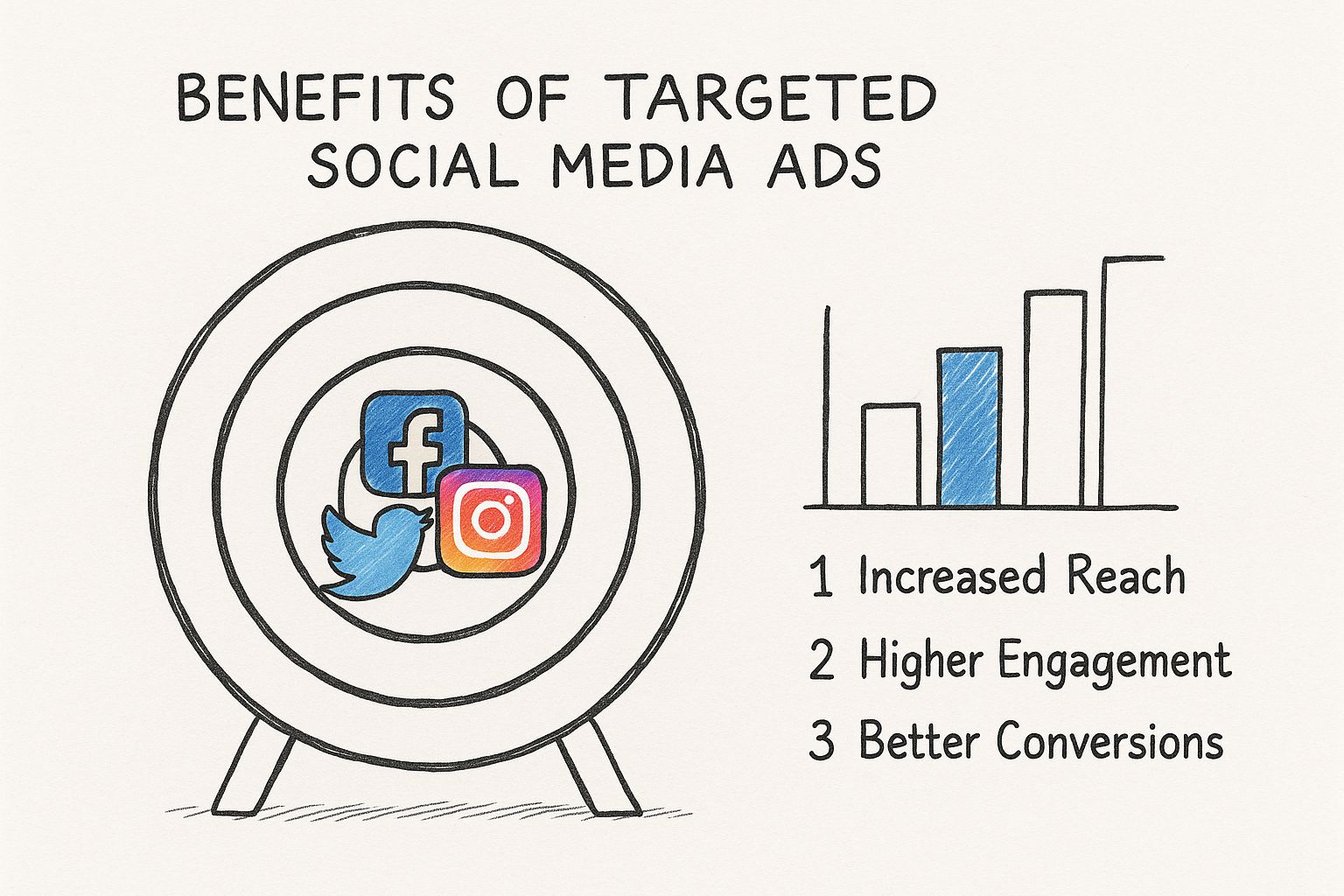
Think of targeted social media ads as your school's secret weapon for finding the right families. Instead of just shouting into the void with broad, expensive marketing, you can connect directly with parents who are actually looking for a school like yours. It’s about spending your budget wisely to share your story with a receptive audience, which ultimately gets you a much better return.
Why Precision Targeting is a Game-Changer for K-12 Schools
Remember the days of putting an ad in the local paper or sending out a mailer to the entire city? Those days are long gone. Parents are online, and you absolutely have to meet them there with a message that clicks. Targeted ads let you slice through the digital clutter and speak to specific family needs. Maybe you're launching a new STEM lab, highlighting an award-winning arts program, or emphasizing a curriculum built on strong values—you can tailor your message for each.
Let's get practical. Imagine you’re running admissions for a private elementary school. You're not just aiming for "parents in Springfield" anymore. With targeted ads, you can get incredibly specific and reach:
- Families living within a 10-mile radius who have kids between 4 and 6 years old.
- Parents who have actively searched for "private education" or follow pages about early childhood development.
- People whose online activity suggests they just moved to your city and are likely looking for new schools.
This isn't just about being efficient; it's a necessity. You stop wasting money on audiences that will never enroll and focus every single dollar on families who are already interested in what your school provides. The ROI from this approach blows traditional marketing methods out of the water.
Getting an Edge in a Crowded Field
The online ad space is noisy, and it's only getting louder. By 2025, global spending on social media ads is expected to reach a staggering $276.7 billion. That’s almost 30% of all digital ad budgets. And it’s not slowing down—projections show that number soaring past $406 billion by 2029. You can dig deeper into these trends over on Sprout Social's blog.
What does this mean for a K-12 school? It means that just being on social media isn't enough anymore. The real advantage comes from mastering targeted ads to make sure your open house invites and program spotlights land in front of families who match your ideal student profile.
When you nail your targeting, you shift from broadcasting a generic message to starting a genuine conversation with the right people. This doesn't just fill seats—it builds a stronger, more connected school community from that very first click.
Building Your Ideal Parent Persona
Great social media ads don't just happen inside an ad manager. They start with a rock-solid understanding of exactly who you're trying to reach. Going beyond simple demographics like age and zip code is the name of the game. For schools, this means creating detailed parent personas—vivid, fictional profiles that represent your ideal families.
Think of these personas not as guesswork, but as data-driven composites. You’ll build them using your current enrollment data, feedback from parent surveys, and even the analytics from your school's own social media pages. The whole point is to paint a crystal-clear picture of the parents you most want to walk through your doors.
Gathering Your Persona Data
To get this right, you need to look at two kinds of information: demographic and psychographic. Demographics tell you who your parents are, but the psychographics tell you why they choose a school like yours. This is where you uncover the core values, anxieties, and motivations driving their decisions.
The best place to start is with the families who are already part of your community.
- Dig Into Your Own Data: Your enrollment records are a goldmine. Where do your current families live? What kinds of professions do the parents have? This gives you a fantastic demographic baseline.
- Ask Your Current Parents: Send out short, simple surveys. Ask them what they value most about your school, how they prefer to communicate, and which social media platforms they turn to for parenting tips or school research.
- Check Your Social Analytics: Dive into the audience insights on your school’s Facebook and Instagram pages. These tools offer aggregated data on your followers' interests, locations, and even their online habits.
A well-defined parent persona becomes your true north for every ad you create. It ensures your ad copy speaks directly to a parent's hopes, your images reflect their aspirations for their child, and your call-to-action solves a real problem for them.
From Data to a Detailed Profile
Once you have all this information, it's time to bring your persona to life by organizing it into a structured profile. This makes them feel less like a collection of data points and more like a real person you're trying to have a conversation with.
To help you get started, here's a breakdown of the components you should be thinking about as you build your own parent personas.
Parent Persona Profile Components
| Category | Data Point Example | Why It Matters for Ad Targeting |
|---|---|---|
| Demographics | Age: 38-45; Income: $150k+; Location: Lives within a 10-mile radius | Helps you set the basic targeting parameters on ad platforms like age, location, and sometimes even household income indicators. |
| Family Situation | Two children, ages 6 and 9; Both parents work full-time. | Informs your messaging around after-school care, flexible schedules, or programs that cater to specific age groups. |
| Values & Goals | Values a strong sense of community and project-based learning. Goal is for their child to be a well-rounded, curious learner. | This is huge for ad copy and imagery. You can highlight your school's community events or showcase photos of collaborative projects. |
| Challenges & Pains | Worried their child isn't being challenged enough in their current public school. Frustrated with large class sizes. | Your ads can directly address these pain points by mentioning your 12:1 student-teacher ratio or advanced curriculum. |
| Media Habits | Active on Facebook and Instagram; Reads local parenting blogs; Follows educational influencers. | Tells you exactly where to place your ads and which publications or influencers you might partner with. |
| Watering Holes | Member of the local YMCA; Shops at Whole Foods; Attends community farmer's markets on weekends. | Offers powerful local targeting options, like geo-fencing ads around specific locations or targeting interests like "organic food." |
Putting this all together helps you hit the bullseye with your ad campaigns, ensuring your message lands where your ideal families are already spending their time.
As you can see, the core idea is to place your school's message where it will be seen and trusted by the right people.
For instance, a private high school might create a persona for "Future-Focused Felicia." She's a 42-year-old physician, deeply concerned about college prep and looking for a top-tier STEM program for her daughter. She uses LinkedIn for her professional network and follows education experts on X (formerly Twitter).
This level of detail is everything. It dictates your ad copy, your visuals, and your platform choice. It’s the very foundation of a strategy called audience segmentation. If you want to go deeper, you can learn more about what audience segmentation is and see how it powers the most successful campaigns. With a detailed persona in hand, you stop shouting into the void and start having meaningful conversations with the right families.
Where to Find Your Future Families: Picking the Right Social Platforms & Ad Formats
You’ve done the hard work of building your parent personas. Now, where do you actually find these families online? It’s tempting to try and plant your school’s flag on every social media platform, but that’s a surefire way to stretch your budget thin and dilute your message.
The smarter move is to be surgical. Focus your efforts on the platforms where your ideal parents are already scrolling, sharing, and connecting. For most K-12 schools I work with, this boils down to the unbeatable duo: Facebook and Instagram.
Facebook is still the king of community. It's where local parent groups thrive, making it an incredible tool for hyper-specific geographic targeting and promoting local events. Instagram, on the other hand, is all about visuals. It’s the perfect stage to show off your beautiful campus, highlight student achievements, and give prospective parents a real feel for your school’s culture through stunning photos and engaging short-form video.
Match the Platform to Your Enrollment Goal
Every ad you run needs a specific job to do. Are you trying to fill seats at an open house or build a waitlist for kindergarten? Your goal will directly influence which platform and ad format you should choose.
Here's how this plays out in the real world:
- Goal: Boost Open House Attendance. Your best bet is Facebook Event Ads. This format is tailor-made for driving registrations. Parents can RSVP with a single click and get automatic reminders. You can even target families who live within a 15-minute drive of your campus. Easy.
- Goal: Showcase Your School's Vibe. Turn to Instagram Reels and Stories Ads. These are perfect for those authentic, behind-the-scenes moments. Think quick clips of a robotics club in action, a snippet from the school play, or the energy of a sports game. It’s about capturing a feeling, not just delivering information.
- Goal: Highlight Multiple Programs. Use Carousel Ads on either platform. This format lets you spotlight several key offerings—like your advanced STEM curriculum, award-winning arts program, and competitive athletics—all in one swipeable ad. Each card can even link to a different page on your website.
The big takeaway here is to match the message to the medium. An ad for a detailed curriculum guide will probably do better on Facebook, where users are more conditioned to click links and read. That vibrant, high-energy video of student life? It was born for Instagram.
Are You Sleeping on TikTok?
While Facebook and Instagram are your bread and butter, don't write off newer players. TikTok, for instance, is no longer just for teens. More and more parents are on the platform, and its algorithm is scary good at connecting niche content with the right audience.
Between 2021 and 2022, TikTok's advertising reach grew by a massive 14.6%. And while only about 18% of marketers have started using it for ads, its sky-high engagement rates signal a huge opportunity for schools willing to get creative. A fun "day in the life of a student" video or a challenge tied to a school spirit week could go surprisingly far.
Ultimately, the most effective https://blog.marcomsociety.org/social-media-marketing-for-schools/ strategy is a thoughtful mix. You might use Facebook to reach parents in specific zip codes, Instagram to wow younger families with beautiful imagery, and even dip your toes into TikTok to connect with your community in a fresh, authentic way.
When you deliberately choose your platforms and ad formats based on your enrollment goals, you’re not just shouting into the void. You’re starting a meaningful conversation with the right people, in the right place, at the right time.
Crafting Ad Content That Actually Converts

Alright, you've pinpointed your ideal parent persona and know which platforms they're scrolling through. Now comes the fun part: creating ads that actually make them stop. This is where your strategy gets real and you start making a genuine connection.
Truly great targeted social media ads do more than just list your school's highlights. They tap into a parent's hopes, dreams, and even their biggest worries about their child's future. The copy and the visuals have to sing in harmony, telling a story that makes a parent think, "This is the place for my kid."
From Features to Benefits in Your Ad Copy
I see this all the time—schools write ad copy that talks about themselves instead of to the parents. It’s an easy trap to fall into. The key is to shift from talking about features (facts about your school) to benefits (how those facts improve a child's life).
Let’s break it down with a classic example:
- Before (Just a feature): "We offer a 12:1 student-to-teacher ratio."
- After (A real benefit): "Your child will never be just another face in the crowd. Our 12:1 ratio means they get the personal attention they need to truly thrive."
See the difference? The second one hits home. It speaks directly to a parent's deep-seated desire for their child to be seen, known, and supported. That’s the kind of emotional connection that gets you an application.
The most effective ad copy speaks directly to a parent's pain points. A headline like 'Is Your Child Ready for High School?' is far more powerful than 'Now Enrolling Grades 9-12' because it taps into a real, immediate concern.
Visuals That Build Trust and Authenticity
On social media, your visuals are everything. They're your first impression, and for schools, authenticity always, always wins. Polished stock photos might look clean, but they feel cold and generic. Nothing beats the genuine warmth of seeing your actual students and your real campus.
Here’s what I’ve learned about creating visuals that work:
- Show Your Real Students: Your best marketing assets are your students. Use photos and short video clips of them learning, playing, and collaborating. A smiling, engaged student says more than a thousand words of ad copy.
- Weave in Social Proof: Don't just tell parents you're great—show them. Put a powerful testimonial from a happy parent or student right onto an image. A picture of a smiling graduate with a quote about their experience is marketing gold. Simple graphics highlighting university acceptance rates or scholarship totals work wonders, too.
- Think Mobile First: This is non-negotiable. With 83% of social ad spending aimed at mobile users, your visuals have to pop on a small screen. That means bright, clear images and any text you add needs to be big enough to read at a glance.
If you have a great photo but there's some distracting text in the background, don't discard it. There are plenty of great AI tools for image cleanup that can help you get your visuals looking perfect before you launch the ad.
Bringing Your Ad Campaigns to Life
You've built your parent personas and created some fantastic ad content. Now for the exciting part: launch. Getting into the technical side of social media ads can feel a little daunting, but platforms like Meta Ads Manager make it more straightforward than you might think.
Your first move is to tell the platform what you want to achieve. Think about your main goal. Are you trying to get more families to sign up for a virtual open house? You’ll probably want to choose a "Leads" or "Traffic" objective. Or maybe you're a newer school and just want to get your name out there. In that case, the "Awareness" objective is perfect. Picking the right objective is critical because it tells the algorithm what a "win" looks like for your school, which helps it spend your budget wisely.
Setting Your Budget and Tracking What Matters
Let's talk money. You don't need a massive budget to see results. I've seen schools get valuable insights and leads by starting with just a few hundred dollars a month. A great way to approach this is by thinking in terms of Cost Per Lead (CPL).
For example, if your goal is to get 20 families to download your admissions guide and you're comfortable spending up to $25 for each download, your starting budget is $500. This method gives you a clear, data-backed benchmark for what success looks like.
Once your budget is in place, you absolutely need a way to track your results. This part is non-negotiable. Installing a tracking tool like the Meta Pixel on your school's website is a must. It's a small piece of code that connects what people do on your site—like filling out an inquiry form—back to the specific ad they saw. Without it, you’re just guessing and can't prove your marketing is actually working.
Making Sense of the Data and Fine-Tuning Your Ads
Okay, your campaign is running and the numbers are starting to come in. What's next? The best approach is to set aside a little time each week to check on performance. Don't get bogged down in every single metric; just focus on the ones that directly impact enrollment.
Here are the big three I always keep an eye on:
- Click-Through Rate (CTR): This is simply the percentage of people who saw your ad and clicked on it. If your CTR is low, it’s a strong signal that your visuals or headline aren't grabbing your audience's attention.
- Cost Per Lead (CPL): As we discussed, this is your total ad spend divided by the number of leads you generated. This number tells you exactly what it costs to get a prospective family into your pipeline.
- Relevance Score/Quality Ranking: Platforms actually score your ads on how well they match your audience. A higher score is great news—it usually leads to better ad placement and lower costs.
A common mistake I see is letting a poorly performing ad run for too long, burning through the budget. Don't be afraid to pause underperforming ads! Take that money and put it toward the ads that have a lower CPL and a higher CTR. It’s all about doubling down on what’s working.
Getting comfortable with these numbers is how you turn a good campaign into a great one. If you want to get more granular on this, our guide on how to measure social media engagement is a great resource.
You can also give your paid ads a serious boost by weaving in some influencer marketing. Think about partnering with a respected local "mom blogger" to talk about your school. This adds a layer of trust you can't buy. The data backs this up: influencer marketing can deliver an ROI of $5.78 for every dollar spent, and that's largely because 61% of consumers trust an influencer's recommendation over a standard brand ad.
For schools looking to really get the most out of their ad spend, digging into proven strategies and creative best practices for Meta Ads can uncover even more opportunities. The key is to constantly analyze, test, and adjust. When you do that, your ad campaigns stop being an expense and start becoming a reliable enrollment-driving machine.
Answering Your Top Questions
When you start digging into targeted social media ads, a lot of practical questions pop up. It's totally normal. Let's walk through some of the most common ones I hear from school marketers to give you clear answers you can actually use.
How Much Should We Really Be Spending on Social Ads?
There's no magic number here, but I can give you a solid starting point. For most small to mid-sized schools, a budget between $500 and $2,000 per month is a realistic place to begin. This gives you enough runway to test different ads and audiences without breaking the bank right out of the gate.
A much better way to think about it, though, is to work backward from your enrollment goals.
Let's say you want to generate 20 new applications this season. If you decide you're comfortable spending up to $100 for each qualified application, then your budget is set at $2,000. The key is to start small, track everything with tools like the Meta Pixel, and then confidently pour more money into the campaigns that are actually getting you tour sign-ups and info requests. Don't forget to ramp up your spending during those key enrollment periods.
What are the Biggest Mistakes You See Schools Making?
The single biggest misstep? Overly broad targeting. Just blasting ads to "parents" in your city is a surefire way to waste your budget. You have to get more granular by layering in interests, online behaviors, and specific demographics to find the families that are a true fit for your school's culture.
Another classic mistake is creating ad content that just feels… well, corporate. Parents are savvy, and they can spot a stock photo a mile away. Your ads will perform so much better when they feature your actual students and show real, authentic moments from campus life.
The biggest unforced error I see is failing to install tracking pixels. If you don't have something like the Meta Pixel set up, you're just guessing. You have no real idea if your ads are leading to inquiries or applications. You're basically advertising in the dark.
Can We Target Families from a Rival School?
This is a question I get all the time. The short answer is no—you can't directly target parents or students of "St. Mary's Prep" by name. Platforms like Facebook and Instagram have privacy policies that prevent that. But, there are some clever and totally ethical ways to get in front of a very similar audience.
You can use geo-fencing to run your ads in the specific zip codes and neighborhoods where you know a lot of that school's families live. It's a surprisingly effective tactic.
You can also target by interests that align with what that school is known for. Think about things like:
- "Private school education"
- "Montessori method"
- "Advanced placement subjects"
- "International Baccalaureate program"
This way, you’re reaching families who are already invested in that specific type of education, all without ever crossing a line or naming a competitor.
At The MarCom Society, we provide the tools and community support K-12 marketers need to master strategies like these and drive real enrollment growth. Join our community of school marketing professionals to gain access to expert-led workshops, resources, and collaborative sessions.









