
Think of a communication audit as a comprehensive health check for your school's messaging. It's not about finding fault; it's a strategic deep dive to see what’s working, what’s falling flat, and where you can build stronger connections with your community.
Simply put, it’s like a financial audit for your brand's voice, making sure every message sent—from a quick social media update to a detailed policy email—is clear, consistent, and hitting the mark.
Understanding Your School's Communication Health
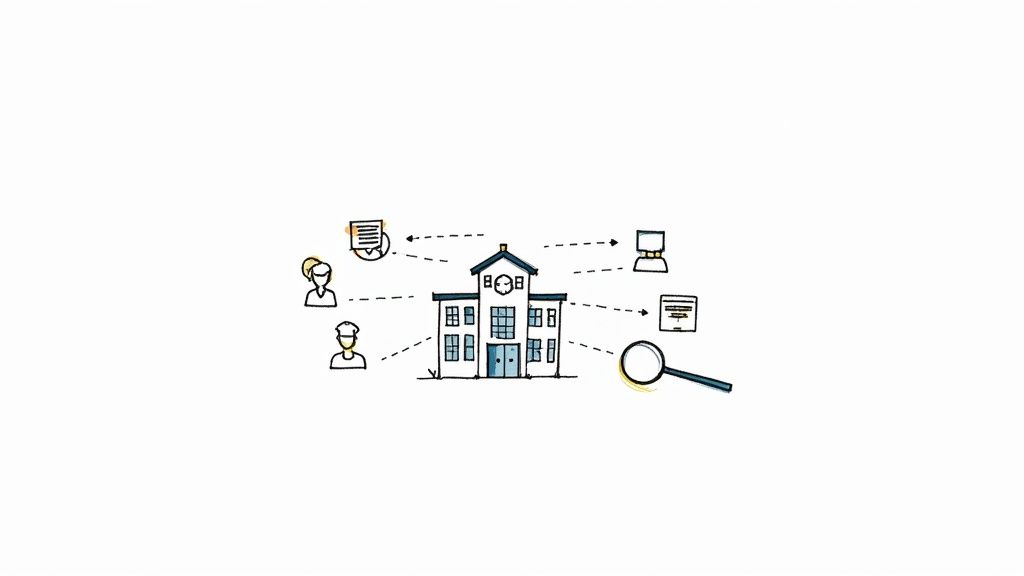
Most school leaders are used to curriculum reviews and budget audits. A communication audit brings that same level of objective, rigorous analysis to your school’s entire communication ecosystem. It systematically examines every single place your school interacts with its community.
This process covers everything. We’re talking about the tone of the weekly parent newsletter, the engagement on your Facebook page, how easily parents can find information on your website, and even the clarity of parent-teacher conference announcements. The end goal is to build an honest, data-backed picture of how your messages are truly being received.
Why It's More Than Just a Report Card
This isn't about giving your communication efforts a passing or failing grade. It’s about uncovering deep, actionable insights so you can make decisions based on evidence, not just assumptions. By looking closely at both internal and external communications, you can pinpoint critical gaps and celebrate hidden strengths.
A thorough audit is the bedrock of any plan to Master Internal Communication Strategy within your school. It forces you to answer some tough but essential questions:
- Message Resonance: Do parents actually understand and connect with our core messages about school values and student achievements?
- Channel Effectiveness: Are we using the right channels? Is email best for parents, while Instagram works better for showcasing student life?
- Audience Perception: Is what we think we’re saying what our community is actually hearing?
- Resource Allocation: Are we pouring time and money into platforms that aren’t delivering results?
A communication audit moves your strategy from guesswork to a evidence-based practice. It provides the clarity needed to strengthen relationships, build community trust, and ensure your most important messages are always heard loud and clear.
To give you a clearer idea, here's a look at the core objectives of a well-executed audit.
Core Goals of a School Communication Audit
This table breaks down what a communication audit aims to accomplish, connecting each goal to a practical example.
| Goal | Description | Example Metric |
|---|---|---|
| Improve Clarity & Consistency | Ensures all communications share a consistent voice, tone, and brand identity, reducing confusion. | Percentage of parents who find school emails "easy to understand" in a survey. |
| Enhance Audience Engagement | Identifies which channels and content types best capture the attention of different stakeholder groups (parents, students, staff). | Average engagement rate (likes, comments, shares) on social media posts. |
| Align with Strategic Goals | Verifies that communication efforts directly support the school's mission, vision, and strategic objectives. | Number of newsletter features directly linked to a key strategic initiative, like DEI or STEM. |
| Optimize Resource Allocation | Determines if the budget, staff time, and tools are being used effectively to achieve the best ROI. | Cost-per-enrolled student from a specific digital marketing campaign. |
| Identify Gaps & Opportunities | Uncovers unmet communication needs or new channels to better connect with underserved segments of the community. | Survey feedback indicating a demand for a staff-only internal newsletter. |
By focusing on these goals, you can turn your audit's findings into a concrete action plan that truly moves the needle.
A Proven Strategy with a Long History
The idea of a communication audit isn't some new fad. It actually took root in the mid-20th century as large organizations started to realize just how critical effective communication was to their success.
By the 1970s, it was a standard business practice. In fact, a 1978 survey found that 68% of Fortune 500 companies were already conducting regular communication audits to stay competitive and ensure everyone was on the same page.
Ultimately, getting a handle on what a communication audit is and what it can do for you is the first real step toward building a more connected and engaged school community. For a closer look at improving staff buy-in, our guide on https://blog.marcomsociety.org/how-to-improve-internal-communications/ offers some great next steps.
Knowing When Your School Needs an Audit
So, when is the right time for a communication audit? It's a question every school leader asks eventually. Sometimes the signs are impossible to ignore, like a sudden drop in enrollment numbers. But more often, the signals are subtle.
The best time for an audit isn't always during a full-blown crisis. In fact, the most strategic moments are often during periods of significant change or even growth.
Think of it like a regular health check-up. You don't wait until you're seriously sick to see a doctor. You go for annual physicals to catch potential problems early and make sure you're on the right track. A communication audit does the same thing for your school's reputation and relationships—it's both a diagnostic tool for existing issues and a proactive strategy for keeping your community strong and connected.
Reactive Triggers: The Warning Lights on Your Dashboard
Certain events are like a check engine light for your school's communications. These are the red flags that tell you something is off and needs immediate attention. When parents, staff, or community members start sending signals that your messages aren't getting through, it's time for a deep dive. Ignoring these warnings can turn small problems into major headaches.
Consider launching an audit if you're facing:
- Declining Enrollment or Increased Transfers: This is often the first and most painful sign of a disconnect. It suggests that the value your school offers isn't being communicated effectively to current or prospective families.
- Mixed or Negative Community Feedback: Are you hearing confusing rumors around town or sensing frustration over school policies? This points to a breakdown in clear, consistent messaging.
- Navigating a Bond Issue or Referendum: When you need the community to support a major financial initiative, trust and clarity are everything. An audit can pinpoint weak spots in your outreach before you launch a campaign that you can't afford to lose.
- A Public Relations Crisis: After the dust settles from a crisis, an audit is non-negotiable. It's the only way to truly understand what went wrong in your communication process and create a solid plan to rebuild trust.
Proactive Moments: Building on a Strong Foundation
Ironically, the absolute best time for an audit is when things are going pretty well. Taking a proactive approach lets you build on your strengths and prepare for future challenges from a position of stability, not panic. It turns the audit from a reactive fix into a powerful engine for strategic planning and continuous improvement.
A communication audit isn't an admission that something is broken. It’s a commitment to being better—a proactive step to ensure your school’s story is told clearly, consistently, and with the greatest possible impact.
Look for moments of positive change as the perfect opportunity to get your communications in sync. These strategic milestones are ideal times for an audit:
- Welcoming a New Superintendent: A leadership transition is a natural moment to pause, assess the current communication landscape, and make sure everything aligns with the new leader’s vision.
- Launching a New Strategic Plan: An audit ensures that every single department, from the front office to the fundraising team, is communicating in a way that supports your new goals.
- Preparing for a Rebranding Initiative: Before you spend a dollar on a new logo or website, an audit gives you the crucial data to make sure the new brand will actually connect with your community.
This kind of regular self-assessment pays off in a big way. One landmark study found that organizations that conduct regular communication audits report a 27% higher employee engagement rate. Even better, 64% of those organizations saw measurable improvements in their internal communication within just one year. You can dive deeper into these findings on Studysmarter.
By treating an audit as a routine health check, you're not just fixing problems—you're building a more connected culture, earning lasting trust, and making smarter, data-informed decisions every single day.
Breaking Down the Audit Process
A full-blown communication audit can feel daunting, but it's really just four distinct investigations that fit together. Don't think of it as one giant project. Instead, picture yourself looking at your school's communications through four different lenses.
When you combine what you see through each lens, you get a complete, 360-degree view of what’s working, what isn't, and why. It ensures you’re not just looking at what you send out, but also how it’s actually being heard and understood by the people who matter most.
Let's walk through each piece of the puzzle.
1. The Internal Communication Review
First things first, you have to look inward. The Internal Communication Review is all about how information moves within your own school walls. Before you can connect with parents and the community, your own team—from teachers and aides to administrators and support staff—needs to be on the same page.
This is where you ask the tough questions about your internal channels:
- Are staff newsletters actually being read?
- Do our team meetings encourage real conversation, or are they just top-down announcements?
- Is important information getting from the district office to every classroom without delay?
Think of it this way: a healthy internal communication system is the backbone of your school's culture. When your staff feels informed and valued, they become your best ambassadors. This review helps you find the friction points and build a more connected team.
2. The External Communication Review
With your internal house in order, it's time to look outward. The External Communication Review is a deep dive into every single touchpoint your school has with the public. It’s an honest look at your school’s public-facing personality across every channel you use.
This part of the audit covers a lot of ground:
- Your School Website: Can a new parent easily find enrollment forms? Is the calendar current?
- Social Media: Are your posts sparking conversations, or are they just announcements that fall flat? Which platforms are actually reaching your families?
- Parent Outreach: This is everything from the weekly e-newsletter and emergency text alerts to the printed flyers that (hopefully) make it home.
- Media Relations: How does the local news talk about your school? Do you have a good relationship with reporters?
This review shows you if your school's story is being told consistently and effectively everywhere, making sure your key messages are hitting home.
The scope of an audit is broad, moving beyond just the messages themselves to look at the entire communication network and climate, as this Wikipedia graphic illustrates.
As you can see, a real audit examines the entire ecosystem, which leads directly to our next, crucial step: finding out what people really think.
3. Stakeholder Perception Analysis
This might be the most important piece of the entire audit. The Stakeholder Perception Analysis is where you stop assuming and start listening. The first two steps looked at what you’re doing; this one is all about how people feel about it.
An audit without stakeholder feedback is like a performance with no audience. You can critique your own delivery all day, but you’ll never know if the message actually landed.
To get these honest insights, you’ll need to use a few different tools:
- Surveys: Send targeted surveys to parents, staff, and maybe even students (at the secondary level) to get solid, measurable data on their preferences and satisfaction.
- Focus Groups: Get small groups together for guided conversations. This is where you uncover the "why" behind the survey numbers and hear powerful stories.
- One-on-One Interviews: Sit down with key community leaders, PTA presidents, or board members for high-level, candid feedback.
This is where the biggest "aha!" moments happen. You'll uncover the gaps between what you think you're communicating and what your community is actually hearing.
4. The Content and Channel Inventory
Finally, it’s time for the Content and Channel Inventory. Think of this as a meticulous spring cleaning of every single communication piece your school creates. You’re essentially taking stock of everything you produce and distribute, from digital posts to paper flyers.
You'll build a master list of assets like:
- All active social media accounts (even the ones someone started years ago).
- Every newsletter or email blast on your schedule.
- Key pages and sections of the school website.
- Brochures, recruitment packets, and event programs.
- The standardized letters and forms sent home with students.
For each item on your list, you’ll note its purpose, audience, and—most importantly—its performance. Knowing how to measure communication effectiveness is key. This inventory almost always reveals duplicate efforts, inconsistent branding, and outdated information, giving you a clear path to streamline your communications and make your job easier.
Your Step-by-Step Guide to Conducting an Audit
Alright, let's move from the "what" and "why" to the "how." A communication audit gives you the raw material, but it’s a structured process that turns that information into a real roadmap for improvement. When you break it down into clear stages, it becomes a completely manageable—and incredibly valuable—project.
This five-stage guide will walk you through the entire process, from the first planning meeting to the final report. Following these steps ensures your audit is thorough, insightful, and actually leads to meaningful change, whether you’re running it yourself or working with an outside expert.
Stage 1: Define Your Goals and Scope
Before you even think about surveys or focus groups, you have to know what you're looking for. The first, most critical step is to set clear goals for your audit. What's the main question you need answered? Maybe you're trying to figure out why a recent bond issue failed, or perhaps you're getting ready for a new superintendent to take the helm. Pinpointing that primary goal is what keeps the entire project from drifting off course.
Once your main objective is locked in, you need to define the audit's scope. You could go broad and look at everything—every email, every social media post, every flyer. Or, you could keep it focused on one specific area, like internal communication with staff or how you reach parents digitally. A well-defined scope prevents the project from becoming a monster and guarantees your findings are directly tied to your school's most pressing needs.
Stage 2: Assemble Your Audit Team
This is not a solo mission. To get a true picture of your school's communications, you need a team that represents a real cross-section of your community. This is the best way to avoid blind spots and capture perspectives you might otherwise miss.
A great audit team should have people from different corners of your district, including:
- Administration: To provide strategic oversight and make sure the audit lines up with district-wide goals.
- Teaching Staff: They're on the front lines and can offer invaluable insights into what’s actually working (and what’s not) at the classroom level.
- Communications/Marketing: Your comms pros will handle the technical side of collecting and analyzing the data.
- Support Staff: From bus drivers to custodians, these folks are essential to school operations and have a unique perspective to share.
Bringing this group together does more than just enrich your data—it builds buy-in from the very beginning. When people are part of the process, they're much more likely to champion the changes that come out of it.
Deciding whether to build this team internally or hire an outside firm is a common crossroads. Each path has its own set of benefits and drawbacks.
DIY Audit vs Hiring an External Consultant
| Factor | DIY (Internal) Audit | External Consultant |
|---|---|---|
| Cost | Lower upfront cost, but requires significant staff time. | Higher initial investment, but a fixed project cost. |
| Objectivity | Can be challenging; internal politics and biases can influence findings. | Highly objective; provides an unbiased, third-party perspective. |
| Expertise | Relies on the existing skills of your communications team. | Brings specialized expertise and experience from working with other districts. |
| Time Commitment | A major time commitment for staff, pulling them from daily duties. | The consultant handles the heavy lifting, freeing up your team. |
| Internal Knowledge | Deep understanding of the school culture, history, and key players. | Requires a learning curve to understand your district's unique context. |
| Credibility | Findings may be questioned internally due to perceived bias. | Recommendations often carry more weight with leadership and the board. |
Ultimately, the choice comes down to your budget, your team's capacity, and how important pure objectivity is to your goals.
Stage 3: Gather and Organize Your Data
This is where the real work begins. You'll be collecting both quantitative data (the numbers) and qualitative data (the stories and experiences). The best audits use a mix of methods to paint a complete picture, combining hard stats with human insights.
Here’s what your data-gathering toolbox will likely include:
- Content Inventory: Time to get organized. Systematically gather examples from every single communication channel—newsletters, website content, social media posts, robocalls, and even printed flyers.
- Surveys: Send short, targeted surveys to parents, staff, and maybe even older students. To get people to actually fill them out, keep them under 15 minutes. Ask about communication frequency, clarity, and which channels they prefer.
- Focus Groups: This is where you get the "why" behind your survey data. Sit down with small groups for guided discussions. You’ll hear firsthand stories and uncover subtle perceptions about your school's messaging that a survey could never capture.
- Metric Analysis: Dive into the analytics from your digital tools. Look at email open rates from platforms like Mailchimp, website traffic patterns in Google Analytics, and social media engagement to see how people are actually interacting with your content.
This multi-pronged approach ensures you’re not just guessing. You're confirming what’s really happening with both data and direct feedback from your community.
This diagram shows a simple workflow, starting with internal staff, moving to the broader community, and tying it all together with stakeholder voices.

The visual makes it clear: a great audit integrates what you learn internally with what you hear externally to create a complete picture of your communication health.
Stage 4: Analyze Your Findings for Patterns
Once all the data is in, it's time to make sense of it. This is where you transform piles of information into actionable insights. Start by organizing everything and looking for recurring themes, surprising trends, and obvious gaps.
The goal of analysis isn't just to report numbers; it's to tell a story. What is the data telling you about the relationship between your school and its community?
Look for the connections. For instance, do the low open rates on your parent newsletter line up with survey comments saying the emails are too long? Does the high engagement on Facebook posts about student achievements match what you heard in focus groups about wanting more positive stories? Finding these patterns is how you diagnose the root cause of your communication challenges.
Stage 5: Create a Report That Drives Action
The final step is to pull all your findings together into a clear, compelling report. This document can't just be a data dump—it needs to be a strategic tool that inspires people to act. You have to structure it so that even the busiest leaders can quickly grasp the key points.
Start with an executive summary that highlights the most critical takeaways and your top-level recommendations. Then, dive into the detailed findings, using charts and graphs to make the data easy to understand. Most importantly, end with a prioritized action plan. We recommend framing your recommendations in a "now, next, later" format. This makes the path forward feel clear and achievable.
This simple step turns your audit from an interesting assessment into the official kickoff for your school's renewed communication strategy.
Turning Audit Data into an Action Plan

So, you've completed your communication audit. You’re now sitting on a mountain of data, but raw information doesn't fix anything on its own. The real magic happens when you translate those findings into a clear, strategic, and actionable plan. A report that just sits on a shelf is a wasted effort. A report that drives meaningful change? That’s a powerful investment.
The first step is to step back and find the story hidden in the data. Your job is to connect the dots between survey results, your content inventory, and all that rich stakeholder feedback. Look for the patterns, because those patterns almost always point to the root cause of your communication challenges.
For instance, you might see that your social media posts get tons of likes and shares, but your parent survey reveals that 40% of families feel out of the loop on key deadlines. That’s a critical pattern. It tells you that your most engaging channel isn’t being used to deliver essential, time-sensitive information.
Identifying Critical Patterns and Insights
As you dig through your audit findings, you’ll start to see common themes emerge. Recognizing these patterns is the key to building a targeted action plan. It’s how you move from looking at isolated data points to understanding your entire communication ecosystem.
Keep an eye out for these common issues:
- Inconsistent Branding: Does your elementary school’s friendly newsletter clash with the high school's super-formal social media tone? When branding is all over the place, it creates a fragmented and confusing identity for the entire district.
- Underused Communication Platforms: Your audit might show that an expensive parent portal has incredibly low adoption rates. Meanwhile, a simple, unmanaged Facebook group is where the real conversations are happening.
- Message-Perception Gap: This is a big one. It's the disconnect between what your school thinks it’s saying and what your community is actually hearing. You might be communicating a new safety policy with the best intentions, but parents perceive it as overly restrictive and untrusting.
If your audit uncovers snags in how information is organized and shared, adopting knowledge management best practices can be a game-changer. This helps ensure the insights you’ve worked so hard to gain are not only acted upon but also woven into your school’s daily operations for lasting success.
From Insights to SMART Goals
Once you've pinpointed the core challenges, it's time to turn them into clear, actionable goals. The SMART goals framework is the perfect tool for this job. It stops you from setting vague aspirations like "improve parent communication" and forces you to create concrete targets.
A communication audit without a SMART action plan is like a doctor's diagnosis without a prescription. It identifies the problem but provides no path to getting better.
Let's break down how to apply this framework to what you’ve learned.
- Specific: Your goal has to be crystal clear. Instead of "do better on social media," a specific goal is "Increase parent engagement on the district's main Facebook page."
- Measurable: How will you know if you're succeeding? A measurable version is "Increase likes, comments, and shares on Facebook posts by 15%."
- Achievable: Be ambitious, but realistic. A 15% increase is a solid, achievable goal. A 150% increase might be setting yourself up for failure.
- Relevant: Your goal must tie back to your school's bigger picture. If a key district objective is to strengthen community connection, then boosting Facebook engagement is highly relevant.
- Time-bound: Give yourself a deadline. It creates focus and a clear finish line. For example, "Increase engagement by 15% over the next six months."
Combining these elements creates powerful objectives that give your team clear direction. For more help putting your plan together, our communications strategy template can guide you in organizing these goals into a cohesive document.
Creating Your Prioritized Action Plan
Finally, you need to organize your SMART goals into a prioritized action plan. You can't fix everything at once, and you shouldn't try.
A simple "now, next, later" approach works wonders.
- Now: These are your quick wins—the low-hanging fruit that builds momentum and shows immediate progress.
- Next: These are the bigger projects you'll tackle in the coming quarter.
- Later: These are the long-term, strategic shifts that might take a year or more.
This method transforms an overwhelming report into a manageable, step-by-step roadmap for real, lasting improvement in your school's communication.
Stepping Around Common Audit Landmines
It’s one thing to decide to do a communications audit; it’s another thing entirely to get it right. Many well-intentioned audits end up being a waste of time because they fall into a few predictable traps. Let’s make sure yours isn't one of them.
Knowing what can go wrong from the start is half the battle. Think of these as the common landmines you need to map out and carefully step around.
The Self-Congratulatory Audit Team
One of the quickest ways to get skewed results is by assembling a biased audit team. If you only include folks from your communications department or the superintendent's cabinet, you're practically guaranteed to get a filtered, overly positive view. You'll miss what's really happening on the ground.
A truly effective audit needs a mix of voices. Pull in representatives from across the district—administrators, yes, but also teachers, counselors, and front office staff. Their perspectives are invaluable for getting a complete picture.
Asking Questions That Beg for a Compliment
Another classic mistake is asking leading questions. It’s tempting to frame survey questions in a way that confirms what you hope is true, like, "Don't you think our new app is a huge improvement?"
This kind of question just fishes for validation. Instead, you need to ask neutral, open-ended questions that give people room to be honest. That’s where the real insights are hiding.
Ignoring the Tough Truths
Let's be honest: hearing criticism is tough. But brushing off negative feedback is a surefire way to render your audit useless.
A communication audit isn't about patting yourself on the back. It's about discovery. The uncomfortable, critical feedback is often where the most important lessons are learned. It points you directly to the cracks in your strategy.
Remember, the goal is to find out what's not working so you can fix it. Embracing that feedback is how you build real trust and strengthen your connection with parents, staff, and students.
The "Audit and Forget" Syndrome
Perhaps the most critical failure of all is doing all this work without a plan to act on what you find. An audit that ends with a fancy report collecting dust on a shelf is a colossal waste of everyone's time and effort.
Before you even send the first survey, get a firm commitment from school leadership. You need to know that there will be time, budget, and people dedicated to putting the recommendations into action.
By navigating around these pitfalls, your audit can be a powerful engine for real change. Keep your process grounded in these four principles:
- Objectivity: Build a diverse team to avoid groupthink and biased interpretations.
- Honest Inquiry: Ask neutral questions designed to uncover the truth, not just confirm your assumptions.
- A Thick Skin: Treat negative feedback as a gift—it's your roadmap for improvement.
- A Commitment to Action: Secure the resources you need to follow through before you start.
Frequently Asked Questions About School Audits
It's only natural to have a few questions when you start thinking about something as in-depth as a communication audit. Let's tackle some of the most common ones that come up for school leaders.
How Often Should Our School Conduct a Communication Audit?
As a general rule of thumb, a full, top-to-bottom audit every three to five years is a great rhythm to get into. This timing is the sweet spot—it keeps your communication strategy fresh and aligned with your district's long-term vision.
But don't feel like you have to wait that long to check in. I'm a big fan of annual "pulse checks." These are smaller, more focused reviews on specific channels, like your social media performance or parent newsletter engagement. They help you stay nimble and make quick adjustments.
Of course, if a major change is on the horizon—like a new superintendent, a bond issue, or a district-wide rebranding—that's the perfect time to go all-in with a comprehensive audit.
How Much Does a Professional Audit Cost?
This is the big question, and the honest answer is: it depends. The price tag for a communication audit can swing quite a bit based on your district’s size, how many different groups you need to hear from (staff, parents, community members), and just how deep you want to go.
A comprehensive review from an outside expert or agency could range from a few thousand dollars to tens of thousands. If that feels out of reach, don't worry—many consultants offer more flexible options. You might find guided DIY kits where they provide the roadmap, or training sessions to equip your own team to lead the charge.
Key Takeaway: When you're talking to your board or leadership team, don't position the audit as an expense. Frame it as what it truly is: a strategic investment. This is about building trust with your families, keeping your best teachers happy, and boosting enrollment—all things that directly support the health and success of your schools.
When you put it that way, the value is undeniable.
At The MarCom Society, we’re here to give K-12 communicators the tools, expert advice, and peer network you need to lead big projects like this with confidence. Join our community to get exclusive resources and connect with others who get the unique challenges you face every day.









