A value proposition is your school's promise to families. It’s the answer to their most important question: Why should we choose you over any other option?
Think of it as the North Star for all your marketing and communications. It’s a clear, powerful statement that explains the unique benefits a student will gain and the specific problems you solve for parents, ensuring every message reinforces what makes your school truly special.
Defining Your School's Unique Promise

It's easy to get this wrong. A value proposition isn't just a catchy slogan or a generic tagline like "Excellence in Education." It runs much deeper. It’s a strategic pillar that should inform everything from your website's homepage headline to the talking points an admissions director uses during a campus tour.
When done right, a strong value proposition becomes the core of your school’s growth. Organizations that invest the time to develop a clear, data-driven promise see incredible results, from building a sustainable enrollment pipeline to winning industry recognition. According to Strategyzer.com, a well-defined value proposition is a critical tool for innovation and growth.
Beyond a Mission Statement
It's also crucial to distinguish your value proposition from your mission. Your mission statement explains your school’s internal purpose and guiding principles—the "why" behind what you do.
Your value proposition is an external-facing promise that answers a parent's most pressing question: “Why should I send my child here?”
For example, a mission might be about fostering global citizenship. The value proposition would translate that into a concrete benefit for families: "We develop globally-aware leaders through a project-based curriculum and immersive language programs that prepare students for a connected world." You can explore more on how to bridge this gap by reviewing these school mission statement examples.
A well-defined promise acts as a filter. It helps you attract families who are a genuine fit for your community. When your messaging is clear and authentic, you draw in parents who aren't just looking for a school—they're looking for your school. This alignment is the foundation of a thriving community where everyone can flourish.
The Foundation of Trust and Authority
A well-crafted value proposition becomes a cornerstone of your school's identity. It builds trust by setting clear expectations and then consistently delivering on them day after day.
To really elevate your promise, consider how effective thought leadership strategies can build authority and influence. By establishing your school as a credible voice on key educational issues, you reinforce the unique value you provide.
Ultimately, a powerful value proposition makes your school the undeniable answer to a family's search for the right educational home.
Why a Clear Promise Drives School Enrollment
Let’s be honest: a strong value proposition does more than just sound nice on a brochure. It directly fuels your school's most critical goal: attracting and keeping the right students. It’s not an abstract marketing concept; it's a tangible asset that makes your school the obvious choice for families who belong with you.
Think about the modern parent's journey. They're drowning in options—public, private, charter, magnet—all vying for their attention. In such a crowded market, a clear, compelling promise acts as a beacon. It cuts through the noise and simplifies a very complex and emotional decision, immediately signaling who you are and why you matter to them.
Without that clarity, you’re forcing prospective families to connect the dots on their own. They might see a list of impressive programs or pretty campus photos, but they won't grasp the core benefit that ties it all together. A powerful value proposition does that heavy lifting for them.
Building Trust Through Consistency
A well-defined promise is the bedrock of consistent messaging. When your head of school, admissions team, teachers, and website all echo the same core message, you build an incredible amount of trust and authenticity.
This alignment makes all the difference in the family experience:
- Website Visitors: They instantly get what makes your school different and can quickly decide if it aligns with their child's needs.
- Touring Families: They hear the same powerful benefits from the admissions director that they read online, which powerfully reinforces their decision.
- Enrolled Parents: They see the promise delivered every day in the classroom, solidifying their choice and turning them into your best advocates.
A value proposition isn’t just a marketing slogan; it’s an organizational commitment. When everyone, from the head of school to the newest teacher, can articulate your promise, your school presents a unified, trustworthy front that truly resonates with families.
This consistency gets rid of confusion and builds confidence. Families feel secure knowing that the school they saw on the website is the same one their child will walk into every morning. That trust is a massive driver of both enrollment and long-term retention.
Standing Out in a Competitive Market
Your value proposition is what makes you different. It carves out a unique space in the minds of parents, preventing your school from being seen as just another generic option. It answers the question, "Why should we choose you?" with a specific, benefit-driven response.
For example, instead of just saying you have "small class sizes," a strong value proposition translates that feature into a real benefit: "In our close-knit community, every student is known, challenged, and inspired to become a confident leader." See the difference? It shifts the focus from a school feature to a student outcome.
On top of that, parent expectations are always evolving. We're seeing a huge trend where people want to align with organizations that share their personal values. For instance, nearly 60% of global consumers are willing to change their habits to reduce environmental impact. While that’s about products, the principle is the same for schools. Parents are actively looking for institutions that reflect their priorities, whether that's sustainability, global citizenship, or character development. If you're curious about how these priorities are shifting, you can explore the research on aligning value propositions with emerging trends.
Driving Measurable Enrollment Results
Ultimately, a clear promise drives action. It gives your admissions team the confident, concise language they need to connect with families on an emotional level. It turns your marketing materials from simple ads into compelling invitations.
When your message is sharp, specific, and focused on what parents truly need, you start to see tangible results:
- More families requesting campus tours.
- Higher conversion rates on your inquiry forms.
- A steady stream of applications from families who are a great fit.
A focused value proposition ensures your marketing efforts aren't just making noise. They're actively attracting the families who will thrive in your community. It’s the engine that powers a sustainable and successful enrollment strategy, turning your school from one of many options into the only choice.
The Building Blocks of a Powerful Value Proposition
Trying to build a value proposition that really clicks with families can feel overwhelming. The good news? You can break the whole thing down into three essential parts. Think of them as the legs of a sturdy stool—if one is missing, your message wobbles and won't support your enrollment goals.
These three core components are:
- The Promise: What unique, tangible benefits does your school actually deliver?
- The Audience: Which specific families are you built to serve?
- The Proof: What credible evidence do you have to back up your promise?
Let's dig into each of these building blocks to see how they fit together to create a message that truly connects with your ideal families and gets real results.
Block 1: The Promise
First up, and most importantly, is your promise. This is the "what"—the core benefit a student gets at your school that they simply can't find anywhere else. A classic mistake here is confusing features with benefits. A feature is something your school has (like small class sizes), while a benefit is what a family gets (like a shy student finally finding the confidence to lead a class project).
Your promise has to be all about the parents, focusing on their hopes and dreams for their child. To really nail down your promise, you have to stop describing your school's assets and start talking about student outcomes.
- Instead of this: "We have a state-of-the-art STEM lab."
- Try this promise: "We inspire the next generation of innovators by turning curiosity into real-world problem-solving skills."
See the difference? That simple shift turns a boring feature into a powerful promise of transformation. It speaks directly to a parent's desire for their child to be ready for the future, not just to have access to some fancy equipment.
This infographic shows just how a clear promise connects with families to build trust and drive enrollment.
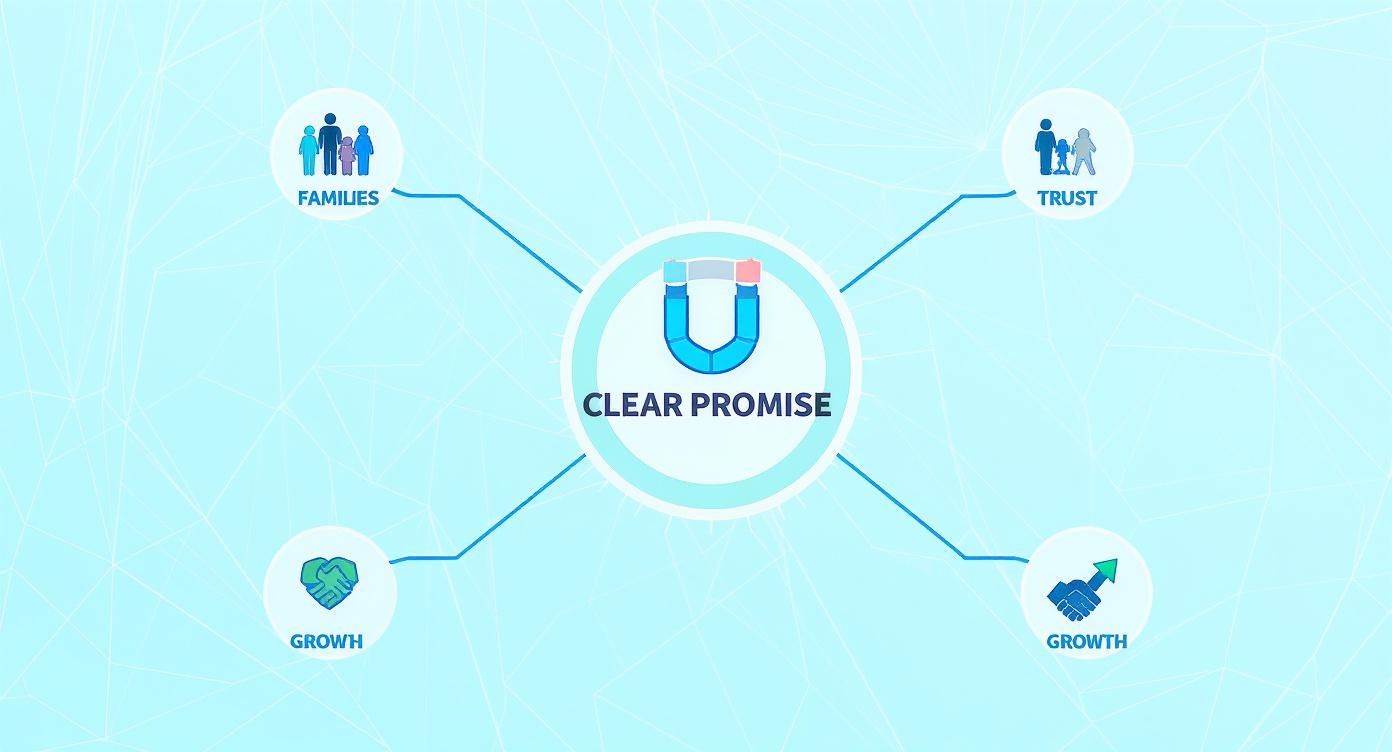
As you can see, a well-defined promise acts like a magnet, pulling in the right families, building trust from the get-go, and ultimately leading to sustainable growth for your school.
Block 2: The Audience
Of course, a great promise can't just float in a vacuum. It has to be aimed squarely at a specific audience. Trying to be the perfect school for every family is a surefire way to water down your message until it means nothing to anyone.
Instead, you need a deep, authentic understanding of the families who will truly thrive in your community. Who are they? What keeps them up at night? What are their biggest hopes for their child's education?
This is where creating detailed parent personas is an absolute game-changer. A persona is basically a semi-fictional character you create to represent your ideal family, based on real data and market research.
Your personal value proposition describes for a particular audience: how you will make a difference, why you are especially equipped to make this difference, and what evidence you have to support that assertion.
This idea, borrowed from a Harvard Business School course on personal branding, is just as true for schools. When you know your audience inside and out, you can shape your promise to speak directly to their worries and their dreams. A school promising intense academic rigor will connect with a completely different family than one focused on creativity and emotional well-being.
Defining your audience makes sure your message actually lands, making your marketing a whole lot more efficient and effective.
Block 3: The Proof
The final piece of the puzzle is proof. A fantastic promise aimed at the perfect audience is still just a claim until you back it up with hard evidence. Families today are smart and skeptical; they need to see real, tangible proof that you can walk the walk. Your proof points are the concrete reasons they should believe you.
Proof comes in all shapes and sizes, and the strongest value propositions use a healthy mix of both stories and stats.
Types of Compelling Proof Points:
- Student Testimonials: A video of a senior talking about how a specific program got them ready for college? Incredibly persuasive.
- Parent Stories: A written story from a current parent about how your school solved a specific problem for their child builds massive trust.
- Program Achievements: Hard data, like the number of students who won regional science fairs or the percentage accepted into top-tier universities, provides undeniable evidence.
- Teacher Credentials: Highlighting faculty with advanced degrees or special certifications shows your commitment to quality.
- College Matriculation Lists: Showing where your graduates end up gives families a clear picture of what's possible.
Gathering these proof points should be a constant, ongoing effort. When you line them up with your core promise, they build an airtight case for your school. Once you have these elements locked in, it's critical to use them consistently everywhere, a principle we explore more in our guide on how to create a style guide for your school. This ensures every single thing you publish reinforces your unique value.
Value Proposition Examples from Leading Schools
Theory is one thing, but seeing a powerful value proposition in action is where the lightbulb really goes on. Let’s bridge that gap between concept and reality by looking at how different schools can craft messages that speak directly to the families they want to attract.
A great value proposition isn’t some generic slogan you can slap on a billboard. It's a carefully constructed promise that gets to the very heart of your school's identity.
Below, we'll break down three distinct examples from a STEM-focused academy, an arts-based elementary school, and a faith-based high school. Each one shows how to weave together the core components—the promise, the audience, and the proof—to create a message that truly connects.
Example 1: The STEM-Focused Academy
First up, picture a high school that lives and breathes science, technology, engineering, and math. They’ve got the shiny new labs and brilliant teachers. But just listing those features is a surefire way to get lost in the noise.
The Promise: "We transform students from passive learners into active innovators, equipping them with the critical thinking and real-world problem-solving skills to lead in a tech-driven future." See the difference? The focus is on the outcome—becoming an innovator—not just the school's resources.
The Audience: This message is laser-focused on forward-thinking parents. They’re worried about their child’s career readiness and want an education that delivers a real competitive advantage, not just good grades.
The Proof: The school backs this promise up with hard evidence: internships with local tech companies, a 95% acceptance rate into top-tier engineering programs, and a portfolio of award-winning student projects.
This works because it speaks directly to a core parental anxiety—the fear that their child won't be prepared for the modern economy—and offers a clear, believable solution.
Example 2: The Arts-Based Elementary School
Next, let's look at an elementary school with a progressive, arts-integrated curriculum. Their whole philosophy is built around nurturing creativity and emotional intelligence. To attract the right families, their value proposition has to shout this from the rooftops.
The Promise: "We cultivate confident, compassionate, and creative thinkers by weaving the arts into every lesson. Our students don’t just memorize facts; they discover their unique voice and develop a lifelong love of learning."
The Audience: This is aimed squarely at parents who believe emotional growth and self-expression are just as important as academic scores. They’re searching for a nurturing place where their child’s individuality will be celebrated.
The Proof: The evidence is everywhere. You’d see it in the student art galleries, the annual theatrical productions that involve every single grade, and testimonials from parents raving about their child’s newfound confidence.
By focusing on the development of the "whole child," this message immediately sets the school apart from more traditional, test-driven institutions. It’s a completely different conversation.
Example 3: The Faith-Based High School
Finally, a faith-based high school. While spirituality is obviously central, a strong value proposition needs to address parents’ practical concerns about academics and character development to really stand out.
The Promise: "We partner with families to develop students of strong character and academic excellence. We ground a rigorous college-preparatory education in timeless values to form leaders who serve their communities with integrity."
The Audience: This resonates with parents who want both a top-tier education and a community that reinforces the moral framework they teach at home. They aren’t willing to compromise on either.
The Proof: The school can point to its service-learning graduation requirement, an impressive college matriculation list, and inspiring stories of alumni who are now making a difference. Small class sizes that foster genuine mentorship are another powerful proof point.
This approach masterfully blends the academic and spiritual promises. It shows parents they don't have to choose between a great education and a values-centered environment—they can have both.
So, how can you tailor your own message? The key is to understand what your ideal parents are really looking for and then frame your school as the undeniable solution.
Comparing Value Proposition Focus Areas
Here’s a quick comparison of how different school types might angle their value propositions to connect with specific parent concerns.
| School Type | Primary Promise (Benefit) | Target Audience (Parent Concern) | Example Proof Point |
|---|---|---|---|
| Public Magnet School | A specialized, tuition-free education that rivals private school quality. | Parents who want academic rigor and unique programs without the high cost of private tuition. | "Our graduates earned over $5 million in college scholarships last year." |
| Montessori Preschool | Fostering independence and a natural love of learning in a child-led environment. | Parents worried about overly structured or "one-size-fits-all" early education. | "Watch our 3-year-olds confidently prepare their own snacks and choose their work." |
| International Baccalaureate (IB) School | Developing globally-minded citizens prepared for top universities worldwide. | Families seeking a world-class, internationally recognized curriculum. | "Our alumni are accepted into universities in 15+ countries on 4 continents." |
| School for Students with Learning Differences | Unlocking each child's potential with personalized, expert-led instruction. | Parents feeling frustrated or underserved by traditional school systems. | "A 9-to-1 student-to-teacher ratio ensures every child gets the support they need." |
As you can see, the most effective messages don't try to be everything to everyone. They make a specific promise to a specific audience and then back it up with undeniable proof.
Actionable Templates to Get You Started
Feeling fired up? Grab your team and use these fill-in-the-blank templates as a launchpad for your next brainstorming session. They're designed to cut through the fluff and get to the core of what makes you special.
Template 1: The Problem-Solver
- For (your target family), who struggle with (a common pain point or concern), our school provides (the unique solution you offer). Unlike (your competitors), we (your key differentiator), which is proven by (a specific proof point).
Template 2: The Outcome-Focused
- We help (your ideal student) become (the aspirational outcome, e.g., confident leaders, creative problem-solvers) by providing (your unique method or program). As a result, our graduates (a compelling achievement or statistic).
These simple frameworks will force you to get specific and define exactly what makes your school the right choice for the right family.
Testing and Refining Your School's Message
Crafting what you feel is the perfect value proposition is a fantastic first step, but it's really only half the job. A truly powerful message isn't just created in a conference room; it’s validated in the real world. Your value proposition can't be an internal best guess—it has to be a proven statement that genuinely connects with your target families and inspires them to take the next step.
This is all about moving from assumption to evidence. The good news? Testing and fine-tuning your school's message doesn't require a huge budget or a dedicated analytics team. It’s about being smart, listening closely, and letting the data tell you what's working. This process ensures your promise isn't just something your leadership team loves, but a powerful tool for driving enrollment.
Practical Ways to Validate Your Message
The only way to know if your message is landing is to put it out there. You can get incredibly valuable feedback using simple, low-cost methods that show you how prospective parents actually respond to different versions of your promise.
Here are a few practical ways to get started:
- A/B Test Your Website Headlines: Use a simple tool to show two different headlines on your admissions page. Maybe one emphasizes academic rigor while the other highlights your nurturing community. Track which one gets more families to fill out your inquiry form.
- Run Small Social Media Ad Campaigns: Set up two small ad campaigns on Facebook or Instagram. Use the same image but different copy. One ad could feature a value proposition centered on innovation, the other on tradition. See which one earns more clicks from your target audience.
- Survey Your Community: Use a simple tool like Google Forms to ask current and prospective parents for their opinions. Present them with two or three value proposition statements and ask which one most compellingly describes your school and, more importantly, why.
When it comes to your website, a strong, tested value proposition is the cornerstone of a great user experience. As detailed in this best practice landing page guide, a clear message is what turns a visitor into an inquiry. These initial tests will give you a ton of information to work with.
Measuring What Matters Most
To sharpen your message effectively, you need to track the right things. This means looking at both quantitative data (the hard numbers) and qualitative feedback (the stories and opinions). Bringing these two together gives you the full picture of what’s resonating.
Here are the key metrics to keep an eye on:
- Website Conversion Rates: After updating your messaging, are more families filling out inquiry forms or scheduling tours?
- Click-Through Rates (CTR) on Ads: Which version of your message is compelling enough to make parents stop scrolling and click for more info?
- Qualitative Feedback: During campus tours or in surveys, what specific words or phrases do parents use when they talk about your school? Listen for echoes of your own messaging.
By consistently gathering this feedback, you create a powerful loop. You propose a message, test how families react, analyze the data, refine the message, and test again. This iterative process turns your value proposition from a static statement into a dynamic and highly effective enrollment driver.
This data-driven approach isn't new, but it's incredibly effective. Businesses have been using analytics for years to figure out which features and promises customers value most. One university, for example, completely transformed its market position by using data to restructure its programs, allowing it to offer superior value at a lower cost. This same kind of rigorous thinking can unlock major opportunities for your school. To get started on the right foot, check out our guide on how to conduct market research for your school.
Common Pitfalls to Avoid When Crafting Your Promise
It’s one thing to know what a great value proposition looks like, but it's just as important to recognize the traps that can trip you up. Even with the best intentions, it’s all too easy to rely on old habits that dilute your message and make your school blend into the background.
By spotting these common mistakes ahead of time, you can steer clear of them. This is how you make sure your final promise is sharp, specific, and truly speaks to the families you want to reach. Let’s walk through the most common missteps we see schools make.
The Jargon and Vague Language Trap
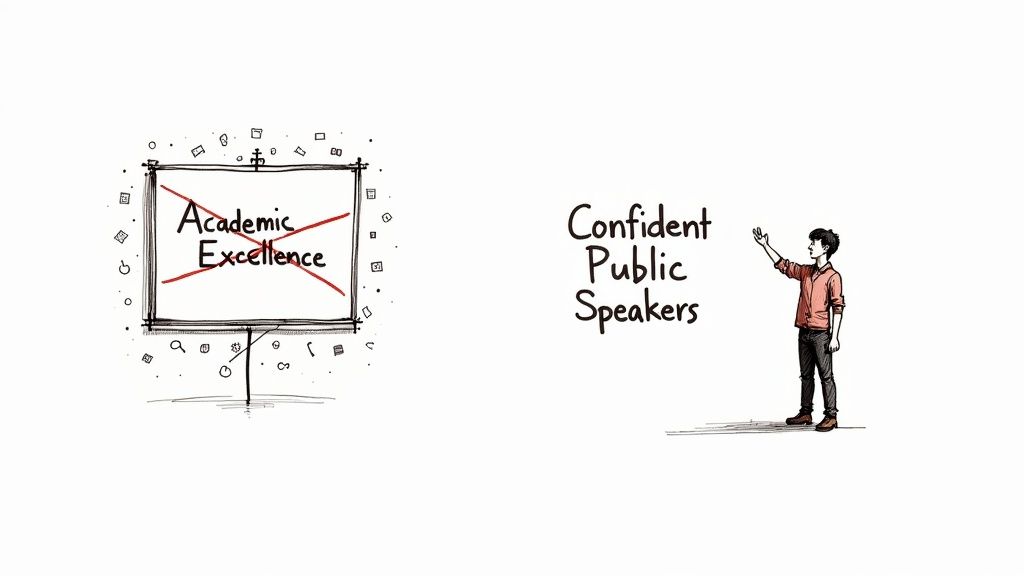
This one is probably the biggest culprit. Schools have a tendency to use impressive-sounding but ultimately hollow phrases. Think "academic excellence," "student-centered learning," or "educating the whole child." While the sentiment is great, these terms have been used so often by so many schools that they've lost all meaning.
Your value proposition has to be tangible. It needs to paint a crystal-clear picture of what a student's experience will actually look and feel like at your school.
- Before: "We are committed to academic excellence."
- After: "We challenge students with a project-based curriculum that prepares 95% of graduates for acceptance into top-tier universities."
See the difference? The "after" version swaps a tired cliché for a specific approach (project-based curriculum) and a hard number (95% acceptance). It’s instantly more credible and compelling.
Focusing on Features Instead of Benefits
Another common mistake is simply rattling off a list of your school’s features without explaining why they matter to a family. A parent doesn't just care that you have "small class sizes"; they care about what that means for their child. Does it mean their shy son will get the one-on-one attention he needs to come out of his shell? That’s the benefit.
A feature is what your school has. A benefit is what a family gets. Always frame your promise around the tangible outcomes and emotional payoffs for students and their parents.
Get in the habit of asking "so what?" for every feature you list. You have a 1:1 laptop program, so what? This simple question forces you to connect the dots between your school's assets and the real-world value they bring to a family. That connection is the heart of a great value proposition.
Trying to Be Everything to Everyone
In the quest to attract as many families as possible, many schools water down their message until it becomes generic and forgettable. Here's the truth: your school isn't the perfect fit for every student out there, and that's okay. In fact, it's a strength. A powerful value proposition has the courage to be specific, even if it means some families won't connect with it.
When you try to please everyone, you end up exciting no one. The real goal is to craft a message so clear and focused that your ideal family reads it and thinks, "That's it. That's exactly what we've been looking for." This requires knowing who you serve best and having the confidence to build your promise around their specific hopes and needs.
Got Questions? We’ve Got Answers.
Even with the best roadmap, a few questions always come up when you start crafting a value proposition for your school. Let's tackle some of the most common ones we hear from school marketers.
Value Proposition vs. Mission Statement: What’s the Real Difference?
It’s easy to get these two mixed up, but they serve very different purposes.
Think of your mission statement as your school’s internal compass. It’s your “why”—the fundamental purpose and principles that guide your faculty and staff. It’s written for you.
A value proposition, however, is an external promise made directly to families. It’s for them. It cuts through the noise to answer their biggest question: “What’s in it for my child here that we can’t find anywhere else?” It’s more parent-centric than your mission and far more specific than a simple slogan.
How Often Should We Revisit Our Value Proposition?
This isn't a "set it and forget it" task. A good rule of thumb is to review your value proposition every 2-3 years.
You should also revisit it anytime there's a major shift. This could be a new head of school, the launch of a signature academic program, a change in what local families are looking for, or a new competitor opening up down the street.
Your core promise should feel stable, but it can't be static. Regular check-ins keep it sharp, relevant, and honest about the incredible value you deliver today—not the value you delivered five years ago.
How Do I Get Leadership to Buy Into This?
Getting your leadership team on board means speaking their language: data and strategy. Don't just show them clever words; show them the evidence.
Arm yourself with competitive analysis, parent survey feedback, and hard enrollment data. Frame the new value proposition as a critical strategic tool, not just a "marketing thing." Explain how a clear, powerful promise will align every department, give your school a real competitive advantage, and ultimately support the mission and financial health of the entire institution.
At The MarCom Society, we provide the tools, expert insights, and collaborative community to help you master strategic messaging and drive enrollment. Join our network of K-12 marketing professionals today.