
So, what exactly is a brand voice? Before we get into the weeds, let's start with a simple, clear idea.
Think of your brand voice as your school's unique personality. It’s not just what you say, but how you say it. It’s the distinct character and feeling that comes through in all of your communications.
Defining Your School's Personality

If your school were a person, how would it sound? Would it be warm and nurturing, like a trusted mentor? Or would it be formal and authoritative, emphasizing tradition and excellence? That consistent character is your brand voice.
This personality is built from the ground up—it's in the specific words you choose, the rhythm of your sentences, and the overall attitude you project in every email, social media post, and website update. It’s what makes you, you.
When you nail your brand voice, your school becomes instantly recognizable. More importantly, it helps you build a genuine, trusting relationship with parents and students. This isn't just a "nice-to-have," either. Research shows that maintaining a consistent brand presence can increase revenue by 23% to 33%. This powerful connection between personality and performance is something every school leader should understand. You can see the full research here to dig into the numbers.
Voice vs. Tone: What's The Difference?
This is where many people get tripped up, but the distinction is actually quite simple. It’s crucial to understand the difference between your brand voice and your tone of voice.
- Brand Voice is your school's fixed personality. It's the core of who you are and stays consistent, no matter what.
- Tone of Voice is your emotional inflection in a specific situation. It’s adaptable and changes based on the audience, context, and channel.
Let's make this concrete. Imagine your school's voice is consistently encouraging and supportive. Your tone, however, would shift depending on the message. When celebrating a student's scholarship on Instagram, your tone would be enthusiastic and joyful. But when addressing a sensitive community issue in an email to parents, your tone would become serious, measured, and empathetic.
The personality doesn’t change, but the emotional expression does. This is the key to authentic and effective communication.
To make this crystal clear, here’s a quick breakdown of how these two concepts differ.
Brand Voice vs Tone of Voice At a Glance
| Attribute | Brand Voice | Tone of Voice |
|---|---|---|
| Consistency | Fixed and constant | Varies with context |
| Represents | Your core personality | Your current mood or feeling |
| Purpose | To build recognition and trust | To suit a specific situation |
| Example | "We are innovative and forward-thinking." | Enthusiastic, serious, or playful |
Understanding this distinction allows you to maintain a strong, consistent identity while still connecting with your community in a way that feels appropriate and human for any situation.
Why a Strong Brand Voice Matters for Growth

Defining your school’s brand voice isn't just a creative exercise—it's a core strategy for growth. In a market full of schools all vying for attention, a consistent voice is what makes you stand out and feel instantly familiar to the right families.
Think of it as the foundation for every relationship you build. When your communication feels dependable and true to who you are, you earn trust. This consistency ensures a smooth, recognizable experience for your community, whether they're reading a newsletter, visiting your website, or scrolling through a social media post.
Building Connections and Loyalty
A memorable personality does more than just share information; it forges real connections. When you speak with a clear, authentic voice, you naturally draw in people who share your school's fundamental values. This is how you turn casual interest into deep-seated loyalty.
Brand voice is the bridge to your audience. Consider this: 76% of consumers prefer buying from brands they feel an emotional connection to, and 64% stay loyal to those that reflect their own values. Learn more about how brand voice attracts business on IgniteVisibility.com.
This emotional bond is what turns families from passive observers into passionate advocates for your school. They don't just enroll their children; they become champions of your mission.
From Voice to Tangible Results
Putting real effort into your brand voice pays off in stronger relationships and long-term, sustainable growth. Every piece of content you create—from a simple tweet to a detailed prospectus—becomes another chance to reinforce who you are and what you stand for.
Beyond grabbing attention, a consistent voice is crucial for creating content that truly lands with your audience and helps you accelerate your organic social media marketing. Ultimately, a strong, well-defined voice doesn't just make your school sound good—it makes it unforgettable.
The Building Blocks of a Memorable Brand Voice
So, how do you actually build a brand voice from the ground up? It’s not as abstract as it sounds. Think of it like a recipe—you need the right ingredients, combined in the right way, to create a personality that’s uniquely yours.
Breaking it down helps you move from vague ideas to a real, workable plan. A strong brand voice really comes down to three key pillars: persona, tone, and language. Each one plays a distinct role in shaping how your school shows up in the world.
Your School's Persona
First up is your persona. This is the big one. If your school were a person, who would it be? An inspiring mentor? A caring guide? A forward-thinking innovator? Or maybe a pillar of tradition?
Nailing this down is your foundational step. Your persona is the "who" behind everything you say and do. It’s the consistent character your community gets to know, ensuring every email, social post, and brochure feels like it’s coming from the same place.
Your brand persona is the consistent personality your community comes to know and trust. It's not about being everything to everyone; it's about being someone specific and reliable. This clarity prevents the communication fractures that can erode trust over time.
The Tonal Range
Next, let's talk about tone. If persona is who you are, tone is how you express yourself in different situations. It's the emotional flavor you add to your words. Your persona is stable, but your tone should be flexible.
For instance, a school with an authoritative persona might use a reassuring tone when talking to anxious new parents. When celebrating a big win for the robotics team, that same persona would shift to a celebratory tone.
Defining this range is what allows you to be human. Ask yourself:
- What emotions fit our school's character?
- When do we need to be more formal, and when can we be conversational?
- How do we sound when we’re excited, serious, or showing empathy?
The Language You Use
Finally, we have language. This is where your voice truly takes shape. It’s all about the specific words, phrases, and sentence structures you choose. This is the most tangible part of your voice—the words on the page (or screen).
Are you going to use educational jargon, or will you stick to simple, everyday language that everyone can understand? Is your style witty and clever, or more direct and heartfelt? These choices make all the difference. For a deeper dive into choosing the right words, our guide on effective copywriting for education has some great pointers.
Your language is the final layer that brings your school’s unique voice to life.
How to Define Your Unique Brand Voice Step by Step
Figuring out your school's unique brand voice can feel like a huge task, but breaking it down into a few manageable steps makes all the difference. The best place to start isn't by inventing something new, but by looking at what you’re already doing. Think of it as a bit of detective work.
Go ahead and pull together your last 15-20 communications—think emails, social media posts, website copy, and newsletters. Now, read them out loud. Do they all sound like they came from the same place? Or does your school sound a bit like it has multiple personalities? This simple audit is incredibly revealing and gives you a baseline of your current habits, both good and bad.
Understand Your Audience and Your Mission
With a clear picture of where you are, it's time to look outward to your community and inward to your core identity. First, who are you actually talking to? The way you speak to a nervous parent looking at kindergartens is going to be worlds apart from how you engage with a high school senior or a nostalgic alumnus.
Next, you need to anchor everything in your school's mission and values. Your voice is simply your mission made audible. If your school's mission is all about fostering innovation, your voice should sound energetic and forward-thinking. If it’s built around a close-knit community, it should feel warm, welcoming, and inclusive.
This infographic does a great job of showing how persona, tone, and language come together to create your voice.
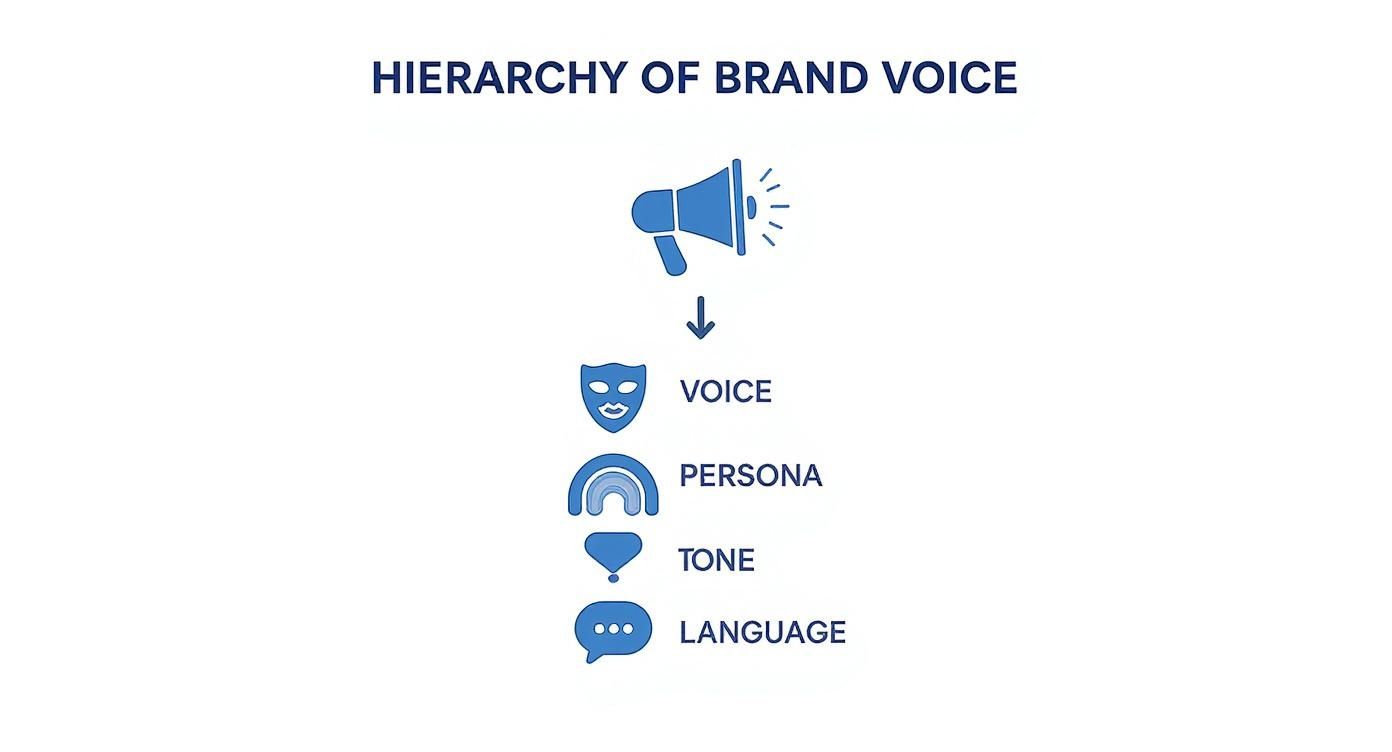
As you can see, a strong voice (the megaphone) is really a combination of a distinct persona (who your school is), a versatile tone (the emotion you use in different situations), and your specific language (the actual words you choose).
Document Everything in a Style Guide
Here’s the most critical part: you have to write it all down. All this foundational work is useless unless everyone who communicates on behalf of your school is on the same page. That’s where a brand style guide comes in.
A style guide is the single source of truth for your brand's voice. It’s a practical document that turns abstract ideas into clear, actionable rules for your team to follow, ensuring everyone speaks with one, unified voice.
This isn't meant to be a stuffy rulebook that collects dust on a shelf. It should be a living, practical tool. At a minimum, it should include:
- Three adjectives that are the essence of your voice (e.g., "Passionate, Supportive, Clear").
- A short and sweet description of your school's persona.
- Simple "do" and "don't" examples for word choice and tone.
- Specific guidelines for different channels, because an Instagram caption should sound different from a formal parent email.
Putting this guide together is one of the best investments you can make in your marketing. To help you build one from the ground up, take a look at our detailed article on how to create a style guide that your team will actually use. By documenting these guidelines, you empower every single person on your staff to be a confident and consistent ambassador for your school.
Excellent Brand Voice Examples You Can Learn From
Theory is helpful, but seeing a brand voice in action is where the lightbulb really goes on. Let's break down how two totally different companies use a consistent personality to build a memorable brand and truly connect with people.
Think about Mailchimp. Their entire mission is to take complicated marketing tools and make them feel simple, accessible, and maybe even a little fun. Their voice lines up with this perfectly—it's consistently helpful, a bit quirky, and always encouraging.
They stick to plain language and sprinkle in a little humor, which makes them feel so much more approachable than your typical tech company. For example, instead of a boring "Success" message, you might see, "High fives all around! Your campaign is on its way." It’s a tiny detail, but that simple bit of copy turns a routine task into a small celebration, reinforcing their supportive personality.
The Power of Aspirational Messaging
Now, let's flip the script and look at Nike. Their voice is a masterclass in inspiration and competition. They aren’t just selling shoes and apparel; they’re selling the idea of achieving greatness and the motivation to get there. Every word is carefully chosen to empower and challenge you.
Their iconic slogan, "Just Do It," is the perfect distillation of this voice. It’s direct, confident, and all about action. You see this reflected across all their marketing, which often uses short, punchy sentences that build a sense of urgency and power.
Nike’s voice isn't just about selling a product; it’s about selling a mindset. It taps into that deep-seated desire we all have to push our limits and become better. That's how they turn customers into believers.
Getting a voice this distinctive doesn't happen by accident—it takes real creative effort. Diving into some proven creative thinking strategies can be a huge help in brainstorming original ideas for your own brand's tone.
The goal is to land on a personality that feels authentic to your mission and resonates with the people you want to reach. For a little more inspiration, take a look at these powerful brand storytelling examples to see how others build that connection.
Common Questions About Brand Voice
You've got the basics down, but putting a brand voice into practice is where the real questions start to pop up. It's one thing to define your school's voice, but it's another to use it consistently across every email, social post, and parent meeting.
Let's walk through some of the most common hurdles to clear things up and get you moving forward.
How Is Brand Voice Different from Brand Tone?
This is probably the most common question I hear, and there's a simple analogy that makes it click.
Think of it like this: your brand voice is your school's core personality—it doesn’t change day-to-day. But your tone is the specific mood or emotion you express in a given situation. Your personality stays consistent, but your mood definitely changes depending on the context.
For example, your school’s voice might always be welcoming and supportive. But your tone when emailing parents about a snow day will be direct and informative. When you're celebrating a state championship win on social media, that same welcoming voice will use a tone that’s exuberant and proud. The personality is the same, but the emotional delivery adapts.
Can My School's Brand Voice Evolve Over Time?
Of course. A brand voice shouldn't be set in stone forever. Just like people, schools grow, their communities shift, and their strategic goals change. What resonated with families ten years ago might not connect as strongly today.
The key is to make any evolution a deliberate, thoughtful process—not an abrupt, jarring switch that leaves your community feeling disconnected.
A great rule of thumb is to review your brand voice guidelines every year or so. This quick check-in ensures your messaging still perfectly reflects your mission and connects with the families you serve. It keeps you relevant without losing the heart of who you are.
Avoid sudden overhauls. A slow and steady evolution will bring your community along with you, rather than making them feel like they're dealing with a completely different school.
How Do I Get My Entire Team to Use the Voice Consistently?
Consistency is a team sport, and it won't happen without a playbook. Your single most powerful tool for getting everyone on the same page is a practical, easy-to-use brand voice style guide.
This isn't a 50-page academic document that gathers dust. It's a hands-on resource that should be front and center for anyone communicating on behalf of your school.
Make sure your guide includes:
- Your Core Voice Traits: A handful of clear, descriptive words that anchor your personality (e.g., "Inspiring, Nurturing, Clear").
- The "This, Not That" Section: Real-world examples of phrases to use and, just as importantly, words or tones to avoid.
- Examples for Different Channels: Show how the voice adapts for a formal admissions letter versus a fun Instagram story.
Once you have this guide, share it! A quick training session can empower everyone, from the front office to the fundraising team, to become a confident champion of your school's unique voice.









