
A content marketing strategy is your master plan for using helpful, relevant content to draw families to your school and keep them engaged. It's the "why" behind every blog post you write, video you film, or social media update you share. It makes sure every bit of effort you put in directly supports your school's big goals, like boosting enrollment or strengthening your community.
What Is Content Marketing Strategy In Simple Terms
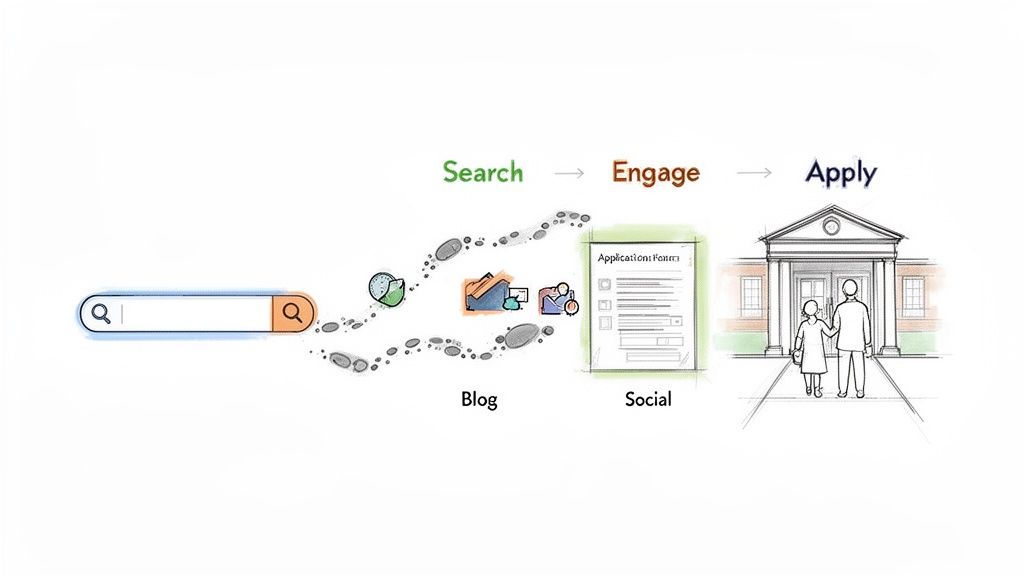
Think of your content marketing strategy as the blueprint for building a bridge. This bridge connects your school to prospective families, making it easy for them to find you and get to know you. You wouldn't build a real bridge without a detailed plan, right? The same goes for your content.
Without a strategy, you’re just creating stuff—a blog post here, a Facebook update there—and hoping something sticks. That's a surefire way to waste time and get inconsistent results. A clear strategy, on the other hand, gives every single piece of content a specific job to do.
It’s about moving from being reactive to being proactive. It forces you to answer the tough questions before you ever write a single word.
The Purpose of a Content Strategy
At its heart, a content marketing strategy is about making intentional decisions. It gives you the clarity to create content that doesn't just grab attention, but actually builds trust and helps families on their journey to choosing the right school.
A solid strategy serves a few key purposes:
- Defining Your Audience: It makes you get specific about who you're talking to. Not just "parents," but real parent personas with unique worries, questions, and dreams for their kids.
- Clarifying Your Message: It helps you nail down what makes your school special and why a family should choose you over the school down the street.
- Aligning Content with Goals: Your strategy connects every piece of content to a measurable school objective, whether that's getting more families to an open house, increasing applications, or even improving current parent retention.
A content marketing strategy isn't just about what you will create; it's about what you won't create. It provides the focus to say "no" to distracting ideas and invest your limited time and money where they’ll make a real difference.
The 5 Pillars Of A Content Marketing Strategy
To make this less abstract, let's break a strategy down into its five core components. Think of these as the essential pillars holding up your entire marketing plan.
| Pillar | What It Answers | Example for a School |
|---|---|---|
| 1. Audience | Who are we trying to reach? | "First-time kindergarten parents in our zip code who are anxious about the transition to a larger school environment." |
| 2. Messaging | What do we want to say to them? | "Our small class sizes and nurturing teachers create a seamless, stress-free start to your child's education." |
| 3. Channels | Where will we reach them? | "Parenting blogs, local family-focused Facebook Groups, and targeted ads on Instagram." |
| 4. Calendar | When will we publish our content? | "We'll share a 'Kindergarten Readiness Checklist' in February and a 'Meet the Teachers' video series in March." |
| 5. Metrics | How will we know if it's working? | "We'll track website traffic to our kindergarten page, checklist downloads, and RSVPs to our spring open house." |
These five pillars give you a practical framework to build from, turning a vague idea into a concrete, actionable plan.
From Jargon to a Practical Playbook
A good strategy isn't some dusty academic document that sits on a shelf. It's a living, breathing playbook that guides your team's day-to-day work. It ensures everyone, from the admissions director to the social media manager, is telling the same story. That consistency is what builds a strong, trustworthy brand.
Ultimately, a content marketing strategy is your roadmap. It shows you where you are now, where you want to go (your goals), and the best routes (your content and channels) to get there. It’s how your school stands out and thrives. If you're looking to brush up on the basics that power this approach, resources on Social Media Marketing Fundamentals can provide a great starting point.
Building Your School's Content Strategy Framework
Trying to execute a content strategy without a framework is like building a school without a floor plan. You might have a vision, but without a clear blueprint, you have no structure to build on. This framework is your blueprint—it turns your school's big-picture goals into a practical, day-to-day plan for your team. This is where abstract ideas become actionable steps.
When you take the time to document your framework, something powerful happens. You’re forced to move beyond assumptions and base your decisions on a real understanding of who you’re trying to reach and what you need to say. That clarity prevents you from wasting time and money on content that doesn't connect. It ensures every blog post, video, and social media update works together to tell a consistent and compelling story about your school.
Start With Your Ideal Family Persona
Before you write a single word, you have to know who you’re writing for. A parent persona is a detailed, semi-fictional profile of the ideal parent you want to attract. This goes way beyond simple demographics like age and zip code. A truly useful persona uncovers the real motivations, anxieties, and questions that drive a family’s search for the right school.
For example, instead of just targeting "parents of elementary schoolers," you could create a persona for "First-Time Kindergarten Mom, Sarah."
- Her Pain Points: Sarah is worried her shy child will get lost in the shuffle of a large public school. She feels totally overwhelmed by the application process and isn't even sure what questions she should be asking on a school tour.
- Her Goals: She's looking for a nurturing environment where her child will feel safe and truly known by the teachers. She wants a school with strong communication and an active, welcoming parent community.
- Where She Looks for Info: She spends her time in local parenting Facebook groups, reads blogs about childhood development, and asks friends for recommendations.
When you understand Sarah this deeply, you can create content that speaks directly to her concerns. Think about a blog post like "5 Ways Our Small Class Sizes Help Shy Students Thrive" or a downloadable "Kindergarten Open House Checklist." Our guide on how to create detailed buyer personas offers a fantastic step-by-step process for this crucial first step.
Define Your Core Message and Value Proposition
Once you know who you're talking to, you need to lock in what you're going to say. Your core message is your school's unique promise of value. It’s the simple, clear answer to the question, "Why should a family choose our school over all the others?" This isn't just a catchy tagline; it’s the central idea that holds all your content together.
To nail down your core message, ask your team these questions:
- What do we do better than anyone else? (Is it your project-based learning, a standout arts program, or exceptional teacher support?)
- What is the main benefit we deliver to families? (Are you preparing students for top universities, fostering unshakeable creativity, or building resilient future leaders?)
- What is our school's personality or culture? (Are you innovative and forward-thinking, traditional and community-focused, or diverse and inclusive?)
The answers will help you shape a value proposition that truly connects with your parent personas and makes you stand out.
Choose The Right Channels for Your Audience
Creating amazing content is only half the battle. It has to be seen by the right people in the right places. Don't fall into the trap of trying to be everywhere at once. Instead, focus your precious time and energy on the channels where your parent personas are already active.
A common mistake is choosing channels based on what’s popular, rather than where your specific audience spends their time. A strong strategy prioritizes impact over presence on every single platform.
If your "Sarah" persona lives in local Facebook groups, that's where you need to be. If you're targeting parents of high schoolers who are deep in the college search, a robust blog with SEO-optimized articles and a professional LinkedIn presence for your school will be far more effective. The key is to meet families where they are.
Build A Thematic Content Calendar
A content calendar is the operational heart of your strategy. It’s your schedule, mapping out what content you'll publish, on which channels, and when. The best calendars are built around themes that follow the natural rhythm of the school year and the family's enrollment journey.
Think about organizing your content around these key periods:
- Enrollment Season (Fall/Winter): Focus on content that drives applications and open house attendance. Think virtual tours, "day in the life" videos, and parent testimonial articles.
- Re-enrollment Period (Spring): Create content that reinforces your value for current families, like showcasing student achievements, faculty spotlights, and alumni success stories.
- Summer Programs: Promote your summer camps and enrichment opportunities with fun, engaging posts and videos.
- Back-to-School (Late Summer): Build excitement with "meet the teacher" videos, handy supply lists, and tips for a smooth start to the new school year.
This thematic approach keeps your content timely, relevant, and directly supportive of your school's most important goals. Planning this way is a serious investment, but it reflects a massive global shift. In fact, content marketing is a booming industry projected to hit a market size of $2 trillion by 2032 as organizations realize its power to build trust and drive results more effectively than old-school advertising. If you want to see the scale of this trend, check out these in-depth content marketing statistics and trends.
Seeing Content Strategy In Action At Real Schools
It’s one thing to talk about frameworks and another to see them work in the real world. How do all these ideas about personas, messaging, and channels actually help a busy school marketer? Let's walk through a few examples to see how a strategic approach gets real results.
These aren't just random acts of marketing. Each scenario is a deliberate play, starting with a specific family in mind, choosing the right format, and aiming for a clear school goal.
Example 1: The Community-Focused Primary School
Picture a primary school that wants to be the go-to choice for first-time kindergarten parents in the neighborhood. These parents are often nervous about the big transition and are searching for a warm, supportive place for their little one.
- Parent Persona: Let's call them "Nervous Newcomer Parents." They value a strong sense of community and need clear, reassuring communication. Their biggest fear is that their child will get lost in the shuffle.
- Core Goal: Increase registrations for open house events and build a reputation as the local expert on early childhood education.
- Content in Action: The school kicks off a blog series called "Your Guide to Kindergarten Readiness." They publish articles like "5 Ways to Ease Separation Anxiety" and "A Day in the Life of a Kindergartener." Then, they share these posts in local parent Facebook groups and run a few targeted ads.
By doing this, the school becomes a helpful guide, not just another option for enrollment. It addresses parents' core worries head-on, building trust long before they ever ask for an application.
Example 2: The Innovative High School
Now, imagine a high school with a unique, project-based curriculum. They need to show prospective families what makes them different and how they're preparing students for the modern world.
- Parent Persona: We can call these "Future-Focused Families." They're tired of the traditional lecture model and want to see authentic, engaging student experiences.
- Core Goal: Drive more enrollment inquiries and stand out from more conventional competitors.
- Content in Action: The school puts its students front and center, creating short, snappy videos for Instagram and TikTok. You see student-led campus tours, quick interviews with favorite teachers, and highlights of cool class projects. The vibe is raw, energetic, and completely genuine.
This move taps into the undeniable power of video. It's a non-negotiable tool now, with over 90% of businesses using it in their marketing. By letting the students tell the story, the school offers a peek into its culture that a glossy brochure could never capture.
Example 3: The Prestigious Private Academy
Finally, let's look at a private academy. Their main challenge is keeping current families happy and reminding them why the tuition is a worthwhile investment. They need to consistently show the incredible value and opportunities they provide.
- Parent Persona: These are the "Invested Achievers." They expect a high return on their educational investment and want to see tangible proof of success.
- Core Goal: Boost re-enrollment rates and strengthen the parent community.
- Content in Action: The academy develops a polished, bi-weekly email newsletter just for current families. Each issue features an in-depth faculty interview, a success story about a recent graduate, and a spotlight on a unique academic program.
This kind of targeted content constantly reinforces the parents' decision. It demonstrates value again and again, turning parents into loyal advocates who feel deeply connected to the school's mission.
The diagram below shows how a solid strategy sits at the center of everything, guiding your decisions on personas, messaging, and channels.
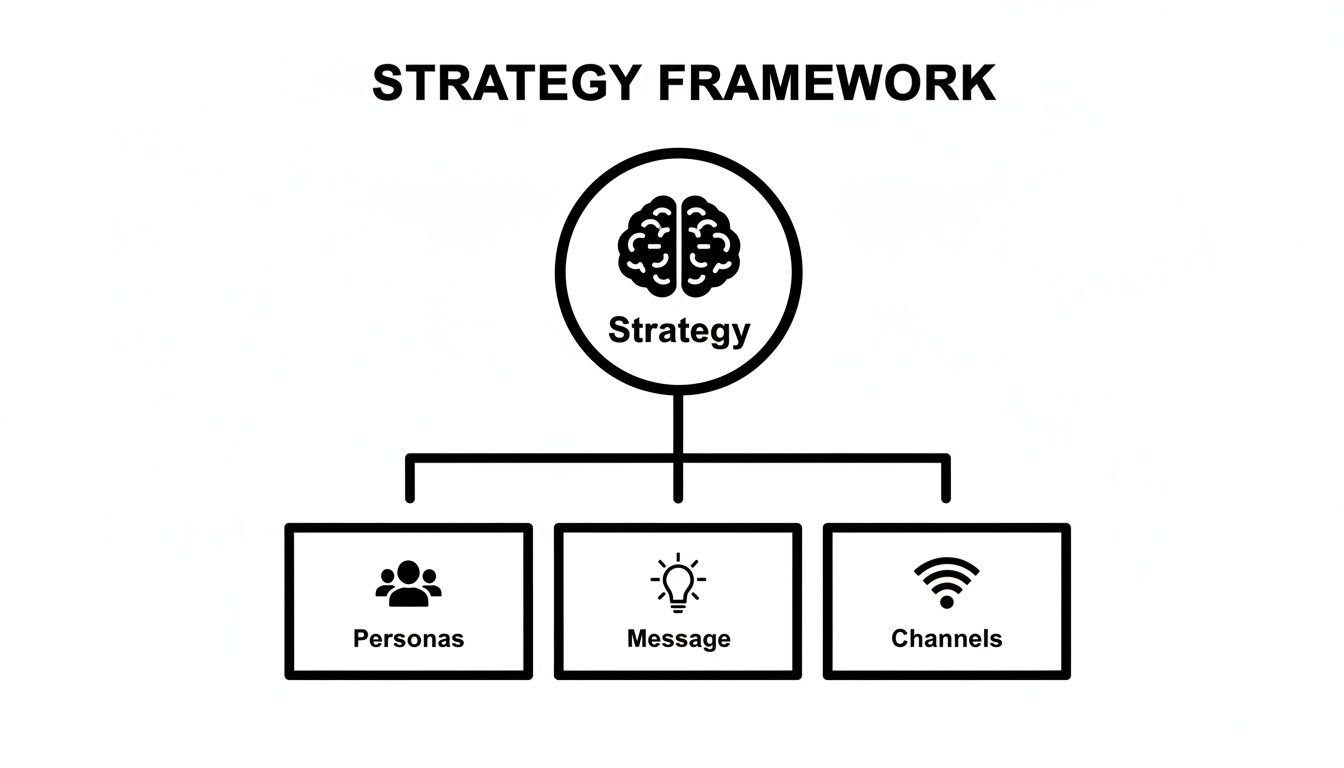
It’s a clear reminder that your core strategy has to come first, informing every other piece of the puzzle. To see how other organizations put this into practice, it’s always a good idea to check out more real-world content marketing strategy examples for inspiration.
A Simple Template to Build Your Content Strategy
All the theory in the world doesn’t help until you have a real plan to put into action. Knowing what a content strategy is and seeing a few examples is a great start, but now it’s time to turn those ideas into a documented plan for your own school.
This simple, fill-in-the-blanks guide is designed to cut through the noise and give you a clear roadmap. Think of it less like a rigid assignment and more like a tool to get your thoughts organized. Remember, a simple plan you actually use is a thousand times better than a masterpiece that just gathers dust.
Let’s walk through it together.
Step 1: Define Your Primary Goal
First things first: what do you really want your content to accomplish this year? You have to be specific here. Fuzzy goals like "increase engagement" are nearly impossible to measure and don't lead to meaningful results. Instead, connect your content goal directly to a larger school-wide objective.
Goal Example for a school we’ll call "Oakwood Academy"
- Our Primary Goal Is: To increase enrollment inquiries from qualified local families by 15% by the end of the second quarter.
Step 2: Outline Your Key Parent Personas
Okay, now who are you talking to? You don’t need a dozen different profiles. Just start with two or three of your most important parent audiences. Get inside their heads and think about their real-world worries and what they’re genuinely looking for in a school.
Parent Persona Examples:
- Persona 1: "First-Time Kindergarten Mom"
- Her Biggest Worry: Her shy child will get lost in the shuffle of a big, overwhelming classroom.
- What She Wants: A nurturing, tight-knit school community where her child will get plenty of individual attention.
- Persona 2: "STEM-Focused Dad"
- His Biggest Worry: His middle-schooler won't be challenged enough and will fall behind when it's time for a competitive high school.
- What He Wants: A school with a proven, hands-on curriculum in science and technology.
Step 3: Establish Your Core Messaging Pillars
Your messaging pillars are the 2-3 foundational themes that consistently answer the question, "So, why should we choose your school?" Every single piece of content you create—every blog post, every video, every social media update—should tie back to one of these pillars.
Core Messaging Pillars for Oakwood Academy:
- Nurturing Community: We foster a supportive, small-school environment where every student is truly known and valued.
- Innovative Learning: We prepare students for the future with our hands-on, project-based STEM curriculum.
- Whole-Child Development: We look beyond academics to focus on character, creativity, and leadership skills.
Your messaging pillars are the heartbeat of your content strategy. They ensure every blog, video, and social post tells a consistent story, building a brand that families can trust and recognize.
Step 4: Map Content Themes to Your School Calendar
Now, let's connect your message to the calendar. By aligning your content ideas with the natural rhythm of the school year, you make sure you’re delivering the right message at exactly the right time to support your enrollment goals.
Thematic Content Calendar:
- August-October (Discovery & Awareness):
- Theme: Why Oakwood?
- Content: Blog posts on "Choosing the Right Middle School," student testimonial videos, "Meet Our Teachers" social media series.
- November-January (Application Season):
- Theme: See Yourself Here.
- Content: Virtual campus tour videos, detailed program guides, "How to Apply" checklists, live Q&A sessions with the admissions director.
- February-April (Decision & Retention):
- Theme: Our Community in Action.
- Content: Alumni success stories, spotlights on unique class projects, posts celebrating beloved school traditions.
Step 5: Select Your Most Effective Channels
Last but not least, where are you going to share these stories? The biggest mistake is trying to be everywhere at once. Instead, focus on the one or two platforms where your key parent personas are already active and engaged.
Primary Communication Channels:
- School Blog: This is your home base for deep, SEO-friendly content that directly addresses parent questions and concerns.
- Facebook Page/Local Groups: Perfect for building a sense of community, sharing visual updates, and promoting events to local families.
- Email Newsletter: Hands down the best channel for nurturing prospective families and communicating value to your current parents.
This template gives you a solid foundation to build upon. If you're ready to go even deeper, you might be interested in our comprehensive communications strategy template that dives further into the execution side of things.
How To Measure Your Content Marketing Success
You've poured your heart into creating amazing content. But how do you know if it's actually working? If you're not measuring its impact, you're essentially marketing in the dark. It's impossible to know if your efforts are truly moving the needle on your school's biggest goals, like boosting enrollment or building a vibrant community.
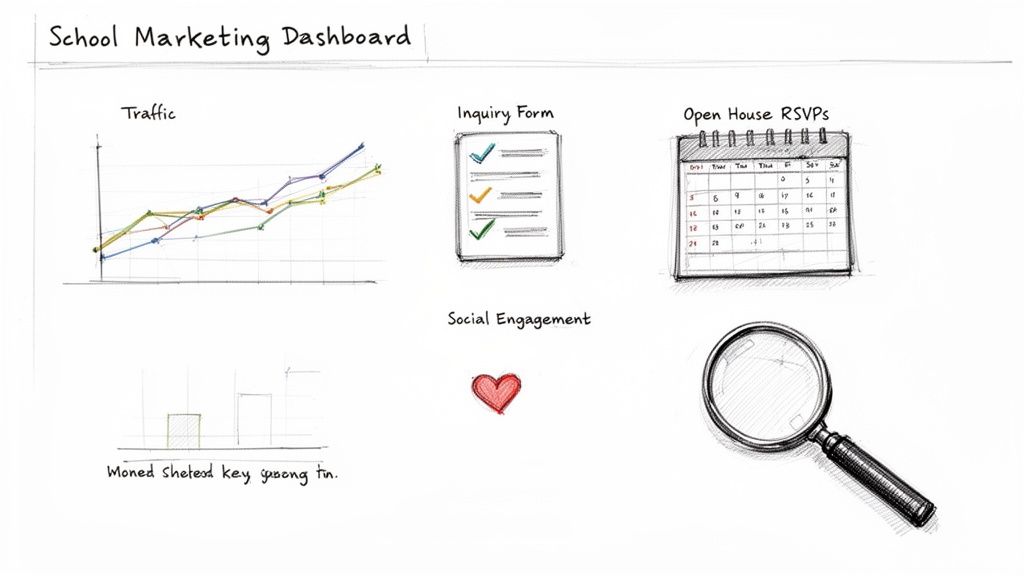
This is where Key Performance Indicators (KPIs) come into play. Think of them as signposts that tell you whether your strategy is on the right track. It’s time to stop chasing surface-level numbers and start focusing on the data that genuinely reflects your school's growth.
Moving Beyond Vanity Metrics
It's so easy to get distracted by "vanity metrics." These are the numbers that look impressive but don't tell the whole story—things like total social media followers or the number of likes on a post. While they feel good, they don't necessarily mean you're attracting the right families or encouraging them to take the next step.
Instead, the real magic happens when you focus on actionable metrics. These are the data points that directly connect your content to your school's most important goals. They show you what’s resonating with prospective parents and what might need a little tweaking.
Essential KPIs For Your School's Content Strategy
To truly understand how your content is performing, you need a clear dashboard of metrics that track a family's journey from initial interest to taking action.
Here's a breakdown of the key metrics to track, what they mean, and the tools you can use to measure them effectively.
| Metric (KPI) | What It Measures | Tool To Use |
|---|---|---|
| Organic Website Traffic | How many people are finding your school's website through search engines like Google after reading your content. | Google Analytics |
| Inquiry Form Completions | The number of prospective families who fill out a form to request more information after engaging with your content. | Your website’s CRM or form software |
| Open House RSVPs | How many families sign up for a campus tour or open house event, often linked directly from a blog post or social update. | Event registration platform (e.g., Eventbrite) |
| Social Media Engagement Rate | The percentage of your audience that interacts (likes, comments, shares) with your content, indicating genuine interest. | Native social media analytics (e.g., Meta Business Suite) |
These KPIs give you a solid, at-a-glance view of your content's health. For a more comprehensive look at this topic, our guide to essential content marketing metrics dives even deeper into what to measure and why it matters.
By keeping an eye on these numbers, you can start connecting the dots between your content and real-world outcomes.
Common Pitfalls To Avoid When Measuring Success
Even with the right KPIs, it's surprisingly easy to misread the signs. Watch out for these common traps that can give you a distorted picture of your performance.
One of the biggest mistakes is creating content for the wrong audience. It’s tempting to write about internal school news or staff awards, but your main focus should always be on the questions and concerns of prospective parents. If your blog traffic is soaring but inquiry forms are flat, you might be attracting the wrong kind of readers.
Another all-too-common error is forgetting a clear call-to-action (CTA). Every single piece of content, from a blog post to an Instagram Reel, should guide the reader on what to do next. A simple "Download Our Kindergarten Readiness Checklist" or "RSVP for Our Spring Open House" can make all the difference. A missing CTA is a missed opportunity.
Quick Wins To Immediately Boost Your Impact
Feeling a bit overwhelmed by all the data? Don't worry. You don’t need to reinvent the wheel to see a real impact. Here are a few simple things you can do right now to get some quick wins on the board.
- Repurpose a Top-Performing Blog Post: Find your most popular article and transform it into a shareable infographic or a quick video. You get fresh content for different channels with minimal effort.
- Launch a "Teacher of the Week" Feature: A simple, authentic social media series highlighting your amazing educators can instantly boost engagement and build a powerful sense of community.
- Add an "Inquiry" CTA to Your Top 5 Blog Posts: Dive into your analytics, find your most-visited blog posts, and make sure each one has a clear, visible button prompting families to request more information.
The goal of measurement isn't just to prove your work's value; it's to improve it. By consistently tracking the right KPIs and making small, data-informed adjustments, you turn your content from a hopeful guess into a predictable engine for your school's growth.
Your Content Strategy Questions, Answered
Even the best-laid plans come with questions once you start to put them into practice. Let’s tackle a few of the most common hurdles I see school marketers run into when they're getting a content strategy off the ground.
Think of this as your go-to guide for those "what if" and "how do I" moments. Getting these details right is often what separates a strategy that looks good on paper from one that actually drives enrollment and engagement.
How Much Time Should Our Small School Team Spend On Content Marketing?
This is the million-dollar question, isn't it? While there's no single magic number, a fantastic rule of thumb is the 80/20 rule. Plan to spend about 20% of your time creating new content and the other 80% promoting and repurposing it.
For a small team, this might look like creating one fantastic "pillar" piece of content each month—say, an in-depth blog post about your school's unique project-based learning approach. Then, you spend the rest of your time slicing that post into social media snippets, email newsletter highlights, and maybe even a short video.
Remember, consistency will always beat volume. It’s far more effective to publish one high-quality, well-promoted piece a month than four mediocre ones that no one sees. Start with a manageable commitment, maybe 5-8 hours per week, see what works, and build from there.
What Is The Difference Between A Content Strategy And A Content Calendar?
This is a big one, and it’s easy to get them mixed up. The simplest way I've found to explain it is by thinking about building a house.
Your content strategy is the architect’s blueprint. It shows who you're building for (your audience), why you're building it (your goals), and what the finished house will look and feel like (your core message and brand voice).
Your content calendar is the construction schedule. It maps out exactly what happens each day—pouring the foundation on Monday (publishing a blog post), framing the walls on Tuesday (sharing on Facebook), and so on—to bring the blueprint to life.
You can't have an effective schedule without the blueprint. The strategy gives you the "why" and the "who," while the calendar organizes the "what" and the "when."
Can We Create A Content Strategy With A Very Small Budget?
Yes, absolutely. A powerful content strategy is built on creativity and resourcefulness, not a bottomless budget. In fact, your most valuable assets are completely free: the authentic stories unfolding in your hallways and classrooms every single day. Your students, teachers, and parents are your content goldmine.
Here are a few budget-friendly ideas that punch way above their weight:
- Embrace user-generated content: Ask parents to share photos from the school play using a special hashtag. You get great, authentic content, and they feel more connected. It’s a win-win.
- Use the camera in your pocket: Today's smartphones shoot incredible video. A quick, behind-the-scenes video from a science fair often feels more genuine and engaging to families than an expensive, highly-produced video ever could.
- Don't spread yourself thin: Instead of trying to be everywhere, focus your energy. Master one or two social media channels where your families actually hang out and post consistently to a blog on your school's website.
The biggest investment in a content strategy isn't money; it's time. A solid plan ensures every minute you spend is focused on activities that will actually move the needle for your school.
At The MarCom Society, we provide the resources, expert guidance, and peer support to help you build and execute a winning content strategy with confidence. Join our community of K-12 marketing professionals to access exclusive workshops, templates, and collaborative sessions.









