
Let's be honest, the term "digital strategy" gets thrown around a lot. It often gets mistaken for just posting on social media or sending out a few emails. But a true digital strategy is so much more than that—it's the master plan, the big-picture thinking that guides every single thing your school does online.
It's the "why" behind your "what." Why are you posting that student spotlight on Instagram? Why are you running that ad for the open house? A solid strategy connects all those actions back to your school's core goals, like boosting enrollment or strengthening your parent community.
Demystifying Your School's Digital Strategy
Think of it like building a new campus. You wouldn’t just start laying bricks and hope it turns into a functional school. You'd start with a detailed architect's blueprint that shows how every classroom, hallway, and athletic field works together to create the perfect learning environment.
Your digital strategy is that blueprint for your online presence. It ensures your website, social media, and parent emails aren't just separate activities, but interconnected parts of a well-designed plan, all working in harmony.
Strategy vs. Tactics: The Blueprint and The Tools
One of the most common hangups for school marketers is mixing up strategy and tactics. It's an easy mistake to make, but understanding the difference is the first real step toward building a plan that actually works. The strategy is your vision; the tactics are the tools you use to build it.
A strategy is your overarching goal—for example, increasing qualified applications by 15% in the next school year. Tactics are the specific actions you take to get there, like launching a targeted Facebook ad campaign or publishing three new blog posts each month.
Let's say your strategic goal is to position your school as the leading choice for STEM-focused families in your county.
Your tactics would be the specific steps you take to make that happen:
- Creating blog articles that showcase your award-winning robotics club.
- Running targeted digital ads for parents who have shown an interest in advanced science programs.
- Producing a high-quality video tour of your state-of-the-art science labs.
See the difference? Each tactic is a deliberate, purposeful action that directly supports the bigger strategy. Without that guiding blueprint, you're just doing random acts of marketing, hoping something sticks.
To help clear this up, here's a simple breakdown of how strategy and tactics differ.
Digital Strategy vs Digital Tactics At A Glance
| Aspect | Digital Strategy (The Blueprint) | Digital Tactics (The Tools) |
|---|---|---|
| Focus | The "why" and the long-term vision. | The "what" and "how" of daily execution. |
| Timeframe | Long-term (1-3 years). | Short-term (daily, weekly, monthly). |
| Scope | Broad, guiding all online efforts. | Narrow, focused on specific channels or campaigns. |
| Example Goal | Become the most recognized K-8 school for arts education in the city. | Get 200 new followers on the school's Instagram account this quarter. |
| Measurement | High-level KPIs like enrollment growth, brand perception, and retention rates. | Specific metrics like click-through rates, post engagement, and email opens. |
Understanding this distinction is foundational. Once you can separate your big-picture goals from your day-to-day actions, you can build a truly effective digital presence.
If you're looking to dig deeper into how these individual actions fit into the larger picture, our guide on what is digital communications is a great next step. It breaks down how every message and channel can support your strategic vision, ensuring every online interaction has a clear purpose.
Why Your School Cannot Afford to Ignore Digital Strategy
In the competitive world of K-12 education, a real digital strategy isn’t just a nice-to-have; it's a must-have. The days of getting by with a basic website and a few social media posts are long gone. Today, a parent's search for the right school almost always starts online, making your digital presence the new front door to your campus.
Long before a family schedules a tour or calls your admissions office, they’re already forming an opinion. They're scrolling through your social feeds, reading online reviews, and getting a feel for your school’s culture from the stories you tell. Without a plan, you’re letting that all-important first impression happen by accident.
A scattered digital effort—an outdated website here, a forgotten Facebook page there—sends a message of disorganization. A school with a unified digital strategy, on the other hand, projects confidence and professionalism, reflecting the quality of the education happening in your classrooms.
Your Digital Presence Is Your New Front Door
Think about how a modern family finds a school. They aren't just looking for a building with teachers; they're searching for a community and a place where their child will thrive. That search is deep, detailed, and almost entirely digital.
This shift means your website, your social media presence, and even your search engine ranking have become your most powerful recruitment tools. And that's where a real digital strategy comes in—it’s about using technology with purpose to meet your school's goals. Consider this: a staggering 97% of consumers check out an organization online before they decide to visit or buy. Parents are no exception.
A school with a well-defined digital strategy controls its narrative. It anticipates the questions parents are asking and provides clear, compelling answers right where they are looking for them—online.
This is a complete game-changer. Instead of just reacting to inquiries, you’re actively guiding families toward your school. You get to showcase what makes you special at every single digital touchpoint, creating a smooth, welcoming path from their first Google search to a submitted application.
The Tale of Two Schools: A Digital Divide
Let's picture two schools in the same town. School A doesn’t have a formal digital strategy. Their website is a nightmare to use on a phone, their newest blog post is eight months old, and their social media is a jumble of event flyers and grainy photos. Unsurprisingly, they have a hard time getting parents to schedule tours, and their admissions numbers are all over the place.
Now, consider School B. They have a clear digital strategy. They know exactly who their ideal families are and create content that speaks to their specific questions and concerns. Their website is a breeze to navigate, they share weekly stories of student success, and their online ads reach new families who just moved to the area.
Which school do you think is thriving? It's School B, of course. Their thoughtful approach creates tangible results:
- A steady stream of qualified inquiries from families who are a great match for their community.
- Higher tour and open house attendance because parents arrive already excited and informed.
- A stronger, more connected community as current families feel proud and eager to share the school's stories online.
This isn’t just a hypothetical scenario; it’s the reality of school marketing today. The link between a smart plan and real-world results is undeniable. Getting the technical side right is also crucial, which is why an education specialist IT support company is vital for your secondary school to make sure your infrastructure can keep up.
Ultimately, ignoring your digital strategy is like making your school invisible to the very families you want to reach. It’s a gamble that can lead to falling enrollment and a brand that gets lost in the noise. This evolution is at the heart of digital transformation in marketing, and it’s a necessary step for any school that wants to secure its future.
The Core Pillars of Your School's Digital Strategy
A powerful digital strategy isn't just one big project; it’s a framework built on several connected pillars. Think of it like building a house—you need a solid foundation and strong support columns to hold everything together. Without these pillars, your online marketing can feel random and disconnected. But with them, you create a cohesive plan that turns abstract goals into real-world enrollment.
Getting these core components right is the key to moving from a vague idea—like "we need to do better online"—to a series of clear, actionable steps. Each pillar helps you answer a critical question, guiding your team from initial brainstorming all the way to execution and making sure every digital effort has a clear purpose.
This diagram shows how all your different channels act as a digital front door to your school, working in harmony under a single, unified strategy.
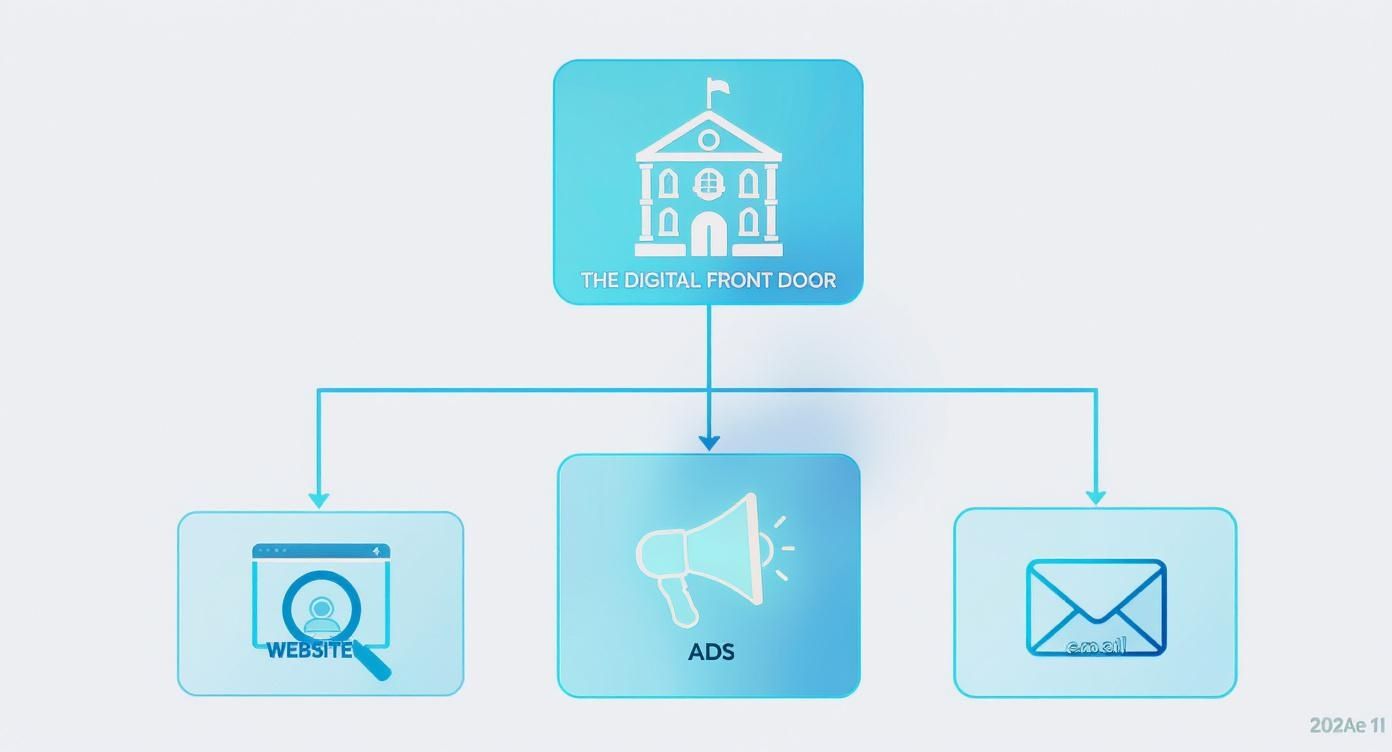
As you can see, your website, ads, and emails aren't isolated tactics. They are all interconnected pathways that lead interested families right to your school.
Pillar 1: Define Your Measurable Goals
First things first: you have to know what you’re trying to achieve. Vague ambitions like “get more inquiries” or “improve our social media” aren’t really goals; they’re wishes. A real goal is specific, measurable, and tied directly to your school's most important outcomes. It gives you a clear finish line.
For example, a weak goal is "increase enrollment." A strong, strategic goal is "increase qualified applications from our target feeder zip codes by 15% before the end of the second quarter." See the difference? This one gives you a specific target, a defined audience, a clear metric, and a deadline.
This kind of clarity is absolutely essential because it shapes every other decision you make. You can’t pick the right road if you don’t know where you’re going.
Pillar 2: Develop Detailed Parent Personas
You can't connect with an audience you don't truly understand. That’s why the second pillar is creating detailed parent personas—fictional profiles of your ideal families that are grounded in real research. These go way beyond simple demographics like age and income.
A good persona digs into a parent's motivations, their worries, and how they prefer to get information. Think about it: the needs of a parent looking for their first-ever kindergarten are completely different from a parent trying to find a new high school for their child mid-year.
- "First-Time Fiona" might be a kindergarten parent whose top priorities are a nurturing environment and a strong sense of community. She’s probably active in local parenting Facebook groups and puts a lot of stock in testimonials from current families.
- "Transfer Tom" could be a high school parent focused on academic rigor and college placement stats. He’s more likely to respond to data-driven content, like a blog post that breaks down your school’s impressive graduate outcomes.
When you develop these personas, you can craft messages that truly resonate, making sure your content speaks directly to the families you most want to attract.
Pillar 3: Build A Powerful Content Engine
Once you know your goals and your audience, it's time to build a content engine to bring them together. This is more than just writing a few blog posts or shooting a couple of videos. It's about systematically planning, producing, and distributing stories that show off what makes your school special.
Your content should be a direct answer to the concerns and hopes of your parent personas.
Think of your content as the answer to every question a prospective family might have. If "First-Time Fiona" is worried about a smooth transition to kindergarten, a video series featuring your welcoming kindergarten teachers is the perfect piece of content.
This strategic approach means every photo, article, and social media update serves a purpose. It stops being "content for the sake of content" and becomes a calculated effort to build trust and gently guide families on their decision-making journey.
Pillar 4: Choose Your Digital Channels Wisely
The fourth pillar is all about picking the right places to deliver your message. It’s a classic mistake to think your school needs to be on every single platform. A much smarter approach is to focus your time and money on the channels where your parent personas are actually spending their time.
If your research shows that your ideal families are glued to Instagram and rely on email newsletters for school news, then those are the channels you should own. Trying to maintain a presence everywhere at once will just stretch your team thin and water down your impact.
Your choice of channels should flow directly from your persona research. Go where your audience is, and you’ll make a stronger connection with a lot less wasted effort.
To help you get started, here’s a look at some of the most effective digital channels for K-12 schools and how to think about their role in your strategy.
| Key Digital Channels For K-12 Schools | ||
|---|---|---|
| Digital Channel | Primary Goal for Schools | Key Performance Indicator (KPI) |
| School Website/Blog | Act as the central information hub and convert interest into action (e.g., tour requests). | Website Conversion Rate, Form Submissions |
| Search Engine Optimization (SEO) | Attract families actively searching for schools in your area. | Organic Traffic, Keyword Rankings |
| Paid Search/Social Ads | Target specific parent personas with compelling messages to generate immediate interest. | Cost Per Inquiry, Click-Through Rate (CTR) |
| Social Media (Organic) | Build community, showcase school culture, and engage current and prospective families. | Engagement Rate, Follower Growth |
| Email Marketing | Nurture leads, communicate with enrolled families, and drive event attendance. | Open Rate, Click-Through Rate (CTR) |
| Online Directories | Increase visibility on platforms where parents compare schools (e.g., Niche, Private School Review). | Profile Views, Referral Traffic |
Choosing a few of these to master is far more effective than trying to do a little bit of everything. Start small, get great results, and then expand.
Pillar 5: Master Your Metrics And Analytics
Finally, the fifth pillar is measurement. A digital strategy isn't complete without a clear way to track your progress and figure out what’s working—and what’s not. This means looking past "vanity metrics" like social media likes and honing in on data that connects directly to your main goals.
For a school, some of the most important metrics include:
- Website Conversion Rate: What percentage of people visiting your site take a valuable action, like scheduling a tour or downloading an admissions guide?
- Cost Per Inquiry: How much are you spending on digital ads to get one qualified lead for your admissions team?
- Channel-Specific Application Sources: Where are your applications actually coming from? Is it organic search, social media, or your paid campaigns?
By consistently keeping an eye on these numbers using tools like Google Analytics, you can make smart, data-informed decisions, prove the value of your marketing budget, and continuously tweak your strategy for even better results. This constant feedback loop is what turns a good plan into a great one.
Integrating Modern Technology into Your Strategy
If your digital strategy is the blueprint, then modern technology is the set of power tools that brings it all to life. Moving past the essentials of a website and a few social media profiles, the right tech gives your school a serious advantage. It's really about working smarter to create connections that genuinely resonate with families.
This isn't just about grabbing the latest shiny object. It's about finding smart solutions to the real-world headaches your admissions and communications teams face every day. Think of it like swapping out a hand-crank drill for a cordless one—you can build the same thing, but one gets the job done faster, with more precision, and with a lot less effort.
Personalization at Scale with AI and Automation
One of the biggest game-changers in marketing today is personalization. Parents don’t just want generic newsletters; they expect communications that speak directly to their family’s interests and where they are in their school search. Trying to track every family's journey manually is an impossible task, which is exactly why Artificial Intelligence (AI) and marketing automation are such powerful allies.
Here’s how it works in practice: an interested parent visits your website and clicks on a blog post about your middle school robotics club. Good automation software can immediately tag their profile with that specific interest. Now, instead of getting a generic "welcome" email, they might automatically receive a follow-up featuring a video of the robotics team in action or a short bio of the science department head.
This approach creates a completely tailored journey, nurturing a family’s interest from their very first click all the way to enrollment. It makes them feel seen and understood, which goes a long way in building trust. While schools are adopting tech for learning and admin, it's just as vital for communication. Exploring effective email outreach tools, for instance, can make a huge difference in how your school engages with prospective families.
Technology should be a strategic advantage, not just a technical checkbox. It’s the engine that powers a more efficient, engaging, and personalized approach to school marketing, saving your team time while delivering better results.
This isn't just a niche trend. Globally, spending on this kind of digital transformation hit around $1.8 trillion in 2022 and is on track to reach about $2.8 trillion by 2025, with AI adoption being a major driver. This massive investment, especially in communications tech, highlights just how critical a forward-thinking digital strategy is for staying relevant.
Creating Immersive Experiences with Video
In an era where parents do most of their research online, nothing gives them a true sense of your campus like video. Static photos and text just can't compete with high-quality virtual tours, "day in the life" student vlogs, or casual Q&A sessions with beloved teachers.
Video breaks down geographic barriers, giving families a genuine feel for your school’s culture before they ever step on campus. It’s a chance for them to connect emotionally with your community—a huge factor in their final decision.
Here are a few ideas to get you started:
- Virtual Tours: Create 360-degree tours that let parents "walk" through your science labs, art studios, and libraries from their couch.
- Student Takeovers: Hand your Instagram Stories over to a student for the day. It’s an authentic, peer-to-peer glimpse into campus life.
- Faculty Spotlights: Film short, engaging clips where teachers share what they love about their subjects and your school.
Using these tools turns your website from a simple brochure into a compelling, interactive destination. It also connects to the bigger picture of technology integration in classrooms. When you showcase innovation in your marketing, you send a strong signal that you embrace it in your education, creating a consistent and powerful brand message.
How To Create an Actionable Digital Implementation Plan
So, you've got a brilliant strategy on paper. Now what? Turning that vision into reality is where the real work begins, and that's exactly what an implementation plan is for. Think of it as the bridge connecting your big ideas to tangible results.
This plan breaks down your ambitious goals into a series of clear, manageable steps. It ensures your team knows exactly what to do, when to do it, and why it matters. Without this roadmap, even the best strategy ends up as a document gathering dust on a shelf. A great plan assigns ownership, sets realistic timelines, and defines what success looks like every step of the way.
Secure Buy-In from Leadership
Before a single dollar is spent or a single ad is launched, you need the people at the top on your side. Getting buy-in from your school’s leadership team isn’t just about getting a budget approved; it’s about making sure your marketing efforts are perfectly aligned with the school's most important goals.
You have to speak their language. Instead of getting bogged down in marketing jargon like click-through rates, talk about the Cost Per Inquiry. Rather than just discussing engagement metrics, show them how building a stronger online community directly leads to improved parent retention.
Your implementation plan is your business case. Clearly articulate the expected return on investment (ROI), not just in terms of marketing metrics, but in the ultimate currency for any school: new student enrollments.
When leaders see that clear, direct line between your digital plan and mission-critical goals like enrollment and financial health, they won't just approve your plan—they'll become its biggest champions.
Start Small with a Pilot Project
The thought of rolling out a massive, multi-channel strategy all at once can be completely overwhelming, especially if you have a small team (or you are the team). The smartest way to get started is with a focused pilot project. This lets you test your ideas on a smaller scale, see what works, and score a quick win to build momentum.
A great pilot project has a few things in common:
- It’s Highly Focused: Target a single, specific audience. For example, you could aim to boost applications for your middle school STEM program from families in a particular zip code.
- It’s Measurable: Set a crystal-clear, achievable goal. Something like, "generate 20 qualified leads in the next six weeks."
- It’s Visible: Pick a project where success will be easily seen and understood by your leadership team and the rest of the school community.
Nailing a pilot project proves your strategy has legs. It also gives you invaluable real-world data that you can use to refine your approach as you scale up.
Build Your Team and Define Roles
Whether your marketing "team" is a full department or a dedicated team of one, defining who does what is absolutely critical. Everyone involved needs to understand their exact role in bringing the plan to life. This simple clarity prevents important tasks from falling through the cracks and keeps everyone accountable.
If you're a solo school marketer, this step is all about being honest about your own bandwidth. Prioritize your tasks based on their potential impact. You should also think about who else in your school could pitch in—maybe there's a teacher who’s a fantastic photographer or an admissions counselor who can help write blog posts.
Ultimately, a successful digital strategy launch comes down to this structured, step-by-step approach. By securing support from the top, starting with a manageable project, and clarifying everyone's role, you build a rock-solid foundation for turning your strategic goals into real achievements that will move your school forward.
Questions We Hear All the Time About School Digital Strategy
When you get down to the brass tacks of building a digital strategy for your school, a lot of practical questions come up. Let's tackle some of the most common ones we hear from school leaders and marketing teams on the ground.
How Often Should We Update Our School's Digital Strategy?
Think of your digital strategy as a living, breathing guide, not a stone tablet. It needs to adapt.
We recommend a major deep-dive review once a year. This is your big-picture planning session, a chance to sync your digital efforts with the upcoming enrollment cycle and your school's overall goals.
But the real magic happens with more frequent check-ins. A quarterly review of your key metrics is essential. This lets you stay nimble, shifting ad spend from one channel to another or tweaking your social media content based on what’s actually working. Constant, smaller adjustments keep you from drifting off course.
What's the Most Important Part of a Digital Strategy for a Small School?
If you're a small school with a tight budget, one thing matters more than anything else: deeply understanding your parent personas. Seriously.
When you know exactly who you're trying to reach—what they care about, what keeps them up at night, and where they hang out online—you can stop wasting money. Forget the scattergun approach of trying to be everywhere at once.
Instead, you can focus your limited time and budget on the one or two platforms where your ideal families are already gathered.
A crystal-clear picture of your audience lets you create messages that truly resonate. You'll get a much better return on your investment by connecting deeply with a specific group than by shouting into the void with generic campaigns.
How Do We Measure the ROI of Our Digital Strategy?
Measuring the return on investment (ROI) for your digital marketing is all about drawing a straight line from your online activities to what matters most: enrollment. You need to track the numbers that tell a clear financial story and prove your work is paying off.
Start by focusing on these key metrics:
- Cost Per Inquiry (CPI): How much are you spending in digital ads to get one qualified family to contact your admissions office?
- Website Conversion Rates: Of all the people visiting your site, what percentage are taking the next step, like signing up for a tour or downloading an info packet?
- Attributed Enrollments: Can you pinpoint which digital channels—Facebook, Google Ads, your blog—are bringing in the most applications and, ultimately, new students?
This is where your school’s CRM or admissions software becomes your best friend. Using it to connect a new family back to the specific campaign that first caught their attention is how you calculate the direct financial impact of your marketing. It’s how you walk into a meeting and show leadership, with confidence, that your strategy is working.
Ready to build a digital strategy that truly drives enrollment? The MarCom Society provides the expert guidance, peer support, and practical resources you need to succeed. Join our community of K-12 marketing professionals and gain access to live workshops, exclusive content, and a network that understands your unique challenges. Learn more and become a member at https://marcomsociety.org.









