
So, what exactly is integrated marketing communications (IMC)?
Think of it as a promise to your community that every time they interact with your school, they get the same clear, consistent story. It’s the strategic glue that binds all your outreach efforts together—from a Facebook post to a campus tour flyer—ensuring they all sing from the same hymn sheet. This harmony creates a seamless experience for prospective families, cutting through the noise and building genuine trust.
Weaving a Cohesive Story for Your School

Let's imagine your school's marketing is an orchestra. Your website is the string section, laying down the foundational melody of your mission and values. Your social media channels are the woodwinds, adding lively, day-to-day flourishes. Meanwhile, your open houses are the powerful brass section, creating an unforgettable, in-person impression.
Now, picture that orchestra without a conductor. Each section plays its own tune, creating a chaotic, confusing mess. That's what happens when marketing efforts are disconnected. The social media team pushes one message while the admissions office sends emails with a completely different tone. This disjointed approach doesn't just confuse families—it actively weakens your school's brand.
Integrated marketing communications is your conductor. It's the strategic plan that ensures every "instrument" in your marketing mix plays in perfect harmony. IMC aligns every message, visual, and call to action across every channel to create one powerful symphony that truly connects with your audience.
The Real Goal of an Integrated Approach
At its core, the objective is simple: make sure a prospective parent hears the same core message no matter where they find you.
This means a parent should get the same feeling and understanding of your school whether they are:
- Scrolling through your school's Instagram feed.
- Opening an email about an upcoming admissions event.
- Exploring the curriculum on your website.
- Seeing a digital ad on a local parenting blog.
This consistency is everything. When every touchpoint reinforces your school's unique value, you build a brand that families recognize, trust, and ultimately choose for their children.
An integrated strategy isn't just about using a bunch of different channels; it's about orchestrating them. The focus shifts from hitting channel-specific KPIs to achieving a single, unified goal, ensuring the whole is far greater than the sum of its parts.
The K-12 Marketing Orchestra: How IMC Creates Harmony
To really grasp how IMC works in practice, it helps to see how the different "instruments" in your marketing toolkit play their part in the larger composition. Each channel has a unique strength, but they all work together to amplify your school's core message.
The table below brings our orchestra analogy to life, showing how distinct marketing channels can collaborate within an IMC framework to create a unified and compelling experience for a K-12 school community.
| Marketing Channel (Instrument) | Role in the IMC Orchestra | Example in a K-12 Setting |
|---|---|---|
| School Website | The String Section (Foundation) | Provides the core, in-depth information about programs, mission, and values that all other channels reference. |
| Social Media | The Woodwinds (Engagement) | Adds personality and daily life glimpses, sharing student success stories that echo the school's mission. |
| Email Marketing | The Percussion (Rhythm & Pacing) | Drives timely action with personalized reminders for application deadlines and tour dates, keeping families on track. |
| Open Houses & Events | The Brass Section (Impact) | Creates a powerful, tangible experience of the school's culture, bringing the digital message to life. |
When each channel understands its role and plays in concert with the others, the result is a clear, resonant message that captures the hearts and minds of prospective families. That's the power of a truly integrated approach.
Why Disconnected Marketing Just Doesn't Cut It Anymore
Not too long ago, marketing a school was a fairly straightforward affair. A well-designed newsletter, a couple of ads in the local paper, and a pristine campus could get the job done. But let's be honest—that world is long gone. Today, prospective families are scattered across a dizzying number of platforms, from niche parenting forums to a half-dozen social media apps.
This explosion of channels has shattered audience attention. When your school’s Instagram posts have one vibe, your website strikes another, and your admissions emails sound like they came from a different planet, you're doing more than just being inefficient. You’re creating confusion. This kind of disconnected approach sends mixed messages, chipping away at the trust you've worked so hard to build and making it nearly impossible to stand out.
The Shift from Buzzword to Baseline
The idea of getting all your marketing efforts to sing from the same hymn sheet isn't new. Integrated marketing communications (IMC) actually emerged as a formal discipline back in the early 1990s. It was a direct response to new technology and the splintering of media channels. What began as a smart academic idea is now a non-negotiable for success.
This strategy forces teams to stop thinking in silos and start working toward a single, unified goal. For instance, the beautiful content you create for your annual viewbook shouldn't just sit there. It can be sliced and diced into social media highlights, expanded into detailed blog posts, and featured in parent email newsletters. This ensures your core message is heard loud and clear, everywhere. This is the bedrock of effective digital marketing for schools.
This infographic breaks down the core benefits your school can expect when you adopt an integrated approach.
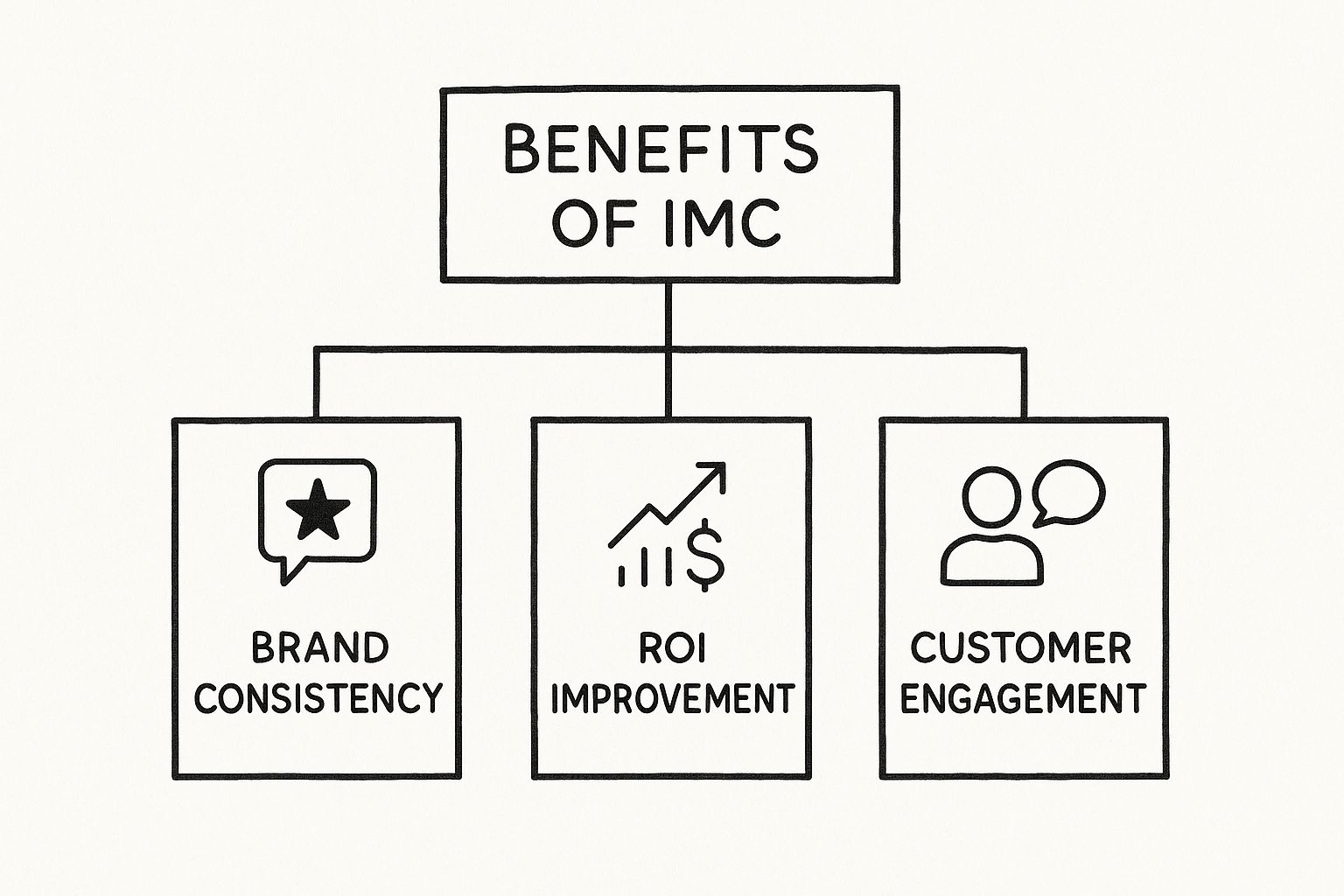
As you can see, consistency has a direct line to how families perceive your brand. That perception, in turn, is what drives engagement and makes every dollar you spend work harder.
Today, families expect a seamless experience. They don't see your marketing channels as separate buckets; to them, it's all just one school. A single disjointed message anywhere along their journey can be the one thing that sends them looking elsewhere.
When your marketing teams are siloed, you're not just wasting resources—you're creating a jarring experience for your audience. Imagine your admissions team investing heavily in a "warm, community-focused" campaign while the academics department runs ads highlighting cut-throat academic rigor. These messages don't just conflict; they cancel each other out, leaving parents wondering what your school actually stands for.
A unified strategy, on the other hand, makes sure every dollar and every hour is spent building a single, powerful, and trustworthy brand identity.
The Core Pillars of a Unified School Brand
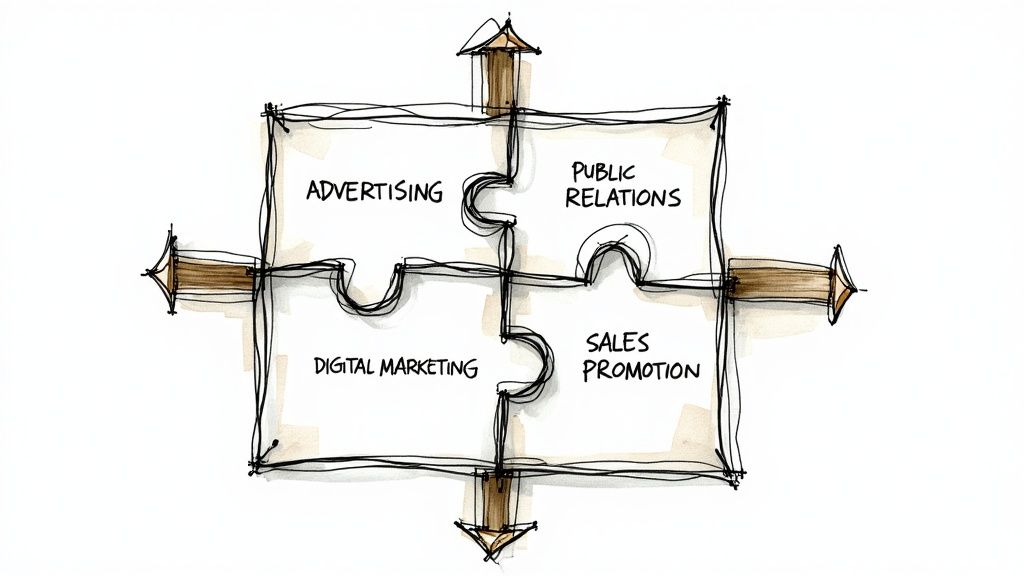
To really make integrated marketing work, you need more than a vague commitment to "being consistent." A truly unified school brand is built on four distinct pillars. Each one supports the others, creating a solid foundation that turns a random assortment of marketing tasks into a powerful, enrollment-driving engine.
Think of it like building a house. You can't just throw up some walls and hope for the best. You need a solid foundation, sturdy framework, a protective roof, and functional plumbing. Leave one out, and the whole structure is compromised.
Let's break down what these pillars look like in the real world of K-12 marketing.
Pillar 1: Knowing Your Audience (For Real)
The first pillar is about moving beyond generic labels. Saying your target is "parents aged 30-45" is a start, but it's not nearly enough. True audience understanding means digging into their motivations, their worries, and what they truly want for their children’s future.
What keeps them up at night? Are they desperately searching for a school with an unbeatable STEM program, a community that feels like family, or a place where their child's artistic talents can truly flourish?
When you understand these deeper needs, every piece of communication—from a social media post to a brochure—can be crafted to connect on an emotional level. You make families feel seen and heard.
Pillar 2: Nailing Your Core Message
Once you know who you’re talking to, you have to decide what you’re going to say—and then stick to it. This is your brand's heartbeat.
Your school’s mission, its core values, and its unique story must be the same everywhere. It needs to show up in a Facebook ad, on your website's homepage, and in the principal’s welcome speech at an open house. A compelling brand message strategy is the blueprint that ensures this consistency.
This doesn't mean every single post sounds identical. It means every piece of content, no matter the format, reinforces the same central promise about who you are as a school.
Key Takeaway: Consistency is the bedrock of trust. When a family hears the same core message again and again across different channels, it stops feeling like a marketing claim and starts feeling like an undeniable truth about your school.
Pillar 3: Achieving Channel Synergy
This is where the "integration" part really comes to life. It’s about making sure your website, social media accounts, email newsletters, and campus tours aren't operating in their own little bubbles. They need to be part of a single, coordinated conversation.
The story that starts with an engaging video on Instagram should seamlessly continue on your website’s admissions page and be brought to life during an in-person visit.
Channel synergy prevents that jarring experience we've all had: seeing a vibrant, modern social media feed only to click through to an outdated website that’s a nightmare to navigate. Each channel should lift the others up, working together to guide a prospective family smoothly from curiosity to enrollment.
To see how this works in practice, let’s compare the old, disconnected way of doing things with a modern, integrated strategy.
Siloed Efforts vs Integrated Strategy in School Marketing
This table shows the practical difference between a disjointed approach and the power of IMC.
| Marketing Activity | Siloed Approach (The Old Way) | Integrated Approach (The IMC Way) |
|---|---|---|
| Open House Promotion | A few social media posts and a single email blast are sent out the week before. | A multi-week campaign starts with "save the date" emails, followed by student testimonial videos on social media, all driving to a dedicated RSVP landing page. |
| Website Content | The "About Us" page lists the school's mission statement, but program pages are just dry descriptions of courses. | Every page, from athletics to arts, reinforces the core message of "innovation" or "community," using consistent language and visuals. |
| Social Media | The Instagram account is managed by one person, the Facebook by another. Posts are ad-hoc and have different tones. | A unified content calendar ensures themes are consistent across all platforms. A video about a science fair on Instagram links to a blog post with more details. |
| Parent Communication | The weekly newsletter from the main office has a different look and feel than emails from the admissions team. | All official school emails use the same branding, template, and tone of voice, creating a professional and cohesive experience. |
As you can see, the integrated approach creates a much more powerful and persuasive experience for prospective families. It’s a story told in unison, not a collection of competing voices.
Pillar 4: Making Data-Driven Decisions
Finally, a successful IMC strategy isn't built on gut feelings or guesswork—it's fueled by data.
This means using analytics to understand what’s actually working. You need to know which messages are resonating, which channels are driving applications, and where you can improve.
Are parents clicking on videos about student life but ignoring posts about your annual fundraiser? That's a huge clue! Use that insight to shape your content calendar for the next month. This data-informed approach ensures your time, budget, and energy are invested where they will have the greatest impact on your enrollment goals.
Real-World Benefits of an Integrated Approach

When you get right down to it, an integrated marketing communications strategy isn't just a textbook theory. It delivers real, measurable results that will get your school leadership’s attention. When every channel tells the same story, prospective families don't just hear your message—they start to believe in it.
This consistency is what turns a family’s mild curiosity into a serious application. It builds a foundation of trust. Suddenly, your admissions cycles become more predictable and successful. You're no longer scrambling to patch together disjointed campaigns. Instead, you're creating a smooth, reassuring journey for parents, guiding them from a social media ad all the way to their final decision. The outcome? A much stronger, more reliable pipeline of inquiries.
Boosting Engagement and Building Trust
Think about it from a parent's perspective. When they encounter your school online, a consistent message across every platform builds immediate confidence. A unified voice makes your school feel professional, organized, and dependable—all the qualities a parent is looking for.
This isn’t just a hunch; the numbers back it up. Research shows that organizations with comprehensive IMC strategies saw an average 20-30% increase in engagement metrics like clicks and conversions. And when you get into personalization—a core part of IMC—those response rates can be up to 10 times higher than generic campaigns.
By eliminating conflicting messages, you create a seamless experience that deepens trust at every touchpoint. This trust is what ultimately convinces a family that your school is the right choice for their child.
A cohesive brand story also does wonders for retention. It doesn't just attract new families; it reassures current ones that they made the right choice. Consistent communication about your school’s values, wins, and community events keeps parents engaged and proud, which is a game-changer for keeping them year after year.
Driving Efficiency and Maximizing ROI
Every K-12 marketing team knows that budgets are tight. An integrated approach is naturally more efficient because it forces you to be strategic about where every dollar goes. When all your efforts are aligned, you stop doing redundant work and wasting money on campaigns that accidentally undermine each other.
This strategic alignment is a direct path to a stronger return on investment (ROI). Imagine having one powerful, unified effort where each channel boosts the others, instead of five separate campaigns that are just okay.
- Eliminate Wasted Spend: You can finally stop running contradictory ads or creating one-off brochures that don't fit the big picture.
- Repurpose with Purpose: A single great asset, like a well-made video, can be cleverly adapted for social media clips, email newsletters, and your website. That saves a huge amount of time and money.
- Focus on What Works: With unified analytics, you can actually see which channels and messages are driving enrollment. This allows you to put more resources into your most effective tactics.
Ultimately, understanding what integrated marketing communications is all about is the first step toward building a more powerful and efficient outreach program. It gives you a clear business case to present to school leadership, showing them exactly how a smart, unified strategy supports long-term enrollment and financial stability. To dig deeper, explore our guide on effective education marketing strategies.
How to Build Your School's IMC Plan
Alright, let's move from theory to action. For a busy K-12 marketing team, the thought of building a new plan can feel overwhelming, but an integrated marketing communications plan doesn’t need to be a hundred-page binder that collects dust.
Think of it as a simple, practical roadmap. It’s a tool that gets everyone on your team—from admissions to the front office—rowing in the same direction. By breaking the process into manageable steps, you can create a powerful strategy that makes the most of your budget and, most importantly, drives enrollment.
Let's walk through how to build your school's first IMC plan.
1. Conduct a Communications Audit
Before you can chart a course forward, you need a clear-eyed view of where you are right now. A communications audit is just that: a complete inventory of every single way your school currently communicates with the outside world. The goal here is to spot what’s working, what’s falling flat, and where your messages are clashing.
Start gathering everything you can find. I mean everything.
- Website pages and recent blog articles
- Social media profiles (and a good scroll through the last few months of posts)
- Email newsletters and automated admissions sequences
- Printed pieces like brochures, viewbooks, and flyers
- Any materials used to promote open houses or other events
Once you have it all laid out, start asking the tough questions. Does the warm, friendly tone on your Instagram match the formal language on your website? Do your brochures talk about the same core values you mention in parent emails? This audit is guaranteed to uncover the gaps and inconsistencies you need to address.
2. Define Your Unifying Core Message
Your audit probably showed you that different messages are being sent from different channels. Now’s the time to fix that by defining one, single, unifying core message. This is the big idea about your school—the one thing you want every prospective family to understand, no matter where they first encounter you.
This message needs to be simple, memorable, and above all, authentic. It’s not just a clever tagline; it's the fundamental promise of what it feels like to be part of your school community. Once this is dialed in, it becomes the filter for every piece of content you create from this day forward.
Key Insight: Your core message is your North Star. Every ad, social media post, and email campaign should point back to this central truth. This consistency is what builds a strong, trustworthy brand identity in the minds of prospective parents.
3. Map the Prospective Parent Journey
Now, it’s time to step into a prospective parent’s shoes. Try to map out every possible touchpoint they might have with your school, starting from their very first Google search all the way to the day they hit "submit" on an application.
This journey map is incredibly valuable because it shows you all the critical moments where you can deliver your core message. For instance, a parent might first hear about you on a local parenting blog, then visit your website, follow you on Facebook, attend a virtual open house, and finally get a series of follow-up emails. Each one of those steps is a chance to reinforce your story.
4. Choose and Integrate Your Channels
Let's be realistic: you can't be everywhere at once. It's far more effective to choose the channels that matter most to your specific audience. Use your parent journey map to help you prioritize. If you discover that prospective families are all hanging out in certain community Facebook groups, then that’s where you need to focus your energy.
Integration is the magic ingredient. For a deeper look at building this out, our guide on creating a communication plan for schools offers a fantastic framework. The idea is to make each channel support the others. Your social media posts should drive people to your website, and your website should be designed to capture email addresses for your nurture campaigns. They all work together.
5. Create a Unified Content Calendar
This is the tool that brings your entire strategy to life. A unified content calendar is a shared schedule that maps out what content is getting published, on which channel, and on what day. It’s the key to making sure your campaigns are coordinated and your core message is being delivered consistently across every platform you use.
6. Set Up Metrics to Measure What Matters
Finally, you have to know if any of this is actually working. Define how you will measure success, and make sure those metrics are tied directly to your school's real-world enrollment goals.
Move beyond vanity metrics like social media likes. Instead, focus on the Key Performance Indicators (KPIs) that truly impact your bottom line: things like website inquiries, tour sign-ups, and, of course, submitted applications. This data will not only prove the value of your integrated approach but also give you the insights you need to make your strategy even better over time.
Putting Your Integrated Marketing Plan into Action
It's one thing to talk about theory, but seeing a strategy come to life in a real school is what truly makes it click. Let's walk through two different scenarios to help you picture what a solid integrated marketing communications plan actually looks like for a K-12 school.
These examples show how schools with very different goals and resources used IMC to get some pretty powerful results. Think of them as a blueprint you can borrow from and adapt for your own community.
Case Study 1: The Community Charter School
First up, we have a smaller charter school with a simple, yet critical, goal: get more students from the surrounding neighborhoods to enroll. Their marketing was all over the place, and their core message just wasn't landing with the families living right down the street.
They decided to pull everything together under one unifying theme: "Hands-On Neighborhood Learning." This simple phrase became the anchor for their entire IMC plan.
Here’s how they did it:
- Website Revamp: The school's homepage got a makeover. It now prominently featured stories and photos of students actively involved in local community projects, bringing that "neighborhood learning" idea to life.
- Community Events: They ditched the standard open house and instead hosted a "Community Science Fair" in a nearby park, making it a fun, low-pressure event for local families. Every flyer, social media post, and sign used the same theme and visual style.
- Local Press: They got in touch with the local newspaper and pitched a story about their students' project cleaning up a local stream. This reinforced their identity as a school that truly invests in its own backyard.
By making sure every channel—from their website to their physical events—told the same consistent story, The Community Charter School finally broke through the noise. The result? A significant increase in local inquiries because families finally got what made the school special.
Case Study 2: Northwood Preparatory Academy
Now for a different challenge. Northwood Preparatory Academy is a private school looking to attract high-achieving students from all over the region. Their problem wasn't just reaching the neighborhood; it was standing out in a much wider, more competitive market.
They built a more sophisticated digital IMC strategy centered on showcasing academic excellence and an innovative culture.
The key for Northwood was creating a seamless digital journey. They mapped out every single online touchpoint a prospective family might have and made sure the message was perfectly aligned at each step.
Their multi-channel approach looked like this:
- Targeted Social Media Ads: They ran slick video ad campaigns on platforms where they knew affluent parents were spending time, highlighting things like their advanced STEM labs and impressive alumni success stories.
- Virtual Open Houses: These online events were promoted heavily across email and social media. It gave families from other towns and even other states a chance to "visit" the campus without the travel.
- Personalized Email Nurturing: As soon as a family downloaded a brochure or attended a virtual event, they were added to an automated email series. These emails weren't generic; they shared specific info tailored to the student's interests, like the robotics club or the fine arts program.
Northwood’s integrated plan was a well-oiled machine. The social ads fed into the virtual events, which in turn captured leads for the targeted email campaigns. This created a powerful funnel that successfully broadened their applicant pool far beyond their local area.
Common Questions About School Marketing Integration
Let's be honest: taking on a new strategy can feel daunting. When I talk to K-12 marketers about integrated marketing communications, a few key questions always pop up, especially for those working on smaller teams. So, let's get into the nitty-gritty and tackle the hurdles you're probably thinking about.
“How Can We Afford This on Our Budget?”
This is probably the #1 question I hear. How can a small school with a tight budget possibly pull this off? Here’s the good news: IMC is about being smarter with the money you already have, not necessarily spending more.
Think of it this way. Instead of your budget being scattered across a dozen different ideas, you’re focusing all that energy and all those dollars on a single, powerful message. You get more bang for your buck.
My advice? Start small. You don’t need to flip a switch and change everything overnight. Just pick two channels—say, your website and your social media—and make sure they’re singing the same tune for your next open house. It's an easy win that builds immediate consistency without a huge investment.
“How Do I Get My Head of School on Board?”
Ah, the internal hurdles. Getting buy-in from leadership can feel like a bigger challenge than the marketing work itself. How do you convince them that this is a worthwhile investment of time and energy?
The key is to talk their language: results.
Frame it as a direct path to a stronger brand and, ultimately, more stable enrollment. Use the data you gathered in your communications audit to show them, "Look, here's where our message is getting jumbled, and here's how that's weakening our impact." When they see the gaps, the need for a unified approach becomes obvious.
The most important first step is to define your single, unifying core message. This simple, powerful statement becomes the North Star for every decision, ensuring that even small, incremental changes are moving your brand in the right, consistent direction.
By starting with a clear message and a small, manageable pilot project, you can actually show leadership the power of IMC in action. Those early results create the momentum you need to get everyone on board and prove that a unified brand isn't just a lofty goal—it's an essential and achievable one for any school, regardless of its size.
Ready to stop juggling disconnected campaigns and start building a powerful, unified brand for your school? Join The MarCom Society, the exclusive professional community where K-12 marketers collaborate, learn, and grow together. Get access to expert workshops, practical resources, and a supportive network to master your school's communication strategy.









