Let's get one thing straight: marketing communications isn't just about sending out flyers or posting on social media. It's the art and science of telling your school's unique story, consistently, across every single touchpoint.
Think of it as the complete collection of messages and media you use to connect with your community. From a quick email reminder about a parent-teacher conference to the design of your open house invitations, it’s all part of your MarCom strategy. The goal is to make sure every single message, big or small, weaves together to build a strong, trustworthy story about who you are.
What Are Marketing Communications in a School Setting?
Imagine your school is putting on a play. You have the actors (your teachers and students), the set design (your campus), the script (your curriculum), and the playbill (your brochures). Each part is essential on its own.
But without a director, the whole production would be a mess. The actors might say the wrong lines, the lighting could be off, and the audience would leave confused.
Marketing communications is your director. It's the strategic process of making sure all these different elements work together to tell the same powerful story. It ensures that when a family interacts with your school—whether online or in person—they get a clear, consistent, and compelling picture of your mission, values, and what makes you special.
The Strategic Role of MarCom
The real purpose of MarCom is to build genuine relationships, not just broadcast information. It's about shaping perceptions and building trust over time. To really get it, you need to understand the fundamental difference between marketing and advertising. Advertising is just one piece of the puzzle—one actor in the play. MarCom is the entire strategic production.
This coordination is what stops mixed signals. It prevents you from having a website that talks about your innovative, forward-thinking approach while your viewbook is filled with grainy, ten-year-old photos. When you get MarCom right, every single interaction reinforces the same core narrative.
Key Takeaway: Effective MarCom turns scattered tactics into a unified powerhouse. It’s the difference between shouting random facts into the wind and telling a consistent story that builds deep-seated trust and encourages action—whether that’s boosting enrollment or strengthening community spirit.
A solid MarCom plan for any K-12 school is built to inform, attract, and engage your families. Each function serves a specific purpose, guiding families from their first flicker of interest to becoming lifelong advocates for your school.
The table below breaks down these core functions.
Core Functions of School Marketing Communications
| Function | Primary Goal | Example Tactic |
|---|---|---|
| Informing | Educate prospective and current families on the school's mission, programs, and unique value. | A detailed, easy-to-navigate "Academics" section on the school website. |
| Attracting | Spark interest and drive inquiries from new families who are a great fit for the school's culture. | Targeted Facebook ad campaigns promoting an upcoming virtual open house. |
| Engaging | Build a strong, loyal community by fostering two-way conversation and showcasing day-to-day school life. | A weekly e-newsletter featuring student achievements and upcoming events. |
| Reinforcing | Reassure families they made the right choice and turn them into passionate advocates for the school. | Sharing positive parent testimonials on social media and the school blog. |
Ultimately, each of these functions works together, creating a continuous cycle that not only brings new families in but also keeps your current community connected and proud to be a part of your school.
Understanding Your School's MarCom Mix
To tell your school's story effectively, you need more than just one tool. Think of your marketing communications strategy like a well-stocked toolbox. You have a hammer, a screwdriver, and a wrench—each has a specific job, but they work best together to build something great. This collection of marketing tools is your MarCom Mix.
It's the specific blend of channels and tactics you use to share your school's message. A successful school doesn't just hang its hat on a flashy website or a single open house. It builds a powerful, consistent voice by orchestrating several key pillars, ensuring every interaction a family has—no matter where it happens—reinforces the same core story.
This infographic breaks down the main goals of your marketing communications, showing how they all work together to inform, attract, and engage your school community.
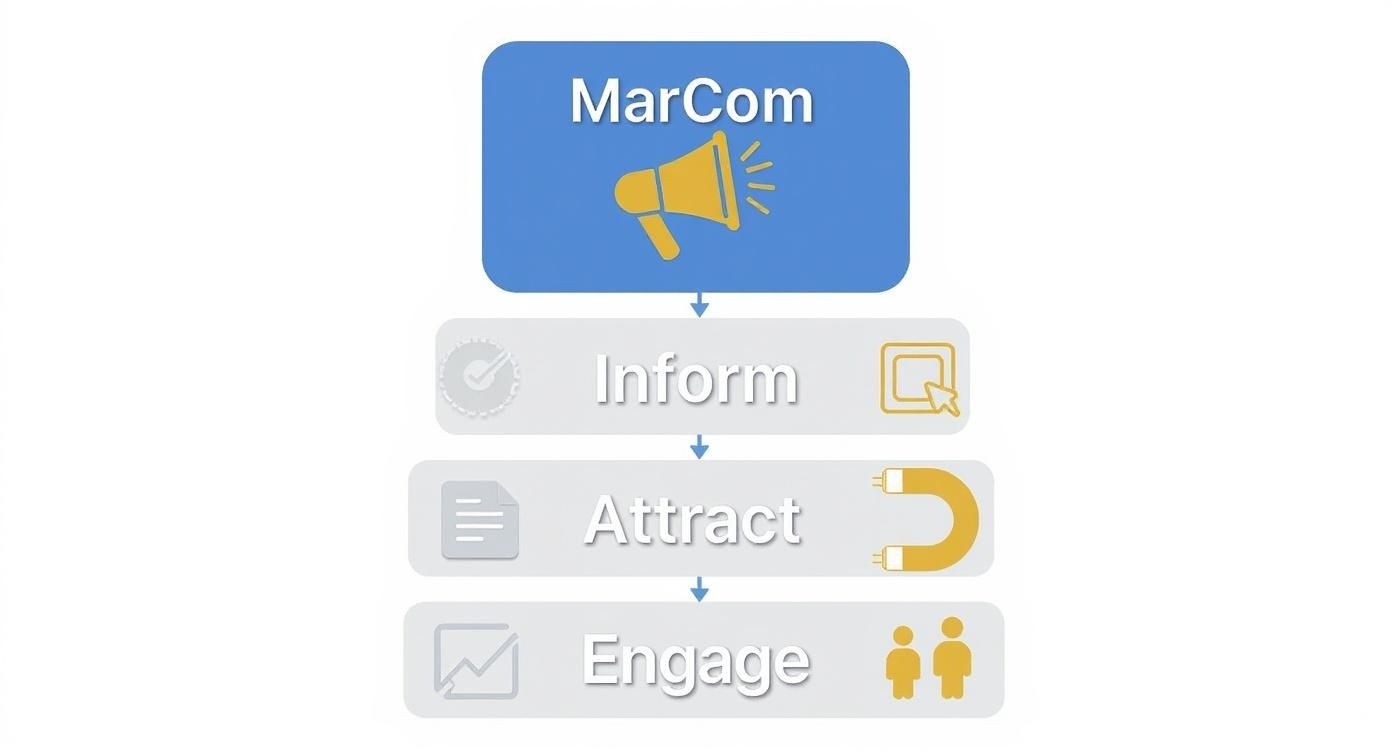
As you can see, every effort serves a distinct but connected purpose, guiding a family’s journey from simply hearing your school's name to becoming a passionate advocate for your community.
The Five Pillars of a Modern School MarCom Mix
Your school's MarCom Mix is built on five core pillars. While each can stand on its own, their true power is unlocked when they work in harmony.
- Advertising: These are the paid efforts to promote your school. It’s about placing your message directly in front of a targeted audience.
- Public Relations (PR): This focuses on earning positive media coverage and managing your school's public reputation. Think of it as building credibility through third-party validation.
- Digital Presence: This is your school’s online home base. It’s everything from your website and blog to your social media profiles.
- Direct Marketing: This involves communicating directly with specific individuals or families, often in a personalized, one-to-one fashion.
- Internal Communications: This is the crucial, and often overlooked, pillar of keeping your current community—staff, students, and parents—informed, engaged, and unified.
Let’s dig into how each of these pillars actually comes to life in a school setting.
Putting the Pillars into Practice
Advertising for a school could mean running targeted Facebook ads for an upcoming admissions event or placing an ad in a local parenting magazine. The key is being strategic and putting your budget where prospective families are most likely to see your message.
Public Relations is about earning your attention, not buying it. This is where you share newsworthy stories, like a student winning a state science fair or a successful community service project. Sending a press release to local news outlets can generate positive, credible exposure that no ad campaign can replicate.
Your Digital Presence is often the very first impression a family gets of your school. It’s your 24/7 digital open house. This includes an easy-to-navigate, mobile-friendly website and active social media channels that showcase the vibrancy of daily student life.
A school's digital presence isn't just a brochure; it's a dynamic window into its culture. A well-managed website and active social media channels provide authentic, daily glimpses that build trust and connection long before a family ever steps on campus.
Direct Marketing is all about creating a personal connection. A perfect example is an email newsletter sent to families who have inquired about your school, giving them valuable info on application deadlines and upcoming tours. It's a direct line to a highly interested audience.
Finally, Internal Communications is the glue that holds your community together. This includes regular updates to staff through an internal portal, a weekly newsletter for current parents, and clear communication channels for student announcements. When your internal community is strong, it radiates outward.
When all these elements are coordinated, you create a seamless and powerful brand experience. To dive deeper into making this happen, you can explore our guide on what is integrated marketing communications to see how all these pieces fit together. This kind of coordination is non-negotiable today, as the number of communication channels has exploded.
The world of marketing communications has shifted dramatically, moving from traditional print and broadcast to a digital-first world. Despite this, a surprising 47% of businesses still operate without a defined digital marketing strategy. Even more telling, 44% of businesses lack a clear way to measure their marketing impact, which highlights a critical need for better analytics in modern communications.
Choosing the Right Channels to Reach Your Community
Knowing what to say is only half the battle. The other, equally crucial half is knowing where to say it. Picking the right channels is what ensures your school's story actually lands with the families you want to reach, instead of just echoing into the void.
Think of it like this: you wouldn't send an urgent snow day alert via snail mail, and you probably wouldn't send a formal acceptance letter in a quick text. The channel has to fit the message and the audience. For schools, this means getting a real sense of where your current and prospective parents spend their time and how they actually prefer to get information.
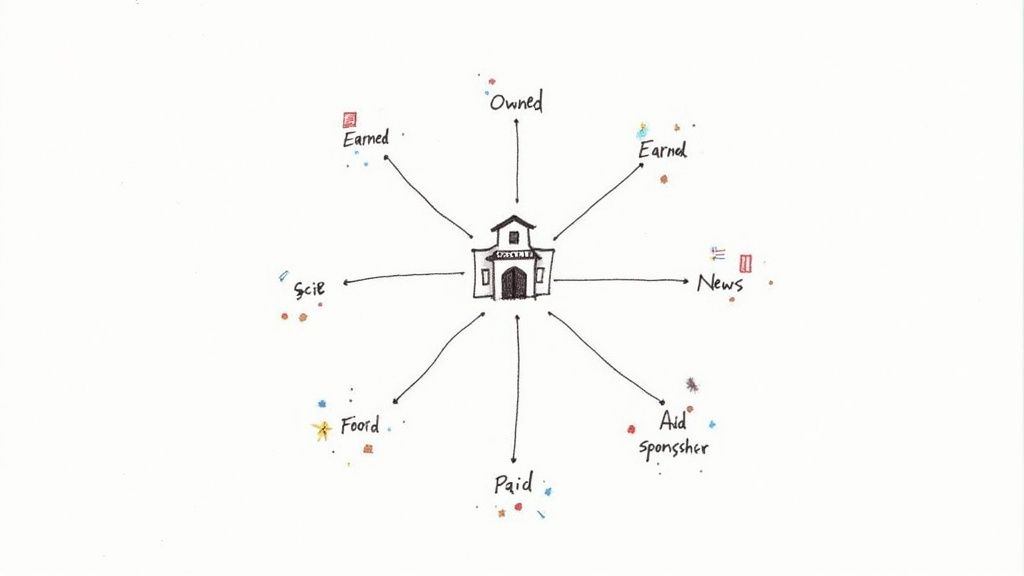
A simple way to map this all out is to think about who's in the driver's seat for each channel. This is often called the owned, earned, and paid media model, and it’s a fantastic framework for building a balanced and effective strategy. It helps clarify where your time and budget will make the biggest impact.
Owned Media: Your Digital Home Base
Owned media is everything your school directly controls. These are your foundational assets, the digital properties where you are the publisher, and you call all the shots.
Your most important piece of owned media is, without a doubt, your school’s website. It’s your digital front door, your 24/7 open house. But it doesn't stop there. Other key owned channels include:
- Your School Blog: The perfect spot for telling longer stories about student achievements, deep dives into your curriculum, or sharing insights from your amazing faculty.
- E-Newsletters: A direct line to the inboxes of your most engaged families, from prospective parents on your inquiry list to your current community.
- Social Media Profiles: Your official accounts on platforms like Facebook, Instagram, or even LinkedIn where you build community and share a slice of daily campus life.
The biggest advantage here is total control. You set the tone, you craft the message, and you decide when it goes live. This is where you build your brand from the ground up and establish yourself as the go-to source of truth for your community.
It’s also crucial to remember that parents are on their phones—a lot. Mobile devices account for 50.5% of global website traffic, edging out desktops at 46.5%. This trend makes a mobile-first approach non-negotiable. Your website and other digital properties must be seamless and intuitive on a smartphone. For more on how these trends are shaping strategy, you can find a wealth of up-to-date marketing statistics.
Earned Media: The Power of Word-of-Mouth
Earned media is the buzz you get from other people. It’s the digital version of word-of-mouth, and it’s gold because it comes with built-in credibility. You don't pay for it; you earn it through your school’s reputation and actions.
Earned media is what people say about you when you're not in the room. It’s the most authentic form of marketing and builds a level of trust that paid advertising simply can't buy.
What does this look like for a school?
- Parent Testimonials: A glowing five-star review on Google or a parent raving about a teacher in a local community Facebook group.
- News Coverage: The local TV station running a story on your school's innovative new STEM lab.
- Social Media Mentions: A parent posting photos from the spring concert and tagging your school’s account, sharing their pride with their entire network.
You don’t directly control earned media, but you can absolutely influence it. You do this by creating amazing experiences worth talking about, sharing compelling story ideas with local journalists, and making it incredibly easy for your happy families to sing your praises online.
Paid Media: Amplifying Your Message
Paid media is exactly what it sounds like: you pay to put your message in front of a targeted audience. This is how you amplify the great stories you’re already telling on your owned channels and connect with new families who might not have heard of you yet.
For schools, paid media is a workhorse for targeted enrollment campaigns. Some of the most common channels include:
- Social Media Ads: Promoting an upcoming open house to families with kids in a specific age range and who live within a 10-mile radius of your campus.
- Local Sponsorships: Sponsoring a local Little League team or a community arts festival to get your school’s name out there.
- Search Engine Ads: Making sure your school appears at the very top of Google when parents search for "best private schools in [your city]."
The real power of paid media is its reach and targeting. It allows you to get your message in front of the right people at the right time. The secret is to use it strategically to boost your owned and earned efforts, not as a standalone solution. Weaving all three together is how you create a powerful, trustworthy marketing communications strategy that truly works.
Comparing Key Digital Communication Channels for Schools
Deciding where to invest your time and resources can be tough. This table breaks down some of the most essential digital channels to help you make an informed choice.
| Channel | Best For | Key Challenge |
|---|---|---|
| School Website/Blog | Providing official information, sharing in-depth stories, being the "source of truth." | Requires consistent updates and maintenance to stay relevant and secure. |
| Email Newsletters | Nurturing prospective families, communicating directly with current parents, sharing important updates. | Cutting through inbox clutter; requires compelling content to maintain high open rates. |
| Building community, sharing visual updates (photos/videos), promoting events to a broad parent demographic. | Organic reach is very low; often requires a paid boost to be seen by your audience. | |
| Showcasing campus life visually, celebrating student success, reaching younger prospective parents. | Creating high-quality visual content consistently can be time-consuming. | |
| Google/Search Ads | Capturing high-intent families actively searching for schools in your area. | Can be competitive and costly, depending on your market; requires keyword expertise. |
Ultimately, a strong strategy doesn't rely on just one channel. It uses a mix of these tools, playing to their individual strengths to create a cohesive and compelling message that resonates with your entire school community.
How to Build a Strategic MarCom Plan
Throwing spaghetti at the wall to see what sticks—a Facebook post here, a random newsletter there—is a recipe for burnout, not results. These "random acts of marketing" drain your budget, confuse your community, and never build any real momentum.
The most successful schools don't just get lucky. They operate with a clear blueprint, a plan where every single communication is a deliberate step toward a much larger goal. Building this plan isn't about creating some massive, dust-collecting document. It's about bringing focus and purpose to your work. Think of it as a roadmap that keeps your whole team on the same page, ensuring every message you send actually moves the needle.
Step 1: Define What You're Trying to Achieve
Before you design a single flyer or write one email, you have to know why you're doing it. What does a "win" actually look like for your school this year? Vague goals like "increase engagement" are useless because you can't measure them. You need sharp, specific objectives that your team can rally behind.
Strong objectives are the bedrock of your entire plan. They transform fuzzy hopes into concrete targets, making it possible to track your progress and, ultimately, prove the value of your work.
Here are a few examples of what clear, actionable school objectives look like:
- Increase our open house attendance by 20% over last year's numbers.
- Generate 50 new admission inquiries through the school website by the end of the fall semester.
- Boost the parent satisfaction score for "school communication" from 85% to 92% by June.
- Grow our Instagram following among local parents by 15% in the next three months.
Notice how each one is specific, measurable, and has a deadline? That's the kind of clarity you need to guide your strategy and know for sure if your efforts are paying off.
Step 2: Identify and Understand Your Audiences
You wouldn't talk to a prospective parent the same way you talk to a current teacher or a nostalgic alum. Each of these groups has completely different needs, questions, and reasons for caring about your school. A one-size-fits-all message ends up connecting with no one.
Your next job is to segment your audiences—to break down your big, generic "community" into specific, meaningful groups.
For most schools, the key players include:
- Prospective Families: What are their biggest anxieties when choosing a school? What critical information do they need to make a confident decision?
- Current Parents: How do they actually want to receive updates? What do they value most about their experience here?
- Current Students: Where do they hang out online? What kinds of stories and accomplishments will make them feel a sense of pride?
- Faculty and Staff: What do they need to know to be our best ambassadors?
- Alumni and Donors: What keeps them feeling connected to the school's mission long after they've left?
Once you've listed your groups, spend some time getting to know them. Creating simple "personas" that outline their goals and how they like to communicate is a powerful exercise. It forces you to make sure your messages are always relevant, respectful, and genuinely helpful.
Step 3: Craft Your Core Message and Strategy
With your goals set and your audiences defined, it's time to figure out what you're going to say and how you're going to say it. Your core message is the big idea, the central theme that captures your school's unique value. It needs to be simple, memorable, and woven through everything you do.
Next, you get tactical. You'll choose the specific channels and activities that will deliver this message to each audience.
Strategic Alignment: This is where the magic happens. Your tactics must directly serve your objectives. If your goal is boosting open house attendance, your tactics might include targeted Facebook ads for local families, a compelling email series to your inquiry list, and a can't-miss call-to-action on your website's homepage.
This is the part where you connect the dots between your goals, your audiences, and your day-to-day actions. A great plan doesn't have to be complicated. If you're looking for a solid starting point, using a proven communications strategy template can give you a reliable framework to build upon.
Step 4: Measure What Matters and Adjust
A plan is only a good plan if you know whether it's actually working. Measurement isn't something you tack on at the end; it has to be baked in from the very beginning. For every single objective you set back in Step 1, you need to define how you'll measure it.
- Objective: Increase open house attendance.
- Metric: Track online RSVPs and the final check-in count.
- Objective: Generate website inquiries.
- Metric: Monitor contact form submissions in your website's analytics.
- Objective: Improve parent communication.
- Metric: Analyze open rates and click-through rates in your email platform.
Check in on these metrics regularly—at least monthly. The data will be your guide. It will tell you what's a hit and what's a miss, allowing you to stop wasting resources on things that aren't working and double down on what is. This constant cycle of planning, executing, measuring, and refining is the engine that drives a powerful school marketing program.
Using Personalization to Connect With Modern Families
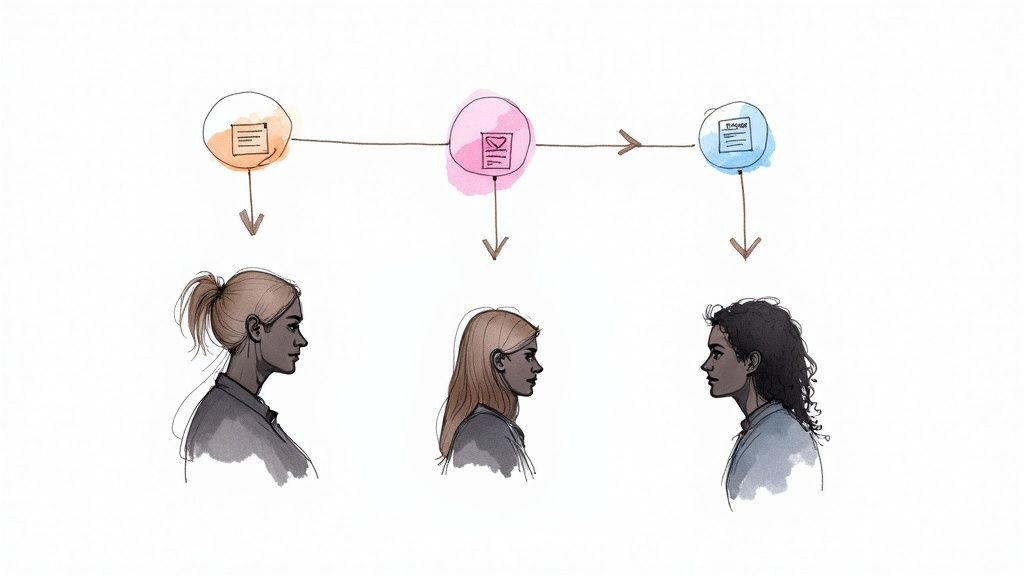
Let's be honest: the days of sending one generic newsletter to every parent on your list are long gone. Today's families don't just want information from your school; they expect to feel understood. Modern school marketing lives and dies by its ability to make each family feel seen, heard, and valued as individuals, not just another name on an enrollment spreadsheet.
This is where personalization comes in. It's the difference between a mass email that gets immediately deleted and a thoughtful message that actually sparks a connection. When a prospective parent receives information that speaks directly to their child’s specific grade level and interests, it sends a powerful message: you're paying attention.
This isn’t a "nice-to-have" anymore—it's a core expectation. In fact, research shows that by 2025, 75% of consumers will be more likely to engage with brands that deliver personalized content. Businesses that get it right are 48% more likely to beat their revenue goals. You can dig deeper into how personalization is shaping marketing trends to see just how critical this is.
Moving Beyond One-Size-Fits-All Messaging
Don't let the word "personalization" intimidate you. It doesn’t require a massive budget or complex technology. At its heart, it’s simply about being relevant. It starts with listening to what different groups in your community actually need and then giving it to them in a way that feels helpful and specific.
The first step, and arguably the most important, is audience segmentation. This just means breaking down your big, broad audience—everyone from prospective parents to current grandparents—into smaller, more focused groups based on what they have in common. Once you do that, you can craft messages that truly hit home. For a deeper dive, our guide on what is audience segmentation is a great place to start.
Here are a few straightforward ways to start segmenting your school’s audience:
- Prospective vs. Current Families: These two groups are on completely different journeys. Prospects need to know about tours and admissions deadlines, while current parents are looking for calendar updates and messages from their child's teacher.
- Grade Level or Division: What a high school parent cares about is worlds away from what a kindergarten parent needs to know. Tailor your content accordingly.
- Interests or Programs: Got a family that's all about sports? Another that's passionate about the arts? Group them by their interest in specific programs like athletics, theater, or STEM.
Practical Personalization in Action
Once you have your groups, you can start delivering tailored experiences that build real trust. This isn't just theory; it’s about making small, meaningful tweaks to your communications that add up to a big impact.
Key Insight: Personalization isn't about knowing everyone's name. It's about demonstrating that you understand and care about each family's unique journey with your school. This is how you transform communication from a simple broadcast into a genuine relationship-builder.
Here are a few real-world examples you can implement right away:
- Website Content: Instead of one generic "Academics" page, create dedicated sections on your website for the Lower, Middle, and Upper Schools, each with photos and information relevant to those specific age groups.
- Email Campaigns: Ditch the single, massive newsletter. Send a short, punchy version to prospective families highlighting upcoming admissions events, and a separate one to current parents filled with community news and important dates.
- Open House Follow-Up: After an open house, send a follow-up email that specifically mentions a program the family showed interest in. A simple, "It was great talking with you about our robotics club!" can make all the difference.
When you take these kinds of steps, you show families that you see them as partners, not just recipients of information. That simple act of acknowledgment is the foundation for building the lasting trust that turns interested parents into enrolled families, and enrolled families into your school's biggest champions.
Of course. Here is the rewritten section, designed to sound completely human-written and natural.
Common Questions About School Marketing Communications
Even with the best plan in hand, real-world questions always pop up. It's one thing to understand the theory, but it's another to apply it when you're facing a specific challenge. This section tackles the most common questions we hear from school leaders and marketing teams on the ground.
We're here to give you straightforward answers that clear up any confusion and help you move forward with confidence. Let's dig into some of the most frequent sticking points.
What Is the Difference Between Marketing and Communications?
This is a classic, and it's easy to get tangled up. Let's simplify it.
Think of marketing as the focused effort to get someone to do something specific—enroll their child, sign up for an open house, or register for a summer camp. It's promotional by nature and aimed at driving a particular action.
Communications is the bigger picture. It's all about building and maintaining relationships with everyone connected to your school. This covers everything from the weekly parent newsletter and internal staff announcements to managing your school's public reputation. The goal here isn't a single transaction; it's about fostering long-term trust and a positive perception across your entire community.
The real magic happens when you stop seeing these as two separate things. The best school MarCom strategies weave them together. This ensures your promotional messages (marketing) always feel authentic and consistent with the larger story you're telling (communications).
How Can a Small School with a Limited Budget Succeed?
A tight budget isn't a roadblock; it's a call for focus. You don't need to be everywhere at once. The key is to zero in on the high-impact channels you can control completely, without spending a fortune.
Start by making your "owned" media shine:
- Perfect Your Website: This is your digital front door. Make sure it's welcoming on mobile devices, simple to navigate, and instantly shows families what makes your school special.
- Go Deep on One or Two Social Channels: Don't burn out trying to manage five different platforms. Figure out where your parents actually are, and commit to creating great content there.
- Activate Your Community: Your current families and students are your most powerful advocates. Word-of-mouth is priceless. Create experiences worth talking about, and then make it easy for people to share their stories through testimonials and spotlights.
How Do We Measure If Our MarCom Is Working?
Measurement can feel overwhelming, but it boils down to one simple rule: connect your metrics to your goals. You need to be able to draw a straight line from your daily work to a meaningful result for the school.
If your goal is to increase enrollment, your most important numbers are pretty clear:
- How many inquiry forms were submitted on your website?
- How many people RSVP'd to—and actually attended—your open house?
- What's the final count of applications you received?
If you're focused on a broader goal like community engagement, you'll track different things:
- Are people opening and clicking links in your newsletters?
- What does your social media engagement look like (comments and shares, not just likes)?
- What are the trends in your annual parent satisfaction surveys?
When you define what success looks like upfront, tracking your progress becomes simple. More importantly, it allows you to clearly demonstrate the value your work brings to the school.
Ready to stop guessing and start building a strategy that works? The MarCom Society provides K-12 school marketing professionals with the expert guidance, practical resources, and supportive community you need to succeed. Elevate your school's story by joining us today.