
A marketing funnel is simply a way to visualize the path a family takes from first hearing about your school to becoming an enthusiastic, enrolled member of your community. It’s not just a marketing theory; it's a practical roadmap that helps you organize every interaction, build meaningful relationships, and guide families from casual interest to confident enrollment.
Understanding the School Marketing Funnel
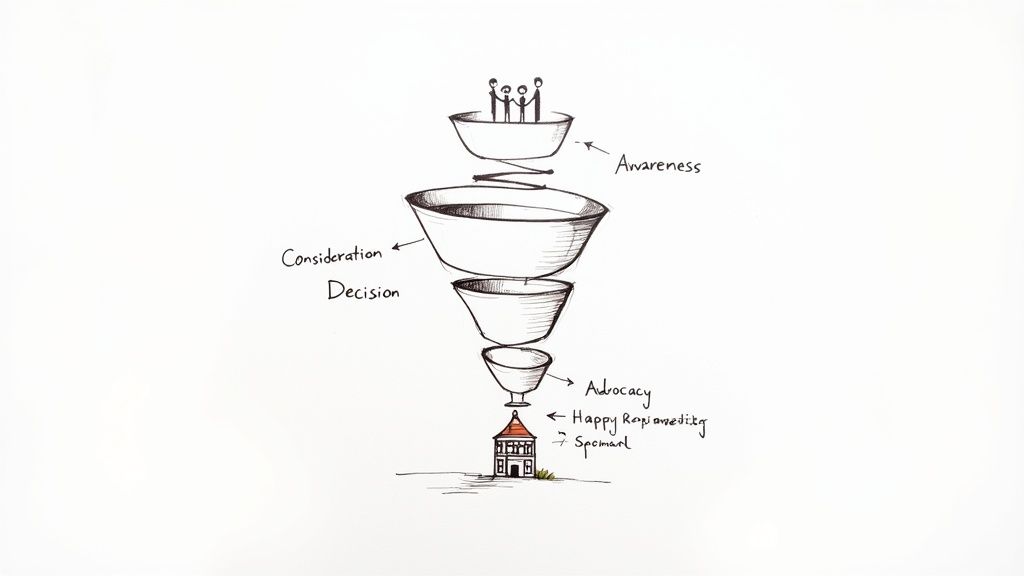
Think of your enrollment process like a guided tour. Each stop on the tour—or stage in the funnel—is designed to answer a family's specific questions and meet their needs at that exact moment. A good funnel makes prospective families feel understood and supported, never lost or overwhelmed.
The funnel works by starting with a wide audience of families who are just becoming aware of your school. From there, your job is to engage a smaller group who begin to actively consider what you have to offer.
Next, you help them make the final decision to apply. But the journey doesn't stop at enrollment. The final, crucial stage is turning your current families into loyal advocates who naturally bring new families right back to the top of the funnel.
The Four Core Stages
This whole process is built around four key stages. Let's break down what each one looks like in a school setting.
To give you a quick overview, this table translates each funnel stage into a clear, actionable goal for your school's enrollment efforts.
The School Enrollment Funnel At a Glance
| Funnel Stage | Primary Goal for Schools |
|---|---|
| Awareness | Get on the radar of local families, making sure they know your school is a great option. |
| Consideration | Showcase what makes your school unique and help families see if it's the right fit for them. |
| Decision | Make it easy and compelling for families to take the next step, like applying or scheduling a tour. |
| Advocacy | Deliver an amazing experience so your current families become your biggest cheerleaders. |
Each stage builds on the last, creating a seamless and logical path for every prospective family.
The idea of mapping out a customer's path has been around for a long time. It actually dates back to 1898 when Elias St. Elmo Lewis created the AIDA model—Awareness, Interest, Desire, and Action. This was one of the first real attempts to understand this journey.
To really dig in and design an effective funnel, it helps to put yourself in the shoes of your prospective families. A great tool for this is Customer Journey Mapping, which provides a clear framework for making sure no one gets left behind. This structured approach is what leads to stronger, more predictable enrollment numbers year after year.
Stage 1: Attracting Prospective Families with Awareness
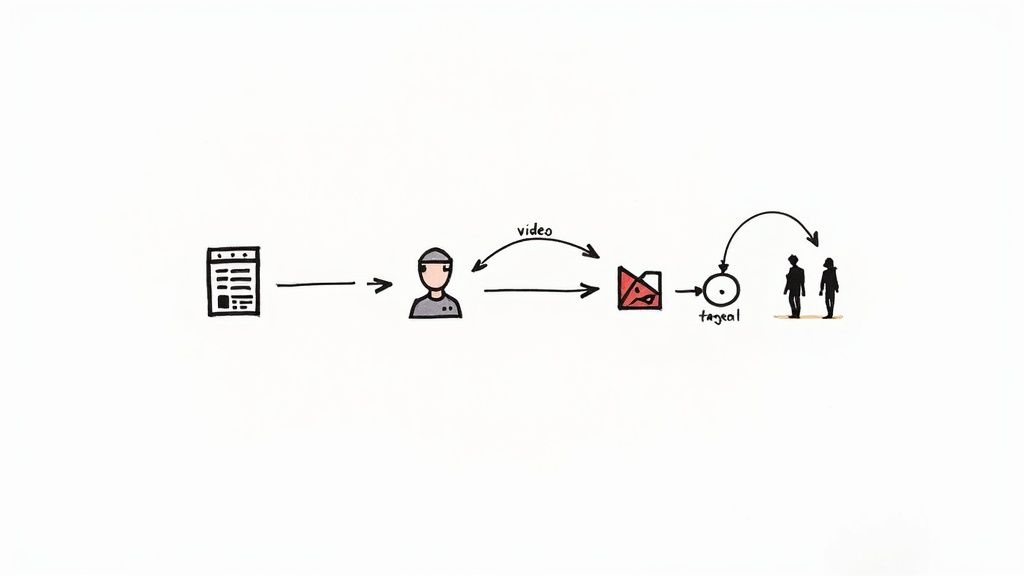
Before a family can enroll, they have to know you exist. It sounds simple, but this is where the entire journey begins. Welcome to the Awareness stage, the widest, top-most part of your marketing funnel.
Your goal here is simple: capture the attention of families in your community. Many of them might not even be actively searching for a new school yet. Think of it like casting a wide, friendly net. You aren't pushing for an application; you're just trying to get on their radar as a great option for their child down the road.
This means you need to be helpful and visible right where parents are already spending their time. And where is that? Overwhelmingly, it's online. With 86% of adults on social media, platforms like Facebook and Instagram are no longer optional—they are essential places to connect with prospective parents.
Reaching Families Where They Are
At the top of the funnel, your entire strategy should revolve around broad outreach. You're not selling enrollment slots; you're building a foundation of trust and establishing your school as a valuable community resource.
Here are a few practical ways to do just that:
- Be Found with Local SEO: When a parent types "best private schools near me" or "kindergarten programs in [Your City]" into Google, you need to show up. A strong, optimized website is non-negotiable.
- Create Genuinely Helpful Content: Write blog posts that answer the real-world questions parents are asking. Think about topics like "Choosing the Right Kindergarten Program" or "How to Prepare Your Child for Middle School." This positions you as an expert, not a salesperson.
- Show, Don't Just Tell, on Social Media: Share authentic photos and videos of everyday life at your school. A quick clip of a science experiment, a teacher spotlight, or a student art project gives families a genuine feel for your school's unique culture.
- Get Involved in Your Community: Sponsoring a local little league team, having a booth at a town festival, or hosting a free family movie night on your field builds incredible goodwill. These real-world connections matter.
The goal of the Awareness stage isn’t just to be seen—it’s to be remembered as a helpful resource. When a family feels you've helped them, they are far more likely to consider you when it’s time to make a decision.
This initial visibility is the bedrock of your enrollment success. If you're looking for more ways to make your school stand out, our guide on how to improve brand awareness offers even more detailed strategies. By creating useful, discoverable content, you ensure that when families do start their school search in earnest, your institution is already a familiar and trusted name.
Stage 2: Nurturing Interest Through Consideration
Okay, so you’ve grabbed a family's attention. They know your school exists. Now what? Welcome to the middle of the funnel: the Consideration stage.
This is where the real research begins. Families have moved past a simple name recognition and are now asking the big question: "Is this the right school for my child?" Your job is to help them answer it.
The goal shifts from casting a wide net to building a real connection. You're no longer just trying to be seen; you're trying to be understood. Think of yourself less as a marketer and more as a helpful guide, providing the substantive information they need to make one of the most important decisions for their family.
It’s worth noting that this process isn't the straight line it used to be. The old-school marketing funnel was a simple A-to-B-to-C path. Today’s families are different. They might jump in and out of their research, discovering you on social media, then Googling your programs, then disappearing for a few weeks before coming back to your website. This is why having valuable, easy-to-find information is non-negotiable. For a deeper dive, check out this article on the shift from traditional to digital marketing funnels on iodigital.com.
Building Trust with Valuable Content
At this point, you can bet that families are looking at you alongside a few other schools. Your content is what will set you apart. It needs to go deeper than a flashy ad and start answering their specific questions about what makes your school truly special.
Here are a few proven tactics that work wonders in the Consideration stage:
- Downloadable Viewbooks or Guides: Create a beautifully designed guide that dives into your curriculum, mission, and student life. Offering this in exchange for an email address is a classic win-win—they get incredible value, and you get a direct line to a highly interested family.
- Virtual or In-Person Open Houses: Nothing beats experiencing your campus firsthand. A well-organized open house gives families a genuine feel for your community, letting them meet teachers, chat with current parents, and picture their child in your halls.
- Authentic Student and Parent Testimonials: Let your community do the talking. A heartfelt video from a parent who has seen their child flourish or a story from a student who found their passion at your school is more persuasive than anything you could ever write yourself.
The Consideration stage is all about proving your value. Every piece of content should help a family envision their child succeeding at your school. This is how you transition from being just another option to becoming their top choice.
Measuring Success in the Middle Funnel
How do you know if you're actually connecting with families and not just shouting into the void? You need to track the right metrics. These numbers (KPIs) tell the story of your engagement.
- Lead Magnet Download Rate: What percentage of people who see your viewbook offer actually download it? A high number here means you’ve created something genuinely compelling.
- Event Registration and Attendance: Look at how many families sign up for your open house versus how many actually show up. This is a direct measure of their interest level.
- Email Engagement: Once they're on your list, are they opening your emails? Are they clicking the links inside? These actions tell you if your follow-up messaging is hitting the mark.
Stage 3: Guiding Families to a Decision
After all the nurturing and information sharing, we've arrived at the sharp end of the funnel: the Decision stage. This is that make-or-break moment when a prospective family transitions from just "thinking about it" to actually starting an application.
Your job now shifts from building awareness to building confidence. It’s all about making that final step feel not just easy, but like the most natural and exciting choice they could make. The goal is to eliminate any last-minute hesitation or friction standing in their way.
Making the Final Step Easy
At this point, families are on the home stretch. They're looking for that final confirmation that they're making the right call for their child. Your communication needs to be supportive, clear, and focused on getting them across the finish line.
This is where your calls-to-action (CTAs) need to be crystal clear. A generic "learn more" button is too passive now. You need direct, action-oriented prompts that leave no doubt about what to do next.
A few great examples include:
- Schedule Your Personal Tour: This feels exclusive and tailored, showing the family you value their individual interest.
- Start Your Application: It’s a direct, unambiguous instruction for those who are ready to take the leap.
- Talk to a Current Parent: This is powerful social proof. It gives them a chance to hear a real, unscripted perspective from someone who was once in their shoes.
Your website is the primary vehicle for these CTAs. Every relevant page should gently but firmly guide visitors toward taking action. For a deeper dive, check out our guide on how to improve website conversion rates for some really practical tips.
The Power of the Personal Follow-Up
While strong website CTAs are a must, you can't beat a personal touch. When a family signals strong interest—say, by attending an open house or downloading your full curriculum guide—a timely, personal follow-up from your admissions team can be the deciding factor.
This is where you pivot from marketing to true relationship-building. A simple, personal email from an admissions counselor asking, "Do you have any questions I can answer?" is incredibly powerful. It shows you see them as a future member of your community, not just another number in a spreadsheet.
Targeted email sequences are also incredibly effective here. Imagine a family tours your middle school. You could follow up with a short series of emails showcasing your award-winning science program, introducing the head of athletics, or sharing a few alumni success stories. This approach keeps your school top-of-mind and proactively answers the questions they're likely weighing.
The key metrics to watch in the Decision stage are straightforward but critical: tour booking rates and application completion rates. These two numbers tell you exactly how well you're converting serious interest into actual applicants—the ultimate goal of your entire marketing funnel.
Stage 4: Creating School Champions Through Advocacy
Getting a family to enroll isn't the finish line. Far from it. That signature on the contract is actually the starting line for building a long-term relationship. This final stage of the funnel is all about Advocacy—the art of turning happy families into your most passionate, effective, and authentic marketers.
Think about it: a fantastic on-campus experience is your single best marketing asset. It creates a powerful, self-sustaining loop that feeds new, interested families right back into the top of your funnel.
From New Family to Raving Fan
The journey from satisfied parent to vocal advocate starts the moment a family enrolls. A warm, well-organized onboarding process is your first and best chance to make a great impression. It reassures them they made the right choice and sets a positive tone for everything that follows.
From that point on, consistent, positive communication is what builds the relationship. This isn't just about blasting out weekly newsletters. It's about intentionally cultivating a true sense of community. Celebrate student achievements, share candid photos from campus events, and give parents plenty of opportunities to connect with one another.
Turning Satisfaction into Vocal Support
In a crowded market, your current families are your secret weapon. When parents feel seen, heard, and genuinely part of the community, they are far more likely to share their positive experiences with friends, neighbors, and colleagues. And word-of-mouth is still the most trusted form of marketing, especially when it comes to a decision as personal as choosing a school.
So, how can you be a little more proactive?
- Encourage Online Reviews: Gently and strategically ask happy parents to leave a review on Google, Niche, or other relevant platforms. Those stars and comments are pure gold for families who are still weighing their options.
- Capture Testimonials: Don't be shy about asking parents to share a few sentences about why they love your school. These authentic stories are incredibly powerful on your website, in admissions materials, and across social media.
- Host Community-Building Events: Things like school carnivals, casual parent-teacher coffee chats, and volunteer days do more than just fill the calendar. They weave families into the fabric of the school, turning it from an institution into their community.
In today's noisy world, a personal recommendation cuts through the clutter like nothing else. Your goal is to create an experience so positive that parents can't help but talk about it.
This is a huge departure from the advertising models of the past. Back in the 1970s, the average person might have seen 20 ads per day. Fast forward to the 2020s, and that number has skyrocketed by over 1,500%, with some estimates putting it in the hundreds daily. It’s harder than ever to get noticed.
By focusing on advocacy, you tap into something far more powerful than a paid ad. You create authentic marketing that truly connects, turning your current families into a volunteer marketing force that continuously fuels your enrollment growth. To see just how much this has changed, check out these great insights on the evolution of customer experiences on YouTube.
Building Your School Enrollment Funnel
Knowing what a marketing funnel is feels good, but turning that concept into an actual enrollment-generating machine for your school? That’s what really moves the needle. This is where we get practical and build a clear, repeatable process that guides families from the moment they first hear your school's name to the day they become your biggest advocates.
To build a framework that consistently attracts and keeps families, you need a solid education marketing strategy. Think of this strategy as the blueprint for your funnel. It ensures every blog post, social media update, and email works together toward the same goal: growing your community. The real magic happens when you start mapping specific content and actions to each stage.
This visual breaks down what a school enrollment funnel looks like in practice, with key tactics for every step of the journey.

As you can see, a healthy funnel isn't just one big marketing push. It relies on different strategies at each level—from broad-reach blog posts at the top all the way down to personalized tours for families who are close to making a decision.
Mapping Your Content to the Funnel
The secret to effective communication is delivering the right message at the right time. By mapping your content ideas to specific funnel stages, you can avoid common missteps, like asking for an application way too early or sending basic info to a family that’s already ready to enroll.
Here’s a quick look at what that could look like:
Awareness Stage Content:
- Blog Post: "5 Early Childhood Milestones Every Parent Should Know"
- Social Media: A quick video tour of your vibrant playground or brand-new science lab.
Consideration Stage Content:
- Downloadable Guide: "A Parent's Guide to Our Middle School Curriculum"
- Webinar: "Navigating the High School Admissions Process: A Q&A with Our Team"
Decision Stage Content:
- Email Series: A short sequence of emails highlighting alumni success stories and testimonials.
- Web Page: A detailed FAQ page specifically for newly accepted families.
This structured approach is what turns random marketing activities into a coordinated, goal-oriented system. When you align your content this way, you create a smooth journey for prospective families, building trust and helping them feel confident in their decision to join your school.
Key Performance Indicators (KPIs) by Funnel Stage
To know if your funnel is actually working, you have to measure it. Tracking the right data at each stage tells you what’s resonating with families and where you might have a "leak" that needs fixing.
| Funnel Stage | Key Metric to Track | Why It Matters |
|---|---|---|
| Awareness | Website Traffic & Social Media Reach | This shows how many new families are discovering your school for the first time. |
| Consideration | Lead Magnet Downloads & Tour Requests | This tells you how many people are interested enough to exchange their contact info for more details. |
| Decision | Application Submissions & Enrollment Rate | These are the bottom-line numbers that show how effectively you're converting interest into new students. |
| Advocacy | Re-enrollment Rate & Parent Referrals | This measures the long-term health of your community and your ability to turn current families into marketers. |
Focusing on these KPIs will give you a clear, data-backed picture of your enrollment health, helping you make smarter decisions about where to invest your time and budget.
To make this whole process run even smoother, you can explore different marketing automation strategies that help deliver the right content at the perfect moment. A great next step is to use a simple checklist to audit your current marketing against this model. You’ll quickly spot your biggest opportunities for enrollment growth.
Frequently Asked Questions About the Marketing Funnel
Even with a great map in hand, you're bound to have questions once the journey begins. Let's tackle some of the most common things school marketers ask when they start putting the funnel concept into practice.
How Long Does It Take to See Results?
This is always the first question, and the honest-to-goodness answer is: it depends. The good news is you can get some quick wins. For example, tweaking your tour sign-up page (a Decision stage action) might boost your numbers in just a few weeks.
But building the whole system, a truly reliable funnel, is more of a long game. Think of activities at the top, like creating genuinely helpful blog posts for parents or improving your school's local search ranking. These are investments. It often takes a solid three to six months of consistent work to really see a jump in website traffic and general awareness.
The key is to remember that the initial effort builds on itself. The work you do now will compound over time, leading to much more predictable enrollment down the road.
What If I Have a Limited Budget?
A small budget isn't a roadblock; it's a focusing lens. It forces you to get strategic, which is actually a huge advantage. Instead of trying to do a little bit of everything, you can pour your energy into the areas that will make the biggest difference for your school.
The goal isn't to do everything at once. It's to do a few things exceptionally well. If your budget is tight, concentrate your efforts on the bottom and middle of the funnel first—the families who are already showing interest.
Here are a few high-impact ideas that won't break the bank:
- Perfect Your Follow-Up: A personalized email sequence for families who have just toured your school costs nothing but time. It’s one of the most effective ways to turn interest into applications.
- Leverage Your Community: Don't be shy about asking your happiest current families for online reviews and testimonials. This kind of social proof is incredibly powerful, and it's completely free.
- Create One Great Resource: Instead of churning out ten so-so blog posts, focus on creating one amazing downloadable guide. Think "Kindergarten Readiness Checklist" or "How to Choose the Right Middle School." Make it something parents truly want.
Can This Funnel Be Used for Fundraising?
Absolutely. The core idea of a marketing funnel—guiding people on a journey from knowing you exist to taking a specific action—works for almost anything. You just swap out the language and tactics to fit the goal.
For fundraising, it looks like this:
- Awareness: You're not selling a program; you're sharing stories of student impact and success.
- Consideration: Instead of a campus tour, you’re providing transparent reports or project-specific pages that show exactly how donations make a difference.
- Decision: Your "apply now" button becomes a simple, compelling online giving page with a clear call to action.
The funnel gives you a reliable framework for any initiative where you need to build a relationship and inspire someone to act.
Ready to stop guessing and start building a predictable enrollment engine? At The MarCom Society, we provide the expert guidance, practical resources, and supportive community K-12 marketers need to succeed. Join us to access live workshops, proven templates, and a network of peers who get it. Learn more and become a member at https://marcomsociety.org.









