
So, what exactly is media relations?
Think of it as the art of building genuine, long-term relationships with journalists, editors, bloggers, and anyone with a media platform. The whole point is to earn positive, credible coverage for your school without paying for it. It’s the difference between buying an ad and having a respected expert recommend you. One is a transaction; the other is a vote of confidence.
Defining Media Relations In Today's World
At its heart, media relations is all about authentic storytelling. It’s moved far beyond the old "spray and pray" method of blasting out a press release and hoping for the best. Today, it’s about positioning your school and its leaders as trusted, go-to sources for the media.
Imagine you've launched an innovative new STEM program. You could run ads, sure. But what if the education editor at your city's major newspaper wrote a feature story about it? That's the power of media relations. It’s about building a connection with that editor, understanding what stories they care about, and showing them why your program is genuinely newsworthy. It’s diplomacy, not advertising.
The Core Components Of Media Relations
While the specific tactics can change, a solid media relations strategy always rests on a few key pillars. Success here is a mix of sharp communication skills, strategic thinking, and a healthy dose of persistence. The goal is always to secure earned media—any positive mention or coverage you didn't purchase.
A strong approach usually involves:
- Crafting compelling stories that not only reflect your school's mission but also hook a journalist's interest.
- Identifying and researching the right media contacts, from the local TV news reporter to that influential parenting blogger.
- Pitching your ideas thoughtfully, making it easy for a busy reporter to see the story and run with it.
- Being a responsive, reliable resource when the media comes calling, positioning your experts as the first people they think to call.
This is all about creating a bridge between your school, the media, and the families you want to reach.
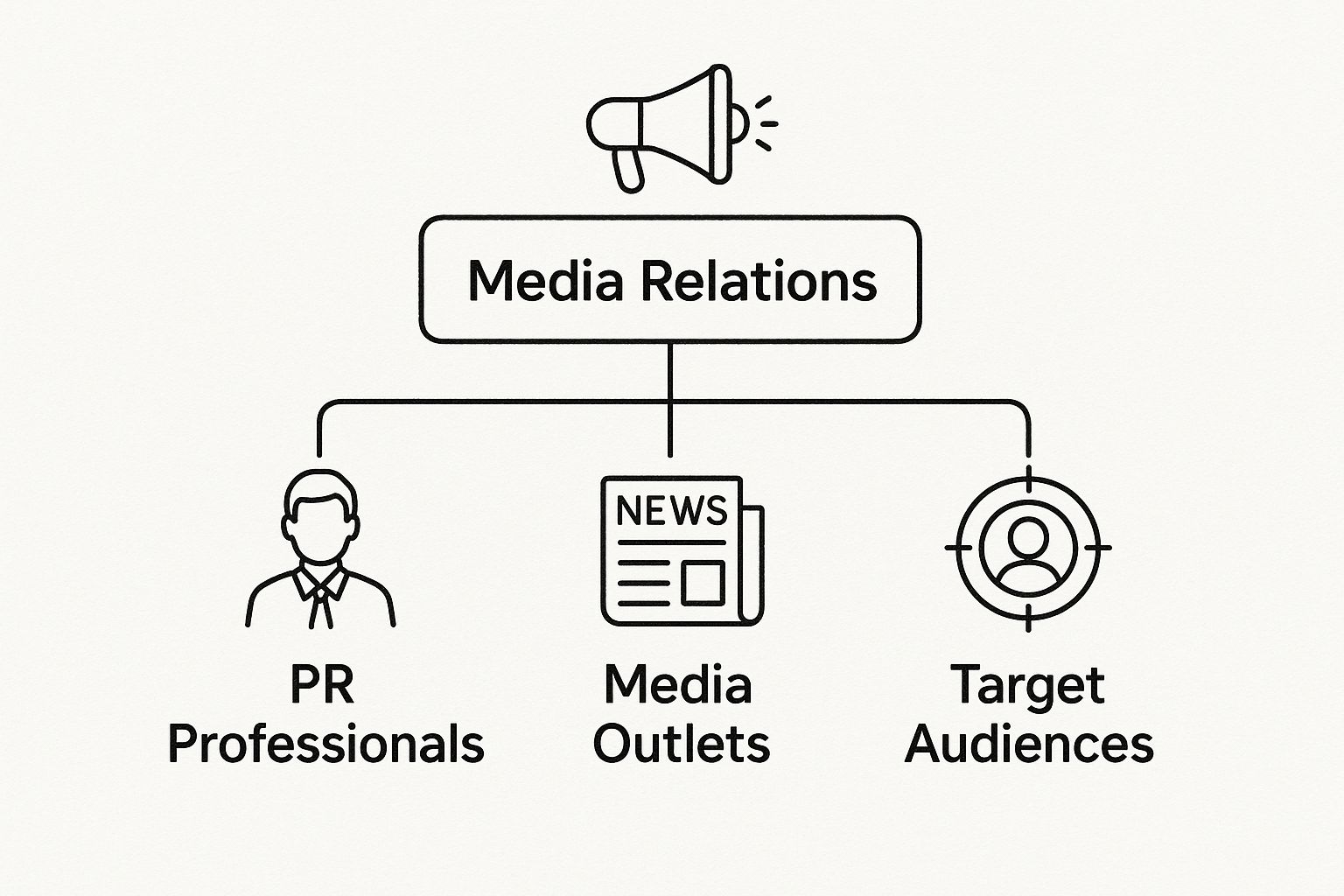
As you can see, the media relations pro acts as that vital link, using credible media outlets as the channel to connect with the public.
Media relations is a specialized function that sits under the wider umbrella of public relations. They work hand-in-hand, but it's helpful to know the difference. To dig deeper, check out our guide that explores what is public relations.
By focusing on these elements, you're not just getting your name out there; you're building third-party validation that money simply can't buy.
Media Relations vs Paid Advertising at a Glance
It's easy to get earned media (from media relations) confused with paid media (from advertising), but they operate on fundamentally different principles. One is about earning trust, the other is about buying space.
Here’s a simple breakdown of the key differences:
| Attribute | Media Relations (Earned Media) | Paid Advertising (Paid Media) |
|---|---|---|
| Credibility | High – seen as an unbiased, third-party endorsement. | Lower – audiences know it's a paid message. |
| Control | Low – you can't control the final story or its tone. | High – you control the message, design, and placement. |
| Cost | Low financial cost, but high investment in time and effort. | High direct cost for ad space and creation. |
| Longevity | High – a good story can have a long shelf life online. | Short – the message disappears once you stop paying. |
| Goal | To build trust, reputation, and long-term relationships. | To generate immediate leads, sales, or traffic. |
Ultimately, both have their place in a well-rounded marketing strategy. But media relations offers a layer of authenticity and authority that advertising alone can never achieve. When a trusted news source tells your story for you, the impact is powerful.
How Media Relations Has Evolved

The world of media relations has gone through a massive transformation over the past couple of decades. Let’s be honest: the days of faxing out press releases and sealing deals over long lunches with a few powerful editors are long gone. The game today is faster, the media landscape is way more fragmented, and success demands a much wider range of skills.
This isn't just about new technology popping up. It's a seismic shift in how news is made, how people consume it, and how it gets shared. If you want to build a media relations program that actually gets results for your school, you first have to grasp this evolution. Sticking to old-school tactics is like trying to use a map from 1995 to navigate a city in 2025—it just doesn't work.
From Gatekeepers to a Crowded Field
Not too long ago, a small circle of editors at major newspapers, magazines, and TV stations were the ultimate gatekeepers. If you could get one of them to like your story, you were golden. Your message was guaranteed to reach a huge audience.
Now? The media landscape is a sprawling, noisy, and incredibly crowded field.
Many traditional newsrooms have shrunk, leaving fewer journalists with heavier workloads. At the same time, an explosion of digital-only outlets, industry bloggers, podcasters, and social media creators has opened up thousands of new avenues to tell your story. Each of these new players has a specific audience, a unique format, and different content needs. This means a one-size-fits-all approach is doomed to fail; you have to be targeted and smart.
The Rise of Digital and Data-Driven Strategies
The internet did more than just create new channels—it completely changed how journalists hunt for stories and how audiences find their news. Search engines are a huge source of traffic for news sites, with predictions showing that in 2025, about 40% of news traffic will come directly from search.
But it’s not as simple as just "doing SEO." New AI discovery tools are changing the game, and the power of social media for news is shifting. News reach on platforms like Facebook and Twitter has dropped by 21% and 34%, respectively. If you want to dive deeper into what's next, you can explore media relations strategies for 2025.
This new reality forces us to think differently. It’s not just about pitching a story anymore. It's about creating genuinely valuable content that can be discovered on its own and building direct connections with people through things like podcasts or short-form video.
Key Takeaway: A modern media relations expert has to be a hybrid professional. You need to be just as comfortable digging into audience data and understanding platform algorithms as you are at writing a persuasive email. It's the perfect blend of classic communication chops and sharp digital marketing know-how.
Success today is all about agility. One day you might be crafting a data-heavy story for an education trade journal, and the next you’re creating a visual-first piece for a social media news account. This multifaceted approach is the only way to cut through the noise and capture the attention of both the media and the families you want to reach.
Building Your Media Relations Strategy
A successful media relations program isn't just about luck or firing off a few emails. It’s the result of a solid, thoughtful strategy. Think of it as a roadmap that takes you from having a great story to seeing it featured in the news. This framework is all about the practical art of crafting a compelling narrative, finding the right people to tell it to, and building genuine relationships that last.
Without a plan, your efforts can feel disjointed and random, like shouting into the wind. A clear strategy makes sure every press release, every phone call, and every email has a purpose. It turns media relations from a checklist of tasks into a powerful engine for building your school's reputation.
Identifying Your Core Narrative
Before you can even think about getting media coverage, you have to know exactly what story you want to tell. What’s the one thing that truly sets your school apart? Maybe it’s a groundbreaking new STEM program, a teacher who’s changing lives, or a student who overcame incredible odds. Your core narrative is the central idea that ties all your communications together.
This goes way beyond a simple list of your school's achievements. It’s the story that connects with people on an emotional level. It answers the fundamental question: "Why should anyone care?"
There’s a huge difference between saying, "We built a new science lab," and telling the story of "how our new science lab is giving students the tools to solve real-world problems right here in our community." The first is a fact. The second is a story people want to hear.
Research and Targeting The Right Journalists
Once you’ve got your story straight, you need to find the right people to tell it to. One of the biggest mistakes you can make is blasting a generic pitch to a massive list of journalists. It’s noisy, it’s lazy, and it almost never works. The real key to success is careful research and smart targeting.
Think about it like this: a thoughtful, personalized pitch to a single journalist who actually covers K-12 education is worth a thousand generic emails.
Your research should dig into a few key questions:
- Who covers education in your area? Look for specific reporters' names, not just the names of the TV stations or newspapers.
- What kinds of stories do they usually write? Spend some time reading their recent articles. Get a feel for what they—and their audience—find interesting.
- How do they like to be contacted? Some reporters live in their email inbox, while others are more responsive on platforms like X (formerly Twitter).
- How does your story help them? You have to frame your pitch as a great tip that will provide their readers or viewers with fresh, relevant content.
A journalist's inbox is a battlefield. The only way to stand out is with a personalized pitch that proves you've done your homework and respect their time. Anything less is just noise.
The Foundation of Authentic Relationships
At its heart, media relations is all about relationships, not transactions. The goal isn't just to get one story published; it's to become a trusted source that journalists can rely on for expert insight, interesting story ideas, and accurate information. That kind of trust doesn't appear overnight.
You build it through small, consistent, and positive interactions over time. Start by following key journalists on social media. Share their articles. Offer a helpful statistic or a connection without asking for anything.
When you finally do pitch them, you'll have laid the groundwork. By making sure your story is a perfect fit for their beat, you show them you're a professional who understands their needs. This long-game approach is what turns a one-off pitch into a real professional partnership.
Putting Your Media Relations Plan Into Action
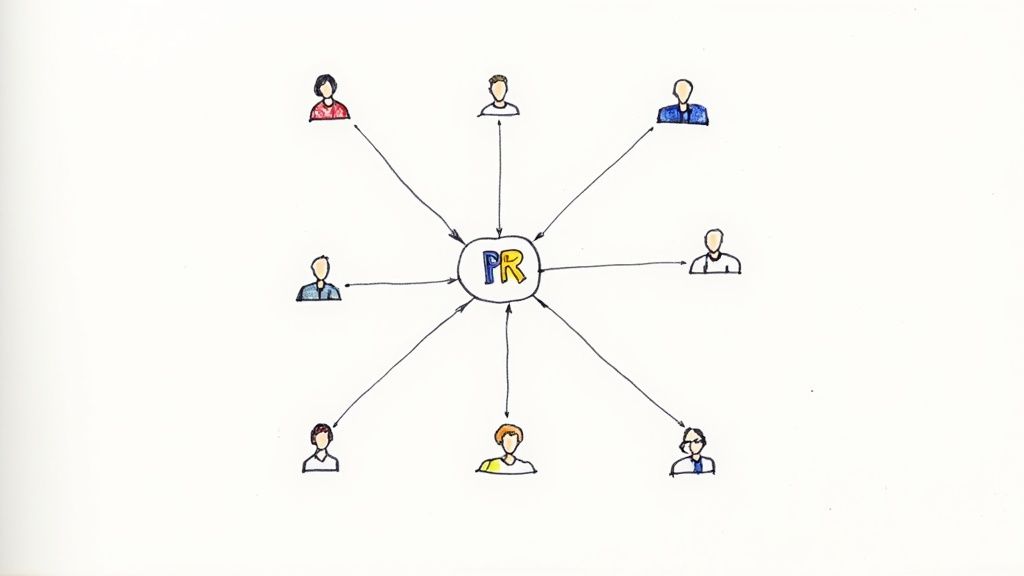
With a solid strategy in place, it’s time to roll up your sleeves and get to work. The modern media relations toolkit isn't just about theory; it's about the practical, day-to-day actions that turn your goals into real, tangible results. This is your playbook for earning that coveted media coverage.
At the heart of it all is the media pitch. Think of this as a short, persuasive email or message designed to grab a journalist's attention instantly. A great pitch isn't a press release summary; it’s a direct, compelling case for why your story is a perfect fit for that specific journalist and their audience. It has to be personal, concise, and immediately valuable.
To support your pitch, you'll need a well-organized digital press kit. Forget the bulky folders of the past—this is a simple, accessible online hub. It should have everything a reporter needs to cover your story without any hassle, saving them precious time.
Crafting Your Content and Connecting With Reporters
To create truly compelling materials, exploring the best AI tools for content creation can give you a major head start. But technology is only one piece of the puzzle. Real success comes from how you build relationships and tailor your outreach.
Today, you can't ignore social media. As of 2025, it’s home to a staggering 5.42 billion users, making it one of the most important communication channels on the planet. With the average person juggling 6.83 different platforms each month, your strategy has to be nimble, adapting your message to each platform while keeping your school's voice consistent.
The goal is to make a journalist's job easier. Provide them with a compelling story, high-quality assets, and quick access to sources. When you become a reliable and helpful resource, they are far more likely to work with you again.
This means being more than just a source of information. You need to be an active, helpful presence where reporters and editors are already spending their time.
Keeping Your Finger on the Pulse
You can't improve what you don't measure. Media monitoring tools are non-negotiable for tracking your efforts in real-time. These platforms show you where your school is being mentioned, help you gauge the sentiment of the coverage, and give you a clear picture of the story being told about your brand.
Here are a few key tactics to weave into your daily routine:
- Listen First: Use social listening to follow key journalists and outlets on platforms like X (formerly Twitter) and LinkedIn. Genuinely engage with their posts to build a sense of familiarity before you ever send a pitch.
- Make it Personal: Never send a generic email blast. Reference a journalist’s recent work in your customized pitches to show you’ve done your homework and aren't just spamming them.
- Prepare for the Spotlight: Once you’ve landed the interview, the real work begins. To make sure your spokespeople are ready to shine, check out this in-depth guide on https://blog.marcomsociety.org/how-to-handle-media-interviews/.
By blending persuasive storytelling, smart social media engagement, and vigilant monitoring, you create a powerful system that generates consistent, positive media coverage for your school.
Why Media Relations Matters for K-12 Schools

Let's ground these ideas in a place where reputation is everything: K-12 school marketing. With parents facing more educational choices than ever before, how a school is perceived in the community can make or break enrollment goals. This is precisely where a smart media relations strategy stops being a "nice-to-have" and becomes a critical tool for growth.
Sure, paid advertising has its place. It can certainly show off your new science lab or highlight your sports programs. But earned media—the stories you don't pay for—tells your school's story with a level of credibility that money simply can't buy.
Think about it. What’s more powerful? A glossy flyer in the mail or a feature on the local evening news about your students' award-winning robotics team? The news story provides third-party validation, an impartial stamp of approval that tells prospective families your school is doing something genuinely newsworthy.
Building Trust and Showcasing Strengths
Good media relations for schools is about more than just sending out a press release for open enrollment. It’s about consistently and strategically sharing the incredible stories unfolding in your classrooms every single day. When you build real relationships with local journalists, you can turn everyday achievements into compelling narratives that resonate with the public.
This kind of proactive work translates into real, tangible results. For example, you could be:
- Pitching a human-interest story to a local TV station about a student-led community garden project. This showcases student initiative far better than any brochure could.
- Positioning your principal as an expert by helping them write an opinion piece for a regional paper on the future of project-based learning.
- Announcing an innovative new literacy program by giving education reporters an exclusive look. This highlights your commitment to academic excellence.
For a school, media relations is the bridge between the incredible work happening on campus and the community you serve. It transforms your school from just another option into a trusted pillar of the community that families are excited to join.
Ultimately, this all comes down to building deep-rooted trust. When a respected news outlet covers your school's successes, it reinforces a powerful story of quality and distinction. That’s what attracts the right families and builds lasting community pride.
Measuring Your Media Relations Impact
So, you've landed some great press. Now what? How do you prove your media relations efforts are actually paying off?
This is where the rubber meets the road. It’s one of the biggest challenges we face in this field—moving past the excitement of seeing your school’s name in print and demonstrating real, tangible value. Simply counting up articles is an old-school tactic that just doesn’t cut it anymore. To show your work is truly strategic, you have to connect the dots between your communications wins and the school’s bottom-line goals.
Forget vanity metrics. We need to focus on the Key Performance Indicators (KPIs) that make leadership sit up and take notice. It's all about showing how that earned media coverage is shaping community perception, sparking enrollment interest, and making your school’s brand stronger. To really get a handle on this, you need to understand the broader context of measuring marketing effectiveness.
Key Metrics That Demonstrate Value
To paint the full picture of your impact, you need to look at both the numbers and the nuance. A good report blends quantitative data with qualitative insights to tell a story that a simple media clip count never could.
- Website Referral Traffic: Jump into your analytics and see how many people are clicking through to your school’s website directly from a news article. This is a direct line from media hit to audience action.
- Message Pull-Through: This one is crucial. Reread the coverage and ask, "Did our key messages make it in?" If you were pitching a story about your innovative project-based learning, did the article actually mention it? This tells you if your core narrative is cutting through the noise.
- Share of Voice (SOV): How much of the local education conversation does your school own? Measure your media mentions against your top competitors. A rising SOV is a clear sign your brand is gaining ground.
- Sentiment Analysis: Don't just count the mentions; analyze the tone. Was the coverage positive, neutral, or negative? This metric is a fantastic barometer for public perception.
Connecting Your Work to C-Suite Priorities
The real goal here is to translate your media relations wins into the language of the leadership team—enrollment, reputation, and revenue. And the good news is, they're listening more than ever.
A recent report found that 84% of communications leaders say C-suite executives are seeking their counsel more often. The challenge? A staggering 44% struggle to connect their metrics back to business KPIs. You can explore the full 2025 comms report from Cision for more on this trend.
This gap is exactly where you can shine. Instead of just reporting a feature story ran, show how it led to a spike in website traffic and a corresponding jump in tour requests or open house sign-ups.
When you frame your results this way, you stop being a "PR person" and start being a strategic partner. You're not just getting media hits; you're proving how media relations actively drives enrollment and builds the long-term value of your institution. For a deeper dive, check out our guide on how to measure communication effectiveness.
Frequently Asked Questions About Media Relations
Even after you get the hang of the basics, a few questions always seem to come up when schools start digging into media relations. Let’s clear up some of the most common ones so you can put these ideas into practice with confidence.
What’s The Difference Between Public Relations And Media Relations?
This is a great question, and it’s easy to get them mixed up.
Think of public relations (PR) as the entire ecosystem of how your school communicates with the world. It’s the whole shebang—parent newsletters, community open houses, social media posts, crisis plans, and internal staff memos. It’s about managing your school’s overall reputation with all its audiences.
Media relations is one of the most important tools inside that PR toolbox. It has a very specific job: building relationships with journalists, bloggers, and media outlets to earn positive news coverage. So, while PR is the big-picture strategy for your reputation, media relations is the hands-on work of getting your stories told by credible, third-party voices.
How Can A Small School Start With No Budget?
You don’t need a fat wallet to get started. You just need to be smart and helpful. Forget about fancy wire services and start small.
Your first step is to identify just five to ten local reporters or niche education bloggers who cover your community. Read their articles, watch their segments, and get a real feel for what they care about.
Instead of a formal press release, send a short, personal email. Pitch a unique story idea happening at your school, offer your head of school as an expert source on a trending topic, or share some interesting data you’ve collected. When you make a journalist's job easier, you're not spending money; you're building a relationship. That's the best no-cost tactic there is.
The best media relations efforts are built on mutual respect and value. When you help a journalist tell a great story, you're not asking for a favor—you're creating a partnership that benefits everyone, especially their audience.
Is Sending A Press Release Still Effective?
Yes and no. The days of blasting a generic press release to hundreds of contacts and hoping for the best are long gone. That approach is a one-way ticket to the delete folder.
But a press release can still be incredibly effective when used surgically. For genuinely big news—like the launch of an innovative new academic program, a major grant award, or the release of a compelling research report—a well-written release is the perfect tool.
The trick is targeted distribution. Send it only to a hand-picked list of reporters who you know are interested in that specific topic. More importantly, follow up with a brief, personal note explaining why you thought this story was a perfect fit for them and their readers. Think of the release as the conversation starter, not the whole conversation.
Ready to elevate your school's communications and build a powerful media relations program? Join The MarCom Society to connect with a vibrant community of K-12 marketing professionals, access expert-led workshops, and gain the tools you need to succeed. Learn more and become a member today.









