
Organizational communication is the living, breathing network of messages and interactions that holds any group together. It’s far more than just sending emails; it's the entire ecosystem of how people share information to work toward a common goal. Think of it as the lifeblood of an organization—it dictates everything from morale and project outcomes to the very culture you build.
What Is Organizational Communication, Really?

Picture your school district as a living organism. If the mission and vision are the brain, then organizational communication is the central nervous system. It’s the intricate web of signals that carries directives from the leadership, relays feedback from the frontline staff, and coordinates every single moving part.
Without a healthy nervous system, the most brilliant strategies fall flat. The message simply never reaches the hands and feet—the teachers, staff, and administrators—who are meant to bring it to life.
This process covers the full spectrum of how information moves. It’s about the formal announcements, yes, but it’s also about the informal hallway conversations. It's the sum of every interaction that shapes how people feel, what they believe, and how they act together.
The Purpose and Channels of Communication
At its heart, the goal of organizational communication is to get everyone on the same page, pulling in the same direction. When it’s working, every person understands not just what they’re supposed to do, but why their work matters to the bigger picture. That kind of clarity is the foundation of a motivated, cohesive team.
To make this happen, information flows through different channels, each with its own role. We can break them down into two main types:
- Formal Channels: These are the official, structured pathways for information. Think of the approved minutes from a school board meeting, the polished weekly newsletter sent to parents, or the principal's all-staff memo.
- Informal Channels: These are the spontaneous, natural interactions that fill the gaps. This could be teachers brainstorming lesson plans in the lounge, a quick chat between department heads after a meeting, or even the "grapevine" that spreads news in any workplace.
An organization's communication is its culture in action. The way people share information, provide feedback, and collaborate is a direct reflection of the underlying values and priorities of the institution itself.
Both channels are absolutely critical. Formal communication provides the necessary structure and authority, but it's the informal networks that often fuel day-to-day problem-solving and build the social fabric of a school. For school leaders, learning to navigate both is essential for cultivating a strong community. You can explore more strategies in our guide on effective communication for school leaders.
Why It Matters in a School Setting
In a K-12 environment, strong organizational communication is the glue that holds everything together. It directly impacts teacher engagement, parent trust, student achievement, and the school’s reputation in the community.
When communication breaks down, you see the consequences immediately: confusion during a crisis, plummeting staff morale, and a glaring disconnect between the school’s stated mission and what actually happens in the classrooms.
For a clearer picture, this table breaks down the core elements of organizational communication.
Core Components of Organizational Communication at a Glance
| Component | Description | Example in a School Setting |
|---|---|---|
| Purpose | To inform, persuade, coordinate, and build relationships to achieve shared goals. | A principal explains a new curriculum standard to ensure all teachers are aligned. |
| Channels | The methods used to transmit messages, both formal (official) and informal (casual). | Formal: District-wide email. Informal: A conversation between teachers in the hallway. |
| Impact | The effect of communication on culture, engagement, productivity, and outcomes. | Clear communication about safety protocols builds trust with parents and staff. |
Ultimately, mastering these components isn't just a "nice-to-have"—it's fundamental to running a successful and healthy school.
How Organizational Communication Has Evolved

To really get a feel for what organizational communication is today, you have to appreciate where it came from. The way we interact at work hasn't always been the collaborative, multi-channel conversation we know now. Its history is a fascinating reflection of huge shifts in technology, management thinking, and society itself.
It all started back in the Industrial Revolution. Before factories popped up, most work was done on farms or in small shops. Communication was simple and face-to-face. But as soon as mechanized production took over in the 18th century, you suddenly had massive factories with complex hierarchies. You couldn't just walk over and chat with everyone anymore.
This new scale demanded new ways to manage people and processes. Communication became a tool for control. Think of a factory foreman shouting orders down an assembly line. The entire goal was efficiency and making sure everyone followed instructions. Feedback wasn't part of the equation. If you want to dive deeper into the academic side of this history, you can explore this overview of its development.
The Human Relations Movement
Then, in the early 20th century, something started to shift. A few forward-thinking researchers and managers began to question the old way. They realized that workers weren't just cogs in a machine; they were people. This was the dawn of the "human relations" movement, which shined a light on how social factors and employee morale could actually boost productivity.
Suddenly, the conversation at work began to change. It was no longer just about giving orders. It became a tool to motivate, to listen, and to understand what employees needed. For the first time, the idea of upward communication—feedback flowing from employees to managers—started to seem like a good idea.
This was a massive turning point. The focus began to move from a purely mechanical process to a deeply human one. Even informal "water cooler" talk, once dismissed as a distraction, was recognized as a vital part of what holds a team together.
The realization that happy, heard employees are productive employees fundamentally altered the course of organizational communication.
The Digital Age and Networked Communication
Of course, the biggest shake-up came with the digital age. The arrival of the internet, email, and later, platforms like Slack and Microsoft Teams, completely blew up the old, rigid communication structures of the 20th century.
Information was no longer stuck in top-down memos or formal, scheduled meetings. It could now zip across departments, time zones, and hierarchies in an instant. This gave rise to what we call networked communication, where ideas and conversations can spark anywhere, at any time, between anyone.
This new world comes with its own set of pros and cons. On one hand, we have incredible speed, transparency, and collaboration at our fingertips. On the other, it's incredibly easy to get buried in an avalanche of information, making it harder to send a clear, intentional message.
Today's organizational communication is a mix of all these layers. We still need clear direction (a nod to our industrial past), we value human connection (thanks to the human relations movement), and we operate with the speed and complexity of the digital era. Understanding this evolution is key to seeing why a modern communication strategy has to be so nimble—balancing formal channels with informal dialogue and using technology to bring people closer, not just to move data around.
The Four Directions of Communication Flow
Think of communication in your school or district as a circulatory system. Information is the lifeblood, and it can't just flow in one direction. For a healthy organization, it needs to travel up, down, across, and even diagonally to nourish every part of the whole.
Getting a handle on these distinct pathways is the first step to mastering organizational communication. Each one has a specific job, from delivering top-level strategy to surfacing brilliant ideas from the front lines. Let's map out these four critical flows.
Downward Communication: Setting the Direction
The most familiar path is downward communication, which flows from leadership down through the hierarchy. This is the classic top-down approach: a superintendent announcing a new district-wide initiative or a principal outlining new procedures in a staff meeting. The goal here is simple: to inform, direct, and guide the team.
In a school setting, this looks like:
- A principal emailing teachers the updated schedule for parent-teacher conferences.
- The school board sharing the newly approved five-year strategic plan.
- An academic dean giving a department head feedback during their annual review.
Downward communication is essential for alignment, but if it's the only direction, it becomes a monologue. People start to feel like they're being talked at, not with. The trick is to make sure these messages are crystal clear and always explain the "why" behind the directive.
Upward Communication: Keeping a Pulse on Reality
Next, we have upward communication, which is a two-way street that sends information from staff back up to leadership. This is your organization's feedback loop. It’s a teacher sharing concerns about a new curriculum in a survey or a maintenance staff member suggesting a more efficient work order process.
Upward communication is the lifeline that keeps leaders connected to the reality on the ground. Without it, you're making decisions in a vacuum, completely disconnected from their real-world impact.
When leaders actively encourage and—most importantly—act on this feedback, they build incredible trust and empower their teams. But when it's ignored? That's one of the fastest ways to disengage your most valuable people.
This image below does a fantastic job of showing the common barriers that can clog these communication channels, turning a clear idea into a jumbled mess.
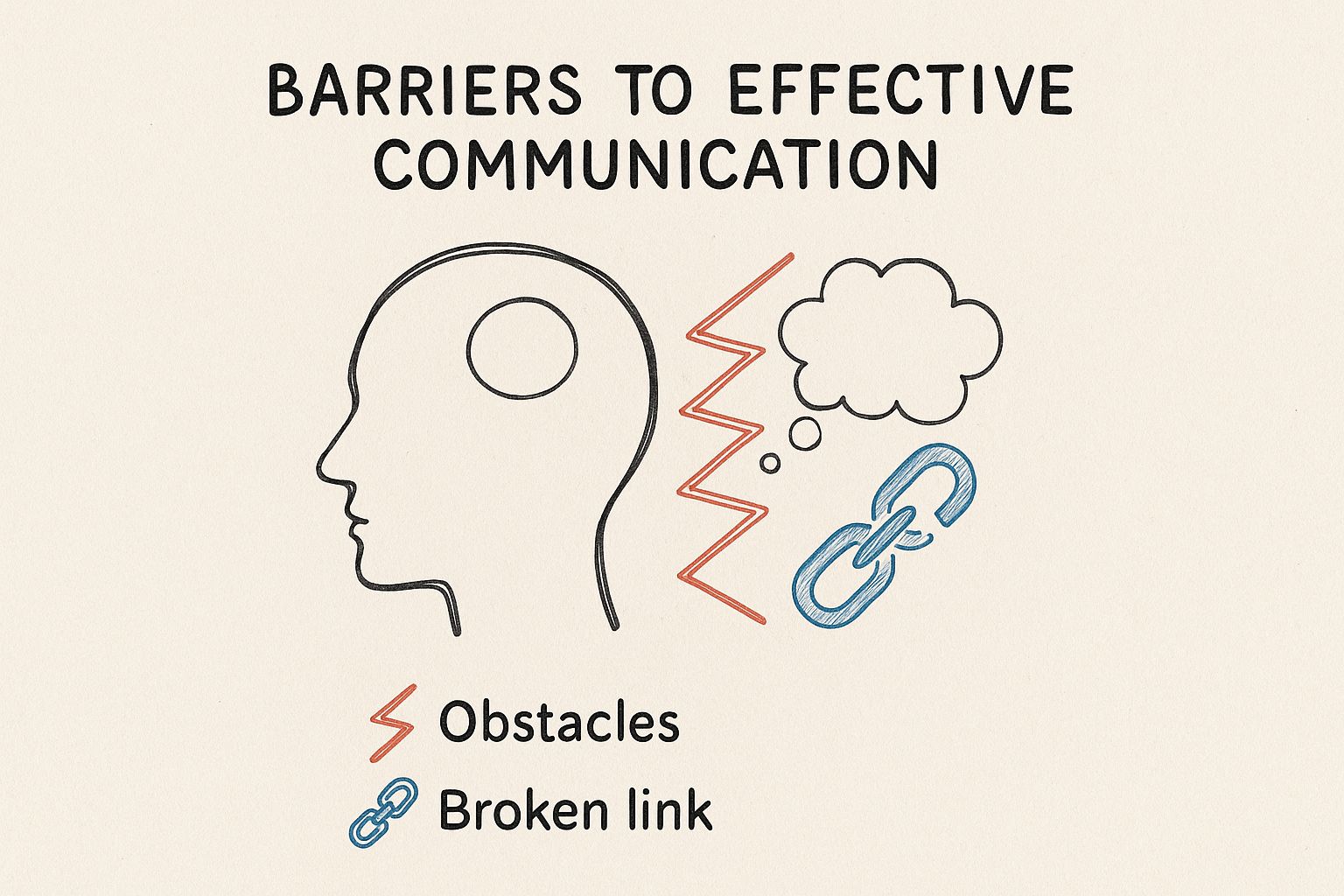
As you can see, what starts as a simple thought can easily get distorted. This is why having clear, multi-directional pathways is non-negotiable.
Horizontal and Diagonal Communication: Where Collaboration Happens
Horizontal communication (sometimes called lateral communication) is the conversation that happens between peers—people at the same level. This is the engine of day-to-day teamwork. Think of the third-grade teaching team huddling to coordinate lesson plans or the communications and admissions departments syncing up for an open house event. It’s all about solving problems and coordinating efforts.
Then there’s diagonal communication, which cuts across different departments and levels. An IT specialist working directly with a science teacher to set up a new lab is a perfect example. This flow is becoming more and more common as projects get more complex and require input from a mix of experts.
These two flows are the antidote to departmental silos. They foster a culture where people work together, share ideas, and solve problems creatively. Without them, you get duplicated work, internal friction, and a whole lot of missed opportunities.
This table breaks down the four flows, showing what they do, how they work, and where they can go wrong.
Comparing Communication Flows Within an Organization
| Direction of Flow | Primary Purpose | Common Channels | Potential Pitfall |
|---|---|---|---|
| Downward | To inform, direct, and delegate tasks from leadership to employees. | Memos, official emails, newsletters, staff meetings. | Information can become distorted or lack context as it moves down. |
| Upward | To provide feedback, share progress, and report issues from employees to leadership. | Surveys, suggestion boxes, one-on-one meetings, performance reports. | Employees may fear being honest, or leadership may fail to act on feedback. |
| Horizontal | To coordinate tasks and solve problems between peers or departments. | Team meetings, collaborative software (e.g., Slack), shared documents. | Can lead to departmental "silos" if not managed well; conflicts may arise. |
| Diagonal | To share information and coordinate on projects across different levels and functions. | Cross-functional project teams, task forces, project management tools. | Can bypass formal channels, potentially causing confusion or authority issues. |
Ultimately, a truly effective communication strategy doesn't rely on just one or two of these. It builds and maintains clear, open pathways for all four, ensuring information gets where it needs to go, when it needs to get there.
Understanding the Core Communication Models
Behind every email, meeting, and hallway chat, there’s a framework that explains how information actually moves from one person to another. To really get a handle on what organizational communication is, we need to peek under the hood at these models. They reveal how our thinking has evolved—from seeing communication as a simple one-way street to understanding it as a complex, multi-lane highway of shared meaning.
Think of these models as a story unfolding. Each one builds on the last, giving us a richer, more accurate picture of what happens when people connect. Let's break down the three big ones, minus the dense academic jargon.
The Linear Model: A One-Way Megaphone
The most basic and oldest framework is the Linear Model of Communication. Picture a principal delivering a morning announcement over the school’s PA system. The message is crafted, sent through a channel (the intercom), and received by the audience (students and staff). That’s it. A straight line from sender to receiver.
This model treats communication like a one-way broadcast. There's no room for an immediate reply or reaction. The sender just pushes information out and hopes it lands the right way.
Where you might still see it:
- Emergency alerts: A fire alarm or lockdown text needs to go out fast and clear. There's no time for a discussion.
- Mass emails: A newsletter sent to your entire parent community is a classic example of one-to-many communication.
- Formal directives: A memo from the superintendent's office laying out a new district-wide policy.
Its limitations are pretty obvious, though. The Linear Model completely ignores the receiver’s interpretation, questions, or potential for misunderstanding. It’s a monologue, not a conversation.
The Interactional Model: A Slow Tennis Match
The Interactional Model takes a big leap forward by finally adding feedback to the equation. Imagine this one like a slow-motion tennis match or even sending letters through the mail. One person serves a message, the other person receives it and then, after a bit of a delay, returns a response.
This model understands that communication is a two-way street. A teacher sends home a progress report (message), and a parent emails back with a question the next day (feedback). It’s an exchange, but a sequential one.
This was a major step up because it recognized that the receiver isn't just a passive sponge. They have an active role, responding and helping to shape the conversation over time.
Still, the Interactional Model doesn't quite get it perfect. It presents communication as a neat, turn-by-turn activity. That’s not how most real-life conversations happen, where we are often talking, listening, and reacting all at once.
The Transactional Model: A Collaborative Brainstorm
This brings us to the most modern and accurate framework: the Transactional Model of Communication. Think of a vibrant brainstorming session where a marketing team is riffing off each other's ideas in real time. In this model, everyone is a sender and a receiver at the exact same time.
Communication isn't about taking turns; it's a dynamic, collaborative dance where everyone creates shared meaning together. The non-verbal stuff—a nod of agreement, a furrowed brow of confusion—is just as critical as the spoken words because it’s instant feedback that steers the conversation as it unfolds.
This model perfectly captures the energy of face-to-face meetings, team projects, and even fast-paced digital chats on platforms like Slack. The goal isn't just to send a message, but to build a mutual understanding. It accepts that our personal experiences, our culture, and our relationship with the other person all color how a message is sent and received.
In this view, the responsibility for clear communication lands on everyone’s shoulders. It’s not just about what you say, but about working together to make sure everyone leaves the room on the same page. This is the gold standard for effective collaboration in any school or district today.
The Real-World Impact of Great Communication
Let's be honest: for a long time, "communication" was dismissed as a soft skill. It was nice to have, but not essential. That thinking is a fast track to failure. In reality, great communication is a hard asset with a direct, measurable impact on an organization’s performance.
When information flows freely and clearly, it's not just about making people feel good—it's about actively driving performance, sparking innovation, and building a stable, resilient workplace. Think of it as the central nervous system of your organization; without it, nothing else functions correctly.
The Financial Case for Clear Communication
The data tells a powerful story here. Poor communication isn't just an annoyance; it’s an incredibly expensive problem. Some surveys suggest that a staggering 70% of workplace failures can be traced back to miscommunication. That’s a huge number.
On the flip side, organizations that get this right reap massive financial rewards. Research from the Holmes Report found that companies with highly effective communication strategies were 3.5 times more likely to outperform their less-communicative competitors.
Even more impressive? These same companies delivered a 47% higher total return to shareholders over five years. The evidence, which you can dig into on the Duquesne University website, couldn't be clearer.
"Great communication builds trust. Trust is the currency of any successful organization, allowing teams to take risks, innovate, and navigate challenges together without succumbing to blame or fear."
When you treat communication as a strategic priority, it directly fuels your financial health and gives you a serious competitive edge. It's not magic; it's just smart business.
Boosting Productivity and Reducing Turnover
Beyond the balance sheet, the day-to-day operational benefits are just as compelling. Clear, consistent, and empathetic communication is one of the most powerful tools you have for keeping your best people. When employees know what’s expected, get regular feedback, and feel a real connection to leadership, they stick around.
This creates a ripple effect of positive outcomes:
- Reduced Conflict: So many workplace disputes start with a simple misunderstanding. Clear communication nips that in the bud.
- Increased Productivity: When teams are aligned on goals, they work faster and make fewer mistakes. It’s that simple.
- Lower Turnover Costs: Keeping great employees saves a fortune in recruiting, hiring, and training costs.
At the end of the day, investing in communication is investing in the core health of your organization. It builds a culture where people feel empowered and motivated to do their best work. If you're ready to see where you stand, a great starting point is our guide on how to measure communication effectiveness.
Turning Theory Into Action: Practical Ways to Improve Communication
Knowing the models of organizational communication is one thing, but making a real difference means putting those ideas to work. It's time to move from the whiteboard to the real world with intentional, practical strategies that get information flowing freely throughout your school or district.
The aim here is to stop just "sending messages" and start building a true communication system. That means creating an environment where feedback is encouraged, directives are crystal clear, and your teams have the right tools to collaborate effectively.
Build Robust Feedback Loops
One of the most powerful shifts you can make is strengthening that upward channel of communication. You do this by creating reliable, easy-to-use feedback loops. When your staff feel genuinely heard, they're not just more engaged—they offer priceless insights that leadership can't possibly see from the top.
Here are a few ways to get started:
- Launch Regular Pulse Surveys: Ditch the giant, once-a-year survey. Instead, use short, frequent surveys to get a quick read on specific topics, like a new school policy or general staff morale.
- Open Up Multiple Channels: Give people options. Think anonymous suggestion boxes (both digital and physical), a dedicated email for ideas, or even scheduled open-door hours with administrators. Not everyone feels comfortable speaking up in the same way.
- Always "Close the Loop": This is the non-negotiable step. You have to acknowledge the feedback you get and let people know what you're doing with it. Even if the answer is explaining why you can't act on a suggestion, that response builds incredible trust. It shows you're actually listening.
Creating a culture of feedback starts with understanding different types of feedback and how each can be used to have more constructive conversations.
Get Everyone on a Unified Messaging Calendar
Downward communication often breaks down because of chaotic timing, not a bad message. Imagine a family calendar, but for your school's official announcements. A unified messaging calendar brings much-needed order, ensuring parents, staff, and students get clear, consistent information without being bombarded.
This shared calendar should be the single source of truth for all major announcements, newsletters, and campaigns, accessible to department heads and school leaders. It’s a simple way to prevent message fatigue and make sure your most critical updates don't get buried. When you coordinate your outreach, you look like a polished, unified team.
Transparency is the bedrock of trust. When you're open about your processes, decisions, and even your challenges, you empower your community and create a culture where people feel respected and included.
Equip Your Teams for Horizontal Collaboration
Silos are where good ideas go to die. To break them down and get your teams talking across departments, you need to give them the right tools and a clear process. Water cooler chats are great, but structured platforms make collaboration far more efficient and visible.
Think about tools that are built for teamwork:
- Project Management Software: Platforms like Asana or Trello are fantastic for this. They create total clarity around who is doing what and by when, making cross-departmental projects feel less like a mystery.
- Shared Document Platforms: If you're not already using Google Workspace or Microsoft 365 for real-time collaboration, you're missing out. It's the simplest way to kill version-control nightmares and those endless email chains.
Giving your people these kinds of resources removes friction and makes it genuinely easier for them to work together. If you're looking to go deeper on this, our guide on how to improve internal communications has even more specific strategies you can use.
Your Questions, Answered
Even with the best models and a clear plan, questions always pop up when you're in the trenches. Let's tackle some of the most common ones that school leaders and marketing teams run into.
What's the Single Biggest Thing That Kills Communication?
It’s one word: mistrust.
When your staff doesn't trust leadership, every message you send—no matter how well-crafted—is viewed through a lens of suspicion. People stop listening to official channels and turn to the rumor mill instead. That's where misinformation, anxiety, and disengagement fester.
Trust is the bedrock. Without it, you can forget about honest feedback, genuine buy-in, or real collaboration. All other communication problems, like unclear messages or departmental silos, just get worse when trust isn't there. Building it has to be priority number one.
How Is This Different From Corporate Communication?
Good question. They're related, but they have different jobs. Here’s a simple way to think about it:
- Organizational Communication is your school's internal nervous system. It’s all about how information moves inside the building—aligning your teachers, building your culture, and making sure everyone is pulling in the same direction. Think staff meetings, internal newsletters, and feedback channels.
- Corporate Communication is your school's external megaphone. This is how you talk to the world outside your walls—prospective families, the media, donors, and the wider community. This covers your public relations, brand messaging, and crisis response.
Basically, organizational communication strengthens your school from the inside out, while corporate communication projects that strength to the world.
What's the Most Important Role a Leader Plays in All This?
A leader's most critical role is to personally model the communication culture they want to see. Everyone else is watching and taking their cues from the top. If a principal is transparent, listens more than they talk, and actively seeks out different opinions, that behavior will trickle down and become the norm.
Leaders are the architects of their organization's communication environment. Their actions—or inactions—set the standard for how everyone else interacts, shares information, and collaborates.
It's all about walking the talk. A leader who preaches "open doors" but shoots down every new idea will quickly foster a culture of silence and compliance. On the flip side, a leader who consistently practices clear, empathetic, and two-way communication creates the psychological safety needed for a healthy and high-achieving team. They can't just set the strategy; they have to live it. Every single day.
Ready to build an unstoppable communication strategy for your school? The MarCom Society is an exclusive community for K-12 marketing professionals who want to connect, learn, and lead. Gain access to expert workshops, practical resources, and a network of peers who understand your challenges. Join us today and start transforming your school's communication from the inside out.









