
Public relations is the strategic process of managing how information about your school is shared with the public, including parents, staff, and the community.
Defining Public Relations Beyond Press Releases

When many school marketers hear the term "public relations," their minds often jump straight to writing a press release for an upcoming event. While that’s certainly part of the job, it’s just one small brushstroke in a much larger masterpiece. To really answer the question, what is public relations?, we have to look past those one-off announcements.
At its heart, PR is the art and science of building and protecting your school’s reputation. Think of yourself as your school's chief storyteller and relationship builder. Every school has a unique story—its mission, the incredible achievements of its students, the passion of its faculty. Public relations is about strategically shaping how that story gets told, who hears it, and how they feel about it.
PR Is Not Just Marketing in Disguise
It's easy to lump PR and marketing together, but they operate on different principles. Marketing often involves paying for space to get your message out there—think social media ads or print brochures. Public relations, on the other hand, is all about earning attention and trust. It's the ongoing, deliberate effort to build positive relationships with everyone who has a stake in your school's success.
This strategic management of perception involves several key activities:
- Shaping Public Opinion: Proactively sharing news and stories that showcase your school's strengths, values, and impact.
- Building Relationships: Engaging with local journalists, community leaders, and even your own staff to create a powerful network of advocates.
- Managing Reputation: Keeping a finger on the pulse of what people are saying about your school and responding thoughtfully to both praise and criticism.
- Communicating in a Crisis: Serving as the calm, clear, and trusted voice during difficult or unexpected events.
The goal of PR isn't just to be seen; it's to be understood, respected, and trusted. It’s about creating an environment where your school's mission can thrive because it has the backing of its community.
To help clarify the distinction, let's break down how PR and marketing differ in a school setting.
Public Relations vs Marketing at a Glance
This table offers a quick comparison of the primary goals, metrics, and channels for public relations and traditional marketing.
| Aspect | Public Relations (PR) | Marketing |
|---|---|---|
| Primary Goal | Build trust, credibility, and a positive reputation. | Drive enrollment, promote programs, and generate leads. |
| Key Metrics | Media mentions, sentiment analysis, community engagement. | Enrollment numbers, website traffic, conversion rates. |
| Channels | Press releases, community events, crisis communications, media relationships. | Paid ads, social media campaigns, school website, email marketing. |
| Control | Messages are filtered through third parties (e.g., journalists). | Full control over the final message, timing, and placement. |
| Cost | "Earned media" is generally lower cost but requires significant time and effort. | "Paid media" involves direct budget allocation for ad space. |
While they have distinct functions, the most successful school communication strategies integrate both PR and marketing seamlessly.
Ultimately, a strong PR program ensures your school's narrative is authentic, consistent, and compelling. It’s a proactive function that lays the foundation for long-term growth and community support. For a deeper dive into building your school's profile, you can learn more about how to improve brand awareness in our detailed guide.
The Core Functions of a School PR Program
A strong public relations program isn't a one-trick pony. It’s a carefully coordinated effort, a set of strategic functions all working in concert to shape and protect your school's reputation. Getting a handle on these core components is the first real step toward building a plan that genuinely resonates with your community.
These functions aren't just abstract ideas; they play out in the daily life of a school. It's no surprise that the global public relations market is expected to jump from $105.12 billion in 2025 to $132.52 billion by 2029. This growth is fueled by a demand for more authentic communication, a trend that directly impacts education. You can read the full research about these PR market trends to see how this shift is playing out.
This image neatly summarizes the main pillars that hold up a modern PR strategy.
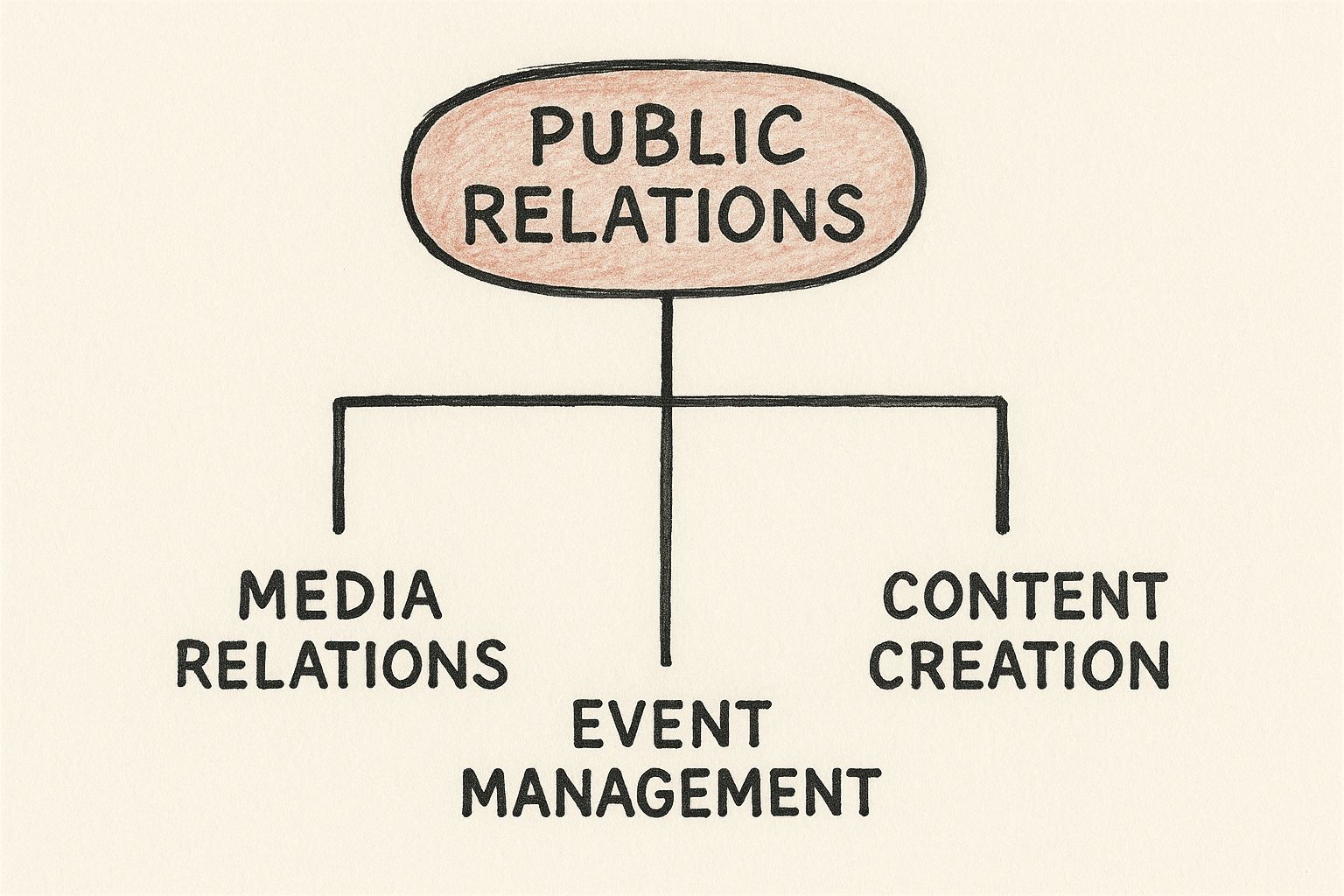
As you can see, essential activities like media relations, community engagement, and even crisis planning are all interconnected, supporting your school's big-picture communication goals.
Mastering Media Relations
Think of media relations as the art of building real, professional relationships with the people who tell stories—journalists, bloggers, and your local news teams. It’s so much more than just firing off a press release into the void and crossing your fingers. The goal is to become their go-to, trusted source for anything related to education in your area.
For instance, don't just announce the annual science fair. Instead, you could pitch a specific, compelling story to a local reporter about a student's incredible project. That human-interest angle is what grabs attention and earns the kind of positive media coverage that makes a difference.
Driving Community Engagement
This is all about weaving your school into the very fabric of the community. It involves actively creating and nurturing partnerships with local businesses, non-profits, and, of course, your families. This function is what keeps your school from feeling like an isolated institution.
Effective community engagement could look like a few different things:
- Hosting Community Events: Think of a free coding workshop open to all local families or organizing a neighborhood park cleanup.
- Partnering with Local Businesses: You could team up with a nearby bookstore for a city-wide reading challenge.
- Engaging Civic Groups: Why not present at a Rotary Club meeting to share exciting updates on your school's latest programs?
These aren't just feel-good activities. They demonstrate your school’s value far beyond academics and build a reserve of goodwill that you can draw on for years.
By becoming an active participant in your community, you build a network of advocates who champion your school because they feel a personal stake in its success.
Strengthening Internal Communications
While public relations often feels like it's all about looking outward, what happens inside your walls is just as crucial. Internal communications ensure that your own team—staff, teachers, and current families—are all informed, engaged, and pulling in the same direction.
When everyone is on the same page, your staff becomes your most passionate and believable brand ambassadors. That genuine positivity they feel naturally radiates out to students, parents, and the rest of the community.
Preparing for Crisis Management
Last but certainly not least is crisis management. This is the proactive, behind-the-scenes work of preparing for the unexpected. Whether it’s a sudden school closure due to weather, a public health issue, or a potential threat to your reputation, a solid plan is non-negotiable.
This means having clear communication protocols ready to go, designating key spokespeople, and even drafting template statements in advance. A well-oiled crisis plan can be the single most important factor in protecting your school's reputation and maintaining community trust when things get tough.
Why Public Relations Is a Game Changer for Schools
A solid public relations strategy does so much more than just create buzz. It’s what builds the deep-seated trust that turns curious parents into enrolled families. It’s the real difference between a school that just exists in a community and one that's a vital part of it.
Think of it this way: PR is a direct investment in your school's brand and its long-term health.
Let's imagine two schools in the same town. School A sticks to traditional marketing—flyers, maybe a few ads for the annual open house. School B, on the other hand, is playing a different game with a proactive PR plan.
When a local TV station starts looking for a story on innovative teaching, School B’s communications lead is ready. They’ve already built a relationship with the reporter and can immediately pitch a feature on their new student-led robotics club.
That positive news segment, seen by thousands in the community, accomplishes something an advertisement never could. It offers third-party validation and builds genuine, lasting credibility.
Building Trust and Enhancing Reputation
This earned trust is everything. While School A remains just another option for parents, School B becomes known as "the school with that incredible robotics team." That kind of positive reputation doesn't just happen; it's the direct result of consistent and strategic storytelling.
A strong PR program is absolutely essential for shaping a school's image, which is a core component of effective branding. It ensures that when people search for your school online, they find stories of student success, faculty innovation, and community spirit.
This carefully managed perception is critical for your school's future. You can dive deeper into building and protecting your school’s image with these tips on proactive school reputation management.
Public relations isn’t an expense; it’s an investment in your school’s most valuable asset: its reputation. A strong reputation attracts talented staff, engages the community, and makes enrollment goals easier to achieve.
Driving Enrollment and Attracting Talent
The ripple effect of good PR flows directly to your most important metrics. When your school is consistently seen in a positive light, it creates a powerful magnetic pull.
- Prospective Families: Parents are far more likely to trust a news story or a recommendation from a community leader than a paid ad. A steady drumbeat of positive PR keeps your school top-of-mind and builds a healthy pipeline of interested families.
- Top-Tier Faculty: Great teachers want to work at schools with a strong, positive reputation. Using PR to showcase your supportive culture and innovative programs helps you stand out in an incredibly competitive hiring market.
Ultimately, public relations completely changes how your school is perceived. Instead of you constantly telling everyone how great you are, you create an environment where others—the media, community leaders, and happy parents—start telling that story for you. That fundamental shift is what turns a good school into a truly respected and sought-after institution.
How to Build Your School's Public Relations Strategy

Knowing what public relations is gets you to the starting line. Actually building a workable plan is where the race is won. For many school marketing teams, creating a PR strategy from scratch feels like a monumental task, but breaking it down into logical steps makes it completely manageable.
Think of your strategy as a roadmap. Without one, you’re just wandering—telling random stories and hoping they land. A clear plan ensures every press release, social media post, and community event purposefully moves you toward a larger goal.
The proof is in the numbers. The global public relations market is exploding, from $88 billion in 2025 to a projected $129 billion by 2026. This isn't just corporate growth; it shows a widespread understanding that strategic communication is the key to building trust and credibility for any organization, schools included.
Define Your Key Audiences
Before you craft a single message, you have to know who you’re talking to. Your school communicates with many different groups, and each one cares about different things. A generic, one-size-fits-all message will resonate with no one.
So, who are you trying to reach? Your key audiences probably include:
- Prospective Families: These are the parents and students actively searching for the right fit.
- Current Families: They are your built-in community and your most powerful ambassadors.
- Faculty and Staff: Your internal team—they need to feel informed, valued, and connected to the mission.
- Community Leaders: Local officials, business owners, and non-profit heads can become incredible allies.
- Local Media: Journalists and bloggers hold the keys to reaching a much wider audience.
Once you’ve mapped out these groups, you can tailor your stories to what matters most to them. This is the bedrock of a solid communication plan. For a deeper dive, our guide on creating a https://blog.marcomsociety.org/stakeholder-communication-plan/ is a great resource.
Set Measurable PR Objectives
What, exactly, are you trying to achieve with your PR efforts? A vague goal like “improve our reputation” is impossible to track. You need to get specific. This is where SMART objectives—specific, measurable, achievable, relevant, and time-bound—come into play.
A great PR objective moves beyond generalities and focuses on tangible outcomes. Instead of "get more media coverage," aim for "secure three positive media placements in local news outlets this semester."
Here are a few examples of strong PR objectives for a school:
- Increase positive social media mentions of our new STEM program by 20% over the next six months.
- Land one feature story in a regional parenting magazine before the next open enrollment period.
- Boost faculty and staff attendance at our internal town halls by 30% this school year.
These kinds of goals give your team clear targets and make it much easier to show the real impact of your work.
Craft Your Core Messages and Choose Your Channels
Now that you know your audience and your goals, it's time to figure out what to say and where to say it. Your core messages should be simple, consistent, and directly reflect what makes your school special. What’s your unique story? What are the key takeaways you want people to remember?
Finally, match those messages to the right channels for each audience. This could be a mix of school newsletters for current parents, social media for prospective families, personal outreach to community leaders, and press releases for local media. As you build out these digital channels, understanding strategies for effective digital outreach is crucial for making sure your story finds the right people online and boosts your school's visibility.
Common PR Misconceptions in Education

Before we can really dig into what public relations is, we have to clear the air about what it isn't. I've seen too many schools miss out on the incredible power of PR because they're held back by a few persistent myths.
These misconceptions can stop a school's leadership team from investing in a strategy that is absolutely essential for building long-term trust and sustainable growth. Let's tackle these head-on.
Myth 1: Public Relations Is Only for Crises
One of the biggest misunderstandings is that PR is just the emergency service you call when a crisis hits. While crisis management is definitely part of the job, treating PR as a reactive tool is like trying to build a roof in the middle of a thunderstorm. It’s too late.
The real magic happens when you're proactive. Year-round PR work builds a strong foundation of trust and goodwill within your community. Think of it as building up a reservoir of positive sentiment—it becomes your greatest asset when challenges inevitably pop up.
Waiting for a crisis to start thinking about PR means you're always playing defense. The goal is to get on offense. It's about consistently sharing stories of student achievements, teacher innovations, and community partnerships long before you ever have to manage a single piece of bad news.
This ongoing storytelling ensures that when a tough situation does arise, your community's first thought isn't based on the current problem, but on the well-established, positive perception of your school you've already built.
Myth 2: Our School Is Too Small for PR
I hear this one all the time: "PR is a luxury for large, well-funded districts." Honestly, that couldn't be further from the truth. In many ways, smaller schools and districts can benefit even more from a smart, focused PR strategy. You don’t need a massive team or a six-figure budget to make a real impact.
Public relations can, and should, be scaled to fit any budget. A smaller school might start by focusing on building a great relationship with one key local reporter. Or maybe it's creating a simple but heartfelt monthly parent newsletter. It could even be as straightforward as getting more active and engaging on a single social media channel.
These targeted efforts can generate incredible momentum without a huge financial investment.
Public relations isn't about the size of your budget; it's about the consistency and authenticity of your story. A small school with a compelling narrative and a direct line to its community can create a powerful and positive reputation.
Myth 3: PR Is Too Expensive and Hard to Measure
Finally, there's the hesitation around cost and ROI. Many school administrators are wary of investing in PR because they think its impact is fuzzy and the price tag is too high. But while PR success isn't always measured in a simple metric like enrollment numbers, its value is absolutely undeniable and, yes, it can be tracked.
Today's tools give us a much clearer picture. We can easily monitor:
- Media Mentions: How often is your school being talked about in the local news or online?
- Website Traffic Referrals: Are people clicking through to your website from a news article or a blog mention? We can see that.
- Social Media Engagement: Is the conversation around your school growing? Are positive comments and shares on the rise?
These metrics provide solid evidence of how PR is boosting your school's reputation and visibility. A thoughtful PR strategy isn't an expense; it's a critical investment in your most important asset—your community's trust.
Answering Your Top School PR Questions
Knowing the theory behind public relations is one thing, but actually putting it into practice is a whole different ballgame. As soon as you decide to get more intentional with your PR, the practical "how-to" questions start bubbling up. This final section is all about giving you clear, straightforward answers to the most common questions we hear from K-12 marketers who are ready to turn all this knowledge into action.
Think of this as your quick-start guide for hitting the ground running. We’ll tackle how to measure what really matters, the very first steps to take if you’re starting from scratch, and where social media fits into the whole puzzle.
How Do I Measure the Success of School PR?
This is one of the biggest hurdles for school marketers: proving the value of your PR work. While you can't always draw a perfectly straight line from a press release to a new student enrollment, you can absolutely track meaningful metrics that show the impact you’re having. Success in PR isn't just about counting website clicks; it's about measuring a real shift in how people feel about your school.
To get the full picture, you'll want to look at a mix of both qualitative and quantitative data:
- Media Mentions and Sentiment: Don't just count how often your school is in the news. Pay attention to the tone of the coverage. Is it positive? Neutral? Negative? There are tools out there that can help you monitor this automatically.
- Website Referral Traffic: Pop into your website analytics and see how many visitors are coming from your earned media. Did that local news article about your science fair winners send a wave of new visitors to your site? That’s a win.
- Social Media Engagement: Look past the follower count. Are people commenting, sharing your posts, and sending direct messages? A high engagement rate is a fantastic sign that your stories are actually connecting with your community.
- Stakeholder Surveys: Every so often, check in with parents, staff, and the wider community. A simple survey can help you gauge their perception of the school. Seeing that perception trend upward over time is powerful proof that your PR is working.
At the end of the day, measurement is about showing how your PR efforts are building a stronger reputation and fostering deeper trust in the community. These metrics are the evidence you need to justify your work and make your strategy even smarter.
What Are the First Three Steps for a School with No PR Program?
Starting from a dead stop can feel overwhelming, but you don't need a massive, hundred-page plan on day one. A few focused, strategic first steps can build some incredible momentum and lay a solid foundation for everything that comes next.
If your school has no real PR program to speak of, here are the first three things you should do:
- Conduct a Simple Communications Audit: Before you can map out your future, you have to understand your present. Take a week and gather up every single piece of communication your school sends out—newsletters, social media posts, website updates, letters home, you name it. This quick audit will show you what you're currently saying, where you're saying it, and where the obvious gaps are.
- Identify One Compelling Story: You don’t need to tell every story at once. Just find one. A single, powerful story that perfectly captures your school's mission. Maybe it’s a unique student project, an inspiring teacher who goes above and beyond, or a new partnership with a local business. Make that one story your entire focus for the first month.
- Build a Small, Targeted Media List: Forget blasting a press release to every journalist in the state. Instead, identify just three to five local reporters, bloggers, or community news editors who cover education or family-focused topics. Start by simply following their work and engaging with them professionally online long before you ever think about sending them a pitch.
These first steps are manageable, don't cost much, and will immediately start building the right habits for a successful, long-term PR program.
How Does Social Media Fit into a PR Strategy?
Back in the day, public relations was mostly a one-way street. Schools pushed information out through traditional media gatekeepers like newspapers and TV stations. Social media completely flipped that script. It’s now a vital, two-way communication channel that puts you in direct conversation with your entire community.
Ignoring comments or failing to engage in conversations on social media is a huge risk. Unanswered questions and unaddressed concerns don't just fade away; they often get louder somewhere else. Your school’s reputation is being shaped on these platforms every single day, whether you’re part of the conversation or not.
So, weaving social media into your PR strategy really means using these platforms to:
- Listen Actively: Pay attention to what students, parents, and community members are saying about your school online.
- Share Your Stories Directly: You don't have to wait for a reporter to pick up your story anymore. You can share it yourself, right now.
- Engage in Real-Time: Jump in to answer questions quickly, celebrate your community's successes, and address concerns with transparency.
Think of social media as the modern front porch of your school. It’s where you build relationships, manage your reputation in the moment, and show your community you're truly listening.
Ready to build a thriving community and master your school's marketing strategy? The MarCom Society offers exclusive resources, expert-led workshops, and a supportive network of K-12 professionals just like you. Join us to elevate your skills and make a bigger impact at https://marcomsociety.org.









