
Search Engine Optimization, or SEO, is all about making your website more visible—and more appealing—to search engines like Google. It’s the practice of sending the right signals to show that your school's content is a trustworthy and relevant answer to what a parent is searching for.
Simply put, the higher your site ranks, the more likely you are to connect with the families you want to attract.
What Is SEO and Why Does It Matter
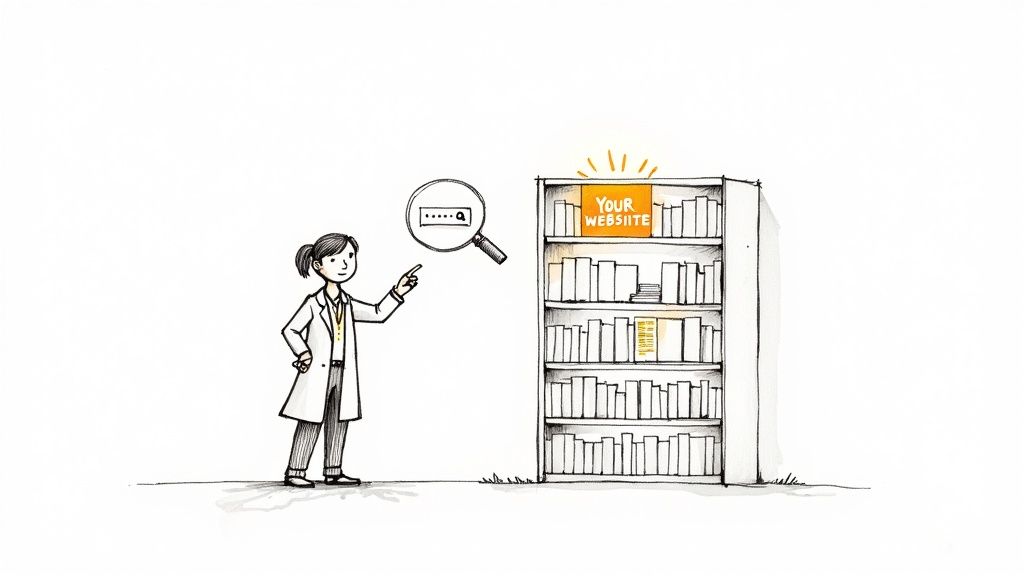
Let’s break this down with an analogy. Think of the internet as a gigantic library and Google as the incredibly smart head librarian. Your school's website is a book on one of the millions of shelves. SEO is how you make sure your book is easy for that librarian to find, understand, and confidently recommend to people looking for exactly what you offer.
This isn’t about trying to trick the system. It’s a thoughtful strategy focused on proving your website's value. That means creating genuinely helpful, high-quality content for your audience and making sure your site is technically solid so search engines can easily read and categorize it.
When you get it right, SEO puts you directly in front of prospective families who are actively searching for a school just like yours. For anyone in K-12 marketing, this is an essential piece of the puzzle. A solid SEO strategy ensures your school’s unique programs and mission are seen by the right people, right when they're looking.
At its heart, SEO aims to boost organic (non-paid) traffic to your website by earning higher rankings in search engine results pages (SERPs). This visibility builds credibility and drives real engagement.
Essentially, a good SEO plan helps you:
- Increase Visibility: Show up higher in search results when parents look for terms like "best private schools near me" or "kindergarten programs with STEM focus."
- Build Trust: A high ranking acts as a stamp of approval from Google, building trust with your audience before they even click through to your site.
- Generate Qualified Leads: SEO brings in families who are already looking for what your school offers, making them much stronger potential applicants.
Key Benefits of SEO at a Glance
To quickly summarize, here's a look at the primary advantages that a well-executed SEO strategy brings to your school.
| Benefit | What It Means for You |
|---|---|
| Increased Brand Visibility | Your school appears more frequently in front of actively searching families. |
| Higher Quality Traffic | Attract parents who are genuinely interested in your programs and values. |
| Enhanced Credibility & Trust | High search rankings signal authority and trustworthiness to your audience. |
| Cost-Effective Marketing | Organic traffic from SEO is "free," offering a high return on investment over time. |
| Competitive Advantage | Outranking competing schools puts you at the top of a family's consideration list. |
| Long-Term Results | Unlike paid ads, a strong SEO foundation provides lasting benefits and consistent traffic. |
Ultimately, investing in SEO isn't just a technical task—it's a strategic move that delivers sustainable growth and strengthens your school's reputation in the community.
For a deeper dive into how this applies specifically to schools, our guide on https://blog.marcomsociety.org/seo-for-education-websites/ offers tailored insights. For a comprehensive understanding of the foundational concepts, you can also refer to resources such as a complete guide to what is Search Engine Optimization.
The Evolution of SEO: From Keywords to User Experience
To really get a handle on SEO today, it helps to take a quick look back at where it came from. In the early days of the internet, SEO was a much cruder game. It felt more like a technical exercise in outsmarting simple algorithms than it did about actually helping people.
This period is often called the "Wild West" of SEO, and for good reason. It was all about tactics like keyword stuffing. People would cram a target keyword onto a page as many times as possible—sometimes even hiding it in white text on a white background—just to get a search engine's attention. The focus was 100% on the keyword, with little to no thought for the actual human reading the page.
The PageRank Revolution
Then, everything changed. As search engines like Google got smarter, the old tricks stopped working. While the term "Search Engine Optimization" was coined around 1997, it was Google's PageRank algorithm in 1998 that truly flipped the script. For the first time, a search engine started looking at a website's authority and relevance, not just how many times a keyword appeared. You can explore more on the history of SEO to see how this foundation was laid.
This forced a huge shift in strategy. Suddenly, SEO wasn't just about what was on your page; it was about your school's reputation across the entire web. The quality and number of links pointing to your site became a massive signal of trust, and the game changed from gaming the system to earning genuine credibility.
Google's major algorithm updates, like Panda (which cracked down on thin, low-quality content) and Penguin (which penalized spammy links), were pivotal moments. Each update pushed the industry closer to a user-first mindset, rewarding sites that provided real value.
From Algorithms to Audiences
That brings us to where we are now. Modern SEO is all about the user experience (UX). Google's algorithms are incredibly sophisticated today. They can understand context, what a searcher is really looking for (their intent), and the overall quality of someone's visit to your website.
Instead of just asking, "Does this page have the right keywords?" Google now asks questions like:
- Does this page load quickly, especially on a smartphone? Site speed and mobile-friendliness are direct ranking factors because they’re huge parts of a good user experience.
- Do people stick around, or do they hit the back button right away? A high "bounce rate" tells Google that your page probably wasn't what the searcher wanted.
- Is the content well-organized, easy to read, and genuinely helpful? Quality and clarity are everything.
This whole journey explains why today's SEO is a mix of technical best practices, great content, and a deep understanding of your audience. It's no longer about tricking a machine. It's about creating a better, more helpful online experience for the prospective families you’re trying to connect with.
Breaking Down the Three Pillars of SEO
Trying to understand SEO can feel like staring at a puzzle with a thousand scattered pieces. The best way to make sense of it all is to group those pieces into a simple, logical framework. Today, modern SEO really boils down to three core pillars that all work together: Technical SEO, On-Page SEO, and Off-Page SEO.
Let’s think of your school's website as a brand-new building you're constructing. Each of these pillars represents a crucial stage of the project. If one is shaky, the whole structure suffers. But when all three are strong, you build a powerful online presence that both families and search engines will trust.
This framework is your blueprint. It helps you organize your efforts and see how different tasks all point toward the same goal: getting found online.
The infographic below shows how SEO has evolved over the years, moving from simple tricks to the well-rounded approach we use today.

As you can see, the focus has shifted from basic keywords to a much more holistic strategy centered on authority and user experience—which is exactly what these three pillars are all about.
Pillar One: Technical SEO
Think of Technical SEO as the foundation of your house. It’s all the behind-the-scenes work that makes sure search engines can find, crawl, and index your website without running into any problems. If that foundation is cracked, everything you build on top of it is at risk.
You could write the most compelling content about your school's unique programs, but if Google's bots can't even access your pages, that content is basically invisible. Technical SEO isn't about the words on the page; it's about the infrastructure that delivers them.
Key parts of technical SEO include:
- Crawlability and Indexability: Can search engine "spiders" easily navigate your site and add your pages to their massive library? This is job one.
- Site Speed: Your pages need to load fast. A study found that 47% of consumers expect a website to load in two seconds or less. Any longer, and they're gone.
- Mobile-Friendliness: With most parents searching on their phones, your website has to work perfectly on any device. Google now uses mobile-first indexing, making this non-negotiable.
- Site Architecture: This is how your site is organized. A logical structure helps both users and search engines understand how your content is related.
Pillar Two: On-Page SEO
Once you have a solid foundation, you can start decorating the inside of your house. That's On-Page SEO. This pillar covers everything you can see and interact with on a webpage—the content, the images, and even the underlying HTML code. It's how you tell search engines what your content is about and which searches it should appear for.
This is where you have the most direct control. On-page work is all about creating high-quality, relevant content that directly answers the questions prospective families are asking. It’s about being helpful, clear, and strategic.
On-Page SEO is the art and science of creating content that is loved by both your target audience and search engine algorithms. It’s about clarity, relevance, and providing a great user experience on the page itself.
Effective on-page SEO focuses on elements like:
- Keyword Research: Finding the actual terms and phrases parents use when searching for schools like yours.
- Content Quality: Creating in-depth, valuable articles and pages that truly solve a searcher's problem or answer their question.
- Title Tags and Meta Descriptions: Writing the compelling headlines and summaries that show up in search results and make people want to click.
- Header Tags (H1, H2, H3): Using headings to structure your content. This makes it easier for people to read and for search engines to understand.
Pillar Three: Off-Page SEO
Finally, Off-Page SEO is your building's reputation around the neighborhood. It includes everything you do outside of your own website to boost your authority and improve your rankings. It's all about building trust and credibility.
Google’s goal is to recommend sites that are respected experts. One of the clearest signals of respect is when other trustworthy websites link to yours. Each of these links, called a backlink, acts like a vote of confidence, telling search engines that your content is worth paying attention to.
But it’s not just about getting as many links as possible; quality is what truly matters. A single backlink from a well-regarded local news site or an educational authority is worth far more than a hundred links from spammy, unknown websites. These external signals prove that others endorse your school, solidifying your position as a trusted voice in the community.
On-Page SEO: Creating Content People and Search Engines Love
With your technical foundation sorted, it's time to shift focus to the part that prospective families actually see and interact with: your content. This is the heart of On-Page SEO. It’s everything you can directly control on any given page of your website, from the words and images to the HTML code working behind the scenes.
Think of it like this: if technical SEO is the architecture of your school building, on-page SEO is the interior design. It's how you furnish each room (or webpage) to make it welcoming, informative, and genuinely useful for every family that walks through the virtual door. It’s all about creating content that answers their questions, calms their anxieties, and helps guide them on their journey.

The first step is always to get inside the head of a parent and understand their search intent. What are they really trying to find when they type "best kindergarten programs near me" into Google? Are they just starting their research and need a list of options? Or are they further along, looking for specifics on curriculum, tuition, or after-school care? Nailing this intent is the secret to creating content that truly connects.
Key Elements of On-Page SEO
Getting your on-page SEO right means blending the art of communication with the science of search. It's more than just putting words on a page; it’s about strategic execution. While there are many factors involved, the practice of writing SEO optimized content really boils down to a few core fundamentals.
Here are the most important elements for any K-12 marketer to get right:
- High-Quality Content: This is non-negotiable. Your content must be well-written, accurate, and genuinely valuable. For a school, this looks like detailed program pages, blog posts that share your unique educational philosophy, and crystal-clear admissions information.
- Keyword Optimization: Once you know what parents are searching for, you can weave those keywords and phrases into your content. The key is to make it feel completely natural, not like you're stuffing words in for a robot.
- Title Tags and Meta Descriptions: Think of these as the headline and short summary that show up in Google's search results. A great title tag and meta description serve as a mini-ad for your page, enticing parents to click your link instead of the one above or below it.
- Header Tags (H1, H2, H3): Headers give your content structure, making it much easier for busy parents to scan and read. They also send strong signals to search engines about what your page is about and how the information is organized.
- Internal Linking: This is simply linking from one page on your site to another relevant page. For example, a blog post you wrote about your school's award-winning STEM program should definitely link back to the main STEM curriculum page. This helps families explore your site and shows Google how all your content is connected.
"On-Page SEO is where your message meets your audience. It's the critical step where you translate your school's unique value into language that both families and search engines can clearly understand and appreciate."
At the end of the day, great on-page SEO is about being clear and relevant. It ensures that when a family lands on your website, they instantly find the helpful, trustworthy information they were looking for. That positive experience tells Google that your page is a high-quality result, which is exactly what you want.
For a deeper dive, our guide to content marketing for education has more specific strategies designed just for schools.
Off-Page SEO: Building Your School's Reputation Online
Think of it this way: on-page SEO is everything you say about your school on your website. Off-page SEO, on the other hand, is what everyone else says about you across the internet. It’s all about the signals that happen away from your website that build your school's reputation and authority.
This is how Google decides if your school is a credible, trustworthy institution that it should recommend to parents searching for the best options in their area.
Imagine a new family moves to your town. They’re not just going to look at your school's brochure. They'll ask their new neighbors for recommendations, check out reviews on local parent forums, and see if you've been mentioned in the local news. Off-page SEO is the digital version of that word-of-mouth referral.
The single most important part of this equation is the backlink. A backlink is just a link from another website pointing to yours. It’s essentially a vote of confidence, a digital nod of approval.
Not All Links Are Created Equal
Let’s be clear: quality trumps quantity every single time. A single link from a well-respected local news station or a prominent education blog is worth more than a hundred links from spammy, irrelevant websites.
When a high-authority site links to you, Google sees it as a powerful endorsement. It tells the search engine that your school is a credible resource, which in turn boosts your own site's authority and helps you climb the search rankings.
At its core, a great off-page SEO strategy isn't about gaming the system. It's about building genuine relationships and creating content so helpful that other people can't help but talk about and link to it.
It's More Than Just Backlinks
While backlinks are the undisputed champion of off-page SEO, they aren't the only factor. Other activities help paint a full picture of your school's prominence online and are a key part of what search engine optimization truly is.
Here are a few other signals Google pays attention to:
- Brand Mentions: Even when a site mentions your school’s name without a link, search engines are smart enough to notice. Consistent mentions across the web help solidify your brand’s authority.
- Online Reviews: What are parents saying about you? Positive reviews on your Google Business Profile and other community directories are huge trust signals for both families and search engines.
- Social Media Buzz: While social shares aren't a direct ranking factor, a lively social media presence gets your content in front of more people. This naturally leads to more website traffic, brand mentions, and potential backlinks.
Ultimately, off-page SEO is about building a rock-solid digital reputation. When you earn high-quality links and cultivate a positive presence across the web, you're sending a clear message to Google: our school is a trusted leader in this community, and we deserve to be at the top of the search results.
Technical SEO: Ensuring Your Website's Foundation Is Solid
Technical SEO might sound a bit daunting, but its purpose is actually quite simple: to make it incredibly easy for search engines to find, crawl, and understand your school's website. I like to think of it as everything that happens backstage during a theater production. If the lighting, sound, and stage changes aren't working perfectly, the audience (and search engines) won't have a good experience, no matter how amazing the actors (your content) are.
This crucial piece of the what is search engine optimization puzzle is all about your website's infrastructure. It's about clearing any technical roadblocks that stand between your amazing content and the families you want to attract. You could have the most compelling mission and programs in the state, but if Google's crawlers can't properly access your pages, you're practically invisible online.
The Nuts and Bolts of a Healthy Website
So, what does this "backstage" work actually involve? Several key factors fall under the technical SEO umbrella. You don't need to be a coding whiz to grasp them, but knowing what they are is vital for any K-12 marketer trying to make an impact. After all, a slow or broken website can send a prospective family clicking away in an instant.
Here are a few of the foundational elements that directly influence both user experience and your search rankings:
- Site Speed: Your pages have to load fast. Seriously fast. Research shows that a mere one-second delay in page load time can lead to a 7% reduction in conversions. For a school, that could mean a tangible drop in campus tour requests or completed applications.
- Mobile-Friendliness: Let's face it, most parents are doing their school research on their phones—often in line at the grocery store or waiting for soccer practice to end. Your website absolutely must deliver a smooth, intuitive experience on any device.
- XML Sitemap: This is just a fancy name for a roadmap of your website that you hand directly to search engines. It guides them to all your important pages, making sure nothing important gets overlooked.
A strong technical foundation isn't just about making Google happy. It's about delivering a fast, reliable, and secure experience for every single family who visits your site. It’s the ultimate signal of a professional, well-run school.
Keeping Your Site in Top Shape
Just like your school's physical campus, your website needs regular maintenance to stay in great condition. Tackling technical issues isn't a one-and-done task; it's an ongoing process that keeps small glitches from turning into major problems that hurt your visibility.
A fantastic place to start is with regular check-ups. You can get a comprehensive picture of your site's health by learning how to do a website audit, which will help you pinpoint exactly where you need to improve. This proactive approach ensures your school's digital front door is always open, fast, and welcoming to both search engines and your future families.
Your Top SEO Questions, Answered
As you start to wrap your head around search engine optimization, a few key questions almost always pop up. Let's tackle them head-on so you can move forward with a clear plan.
How Long Does SEO Actually Take to Work?
This is the big one, isn't it? The honest answer is: SEO is a marathon, not a sprint.
You might see some small wins or minor ranking shifts within a few weeks, which is always encouraging. But for the kind of significant, needle-moving results—like landing on the first page for important keywords—you should plan on a timeline of 4 to 12 months.
Why such a wide range? Because success hinges on a few key things: the age and authority of your school's website, how competitive your local market is, and, most importantly, how consistently you apply your SEO efforts.
Can I Do SEO Myself, or Should I Hire Someone?
You can absolutely get started on your own! Tackling the on-page SEO basics we discussed earlier is a fantastic starting point for any school marketer. If your website is straightforward and your competition isn't too fierce, a DIY approach can get you pretty far.
However, if you're in a highly competitive area with dozens of other schools vying for the same families, bringing in an SEO professional might be the right move. Their deep expertise can help you build and scale a strategy that truly stands out.
What’s the Difference Between SEO and SEM?
Think of it like this: SEM (Search Engine Marketing) is the entire pizza, while SEO is one of the most important slices.
- SEO is all about earning traffic organically through unpaid search results. It’s the long-term game of building trust and authority with Google.
- SEM is the broader umbrella term that includes both organic SEO and paid advertising, like the Google Ads (PPC) you see at the top of the search results.
Both work together, but SEO is the foundation for sustainable, long-term visibility.
Ready to elevate your school's marketing strategy with expert guidance and a supportive community? Join The MarCom Society to access exclusive resources, live workshops, and a network of K-12 professionals just like you. Learn more and become a member today.









