So, what do we actually mean when we talk about stakeholder engagement? At its heart, it's the ongoing, two-way conversation between a school and its entire community. This isn't just about sending out newsletters or posting updates; it's about building genuine, lasting relationships with every single group invested in your school's success.
Defining Stakeholder Engagement in a School Setting

Try to think of your school less like an isolated building and more like the central hub of a vibrant community. Stakeholder engagement is the energy that keeps that hub buzzing. It’s the active process of listening to feedback, understanding what each group truly needs, and bringing them into the fold on decisions that affect them.
This approach transforms engagement from a simple to-do list into a unified strategy for growth. When everyone—from parents and teachers to students and local business leaders—feels heard and valued, they stop being a passive audience and become active partners. It’s the fundamental difference between broadcasting a message at people and starting a meaningful conversation with them.
The Core Components of Engagement
Real, effective engagement isn’t built on one-off events like a single parent-teacher night. It’s a continuous cycle of interaction that rests on a few key pillars:
- Identifying Your People: The first step is knowing who has a stake in your school. This means looking beyond the obvious to include everyone from your internal faculty and staff to external partners like alumni, local government, and community organizations.
- Creating a Two-Way Street: You need channels where information flows in both directions. This could be anything from town halls and regular surveys to advisory councils and even simple, open-ended social media questions.
- Making Decisions Together: Bringing stakeholders into the decision-making process is crucial. When their perspectives help shape the school's future, you don't just get better ideas—you get genuine buy-in.
- Building Real Relationships: The goal is to move beyond purely transactional interactions. It’s about fostering connections built on mutual respect and a shared vision for helping students succeed.
At the end of the day, stakeholder engagement is the cornerstone of modern school communications. It’s the shift from simply managing perceptions to co-creating a better educational experience for everyone. This strategic mindset is what builds long-term support and turns community members into your biggest advocates.
Who Are Your Stakeholders?
Before you can engage anyone, you need a clear picture of who they are and what they care about. Every school's community is unique, but most share a common set of key groups.
Here’s a look at the typical stakeholder groups in a K-12 environment. Use this as a starting point to map out your own school's community.
Your School's Key Stakeholder Groups
| Stakeholder Group | Primary Interests | Effective Engagement Channels |
|---|---|---|
| Current Students | Quality of education, school culture, extracurriculars, feeling heard. | Student government, surveys, suggestion boxes, classroom discussions, social media. |
| Parents/Guardians | Child's academic progress, safety, school values, communication. | Parent-teacher conferences, newsletters, portal updates, parent association meetings, surveys. |
| Teachers & Staff | Professional development, resources, school policies, supportive work environment. | Staff meetings, internal communications, professional learning communities, advisory committees. |
| School Leadership | School performance, budget, reputation, community support, enrollment. | Board meetings, leadership retreats, strategic planning sessions, community forums. |
| Alumni | School legacy, networking, giving back, staying connected. | Alumni newsletters, reunion events, fundraising campaigns, mentorship programs. |
| Community Members | Property values, local partnerships, school's impact on the neighborhood. | Open houses, community service projects, local media outreach, public forums. |
Thinking through each group's specific interests and preferred communication channels is the first step toward building a truly strategic and effective engagement plan.
A Global Perspective on Local Action
The beauty of these principles is that they work everywhere, adapting to local needs to create real impact. Take, for example, a model used in global health research. Researchers empowered local "stakeholder engagement champions" in several countries to design and lead initiatives for their own communities.
This decentralized approach boosted local leadership and made sure the strategies were actually relevant. You can read more about how this model strengthens local relevance and equity in engagement on the National Center for Biotechnology Information's website. By empowering the people closest to the action, any organization—whether in global health or K-12 education—can build much stronger, more authentic partnerships.
Building Your School's Engagement Strategy
A powerful stakeholder engagement strategy isn't something that just materializes out of thin air; it has to be built, piece by piece. Turning good intentions into real, measurable results requires a practical framework. And it all starts with a simple, foundational question: who is in your school's orbit, and what do they truly care about?
First things first, you need to identify and map your stakeholders. Think of this as creating a relationship blueprint for your entire school community. This isn't just about making broad lists of groups like "parents" or "teachers." It's about digging deeper to understand their unique interests, their concerns, and their potential influence. Some stakeholders might just need to be kept in the loop, while others will become your most trusted partners in key decisions.
Getting this initial analysis right is the most critical part of the process. Once you have a clear picture of who you're talking to, you can figure out the best way to reach them and decide what level of involvement makes sense for each group.
A Framework for Action
Mapping your community is the foundation, but a real strategy needs pillars to hold it up. A successful framework doesn't just stop at identification; it moves into interaction and, ultimately, integration. This ensures that engagement becomes a living, breathing part of your school's culture.
This visual breaks down the basic flow for putting your plan together.
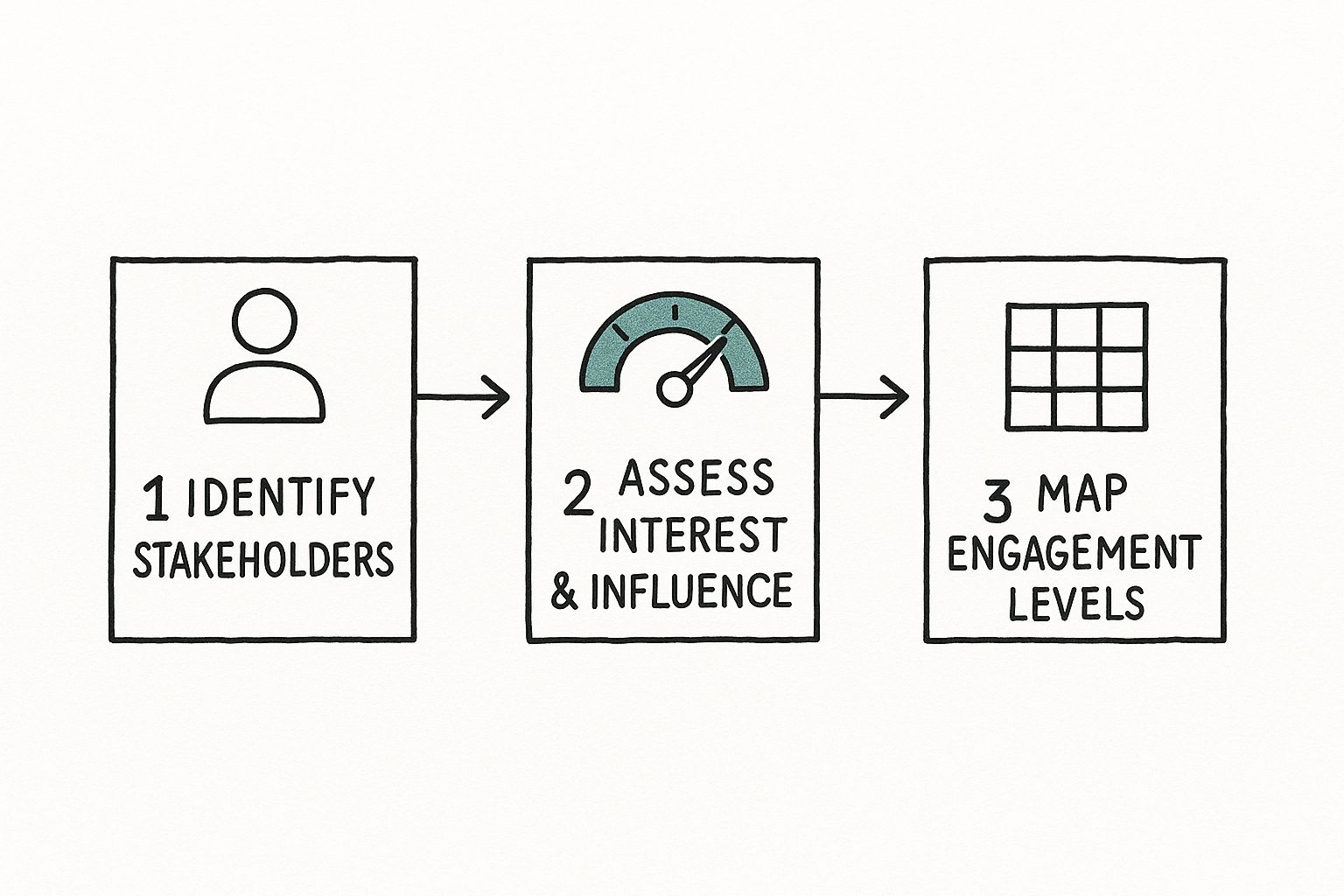
The process shown here—identifying stakeholders, figuring out what they need, and mapping out how you'll engage them—gives you a clear, repeatable path. It's how you turn those lofty goals into actions you can actually take.
Creating Genuine Two-Way Communication
With your stakeholder map in hand, the next move is to open up clear, two-way lines of communication. This is about more than just broadcasting announcements; it's about creating spaces where real dialogue can happen.
Think about which channels will work best for your different groups:
- For parents: Regular surveys, an interactive parent portal, or well-organized advisory council meetings can be goldmines for feedback.
- For students: Student government, suggestion boxes (both the old-school kind and digital ones), and casual focus groups are great for capturing their honest perspectives.
- For community partners: Targeted newsletters, partnership fairs, and simple one-on-one meetings are perfect for building and maintaining strong local relationships.
The real magic happens when you create systems that don’t just collect feedback but actually use it. For instance, if your school is thinking about rolling out new technology, get teachers involved in a pilot program and survey parents about their home internet access and any concerns they might have. This turns what could be a top-down directive into a shared community project.
Using technology to make these interactions more personal is also becoming a game-changer. Many schools now use data to segment their stakeholders and send communications tailored to their specific interests, a trend that builds both trust and participation. You can learn more about how technology is shaping the future of engagement and what to expect in the coming years. Ultimately, a great strategy makes sure every voice has a clear way to be heard, valued, and acted upon.
How Engagement Drives Real School Success

It’s one thing to understand the definition of stakeholder engagement, but it’s another thing entirely to see what it can actually do for a school. This isn't just about feeling good or creating a positive vibe; strong stakeholder relationships are a direct line to measurable success. This is where the "why" comes into focus, turning a concept into results you can see and feel.
When a school consistently brings its community into the fold, it builds a powerful, positive reputation that becomes its single greatest asset. This isn't just fluffy PR—it has a direct impact on enrollment and retention. Families are naturally drawn to schools where they feel heard and valued, which is the key to building a stable and thriving student body.
Boosting Academic and Community Outcomes
The ripple effects of great engagement are felt right in the classroom. When parents, teachers, and students are all pulling in the same direction, a supportive learning ecosystem takes shape. This partnership makes students feel more connected and motivated, and research consistently shows this leads to better grades and higher attendance.
But the benefits don't stop at academics. Engagement opens up entirely new avenues for resources and funding. When local business leaders and community members feel a real connection to your school's mission, they shift from being bystanders to becoming passionate advocates.
A school is not an island. It’s a vital organ within a larger community ecosystem. True engagement means recognizing that the health of the school and the health of the community are deeply intertwined, creating a cycle of mutual support and shared success.
This advocacy can spark incredible new partnerships. Think about a middle school that starts a dialogue with local tech companies. By inviting professionals to speak in classrooms or join a career day, the school plants a seed. That relationship could easily grow into a sponsored STEM lab, giving students access to equipment the school budget could never afford on its own.
This is stakeholder engagement in action. It moves past simply sending newsletters and into genuine, productive collaboration.
The Foundation of Lasting Support
At the end of the day, effective stakeholder engagement builds a bedrock of trust that helps you weather any storm. Whether you’re facing a budget shortfall, rolling out a new curriculum, or dealing with a public relations challenge, having a community of supporters in your corner is priceless. They become your champions, your sounding board, and your partners in finding solutions.
This isn’t a new idea, either. It borrows heavily from proven strategies outside of education. Many lessons from the business world, especially those based on the principles of customer engagement, apply directly to schools. The core concept is identical: strong relationships breed loyalty, support, and long-term success.
Stakeholder Engagement Strategies You Can Use Today

It’s one thing to understand why stakeholder engagement matters, but it’s another thing entirely to put it into action. Moving from theory to practice is where the magic happens, giving your school the momentum it needs to see real results. The secret is to start with initiatives that are both meaningful and manageable.
Below, we’ll walk through three powerful, real-world examples of engagement strategies that consistently work in K-12 schools. Don't think of these as rigid instructions. Instead, see them as flexible blueprints you can adapt to fit your school’s unique culture and community.
Strategy 1: The Parent Advisory Council
A Parent Advisory Council, or PAC, goes a step beyond the traditional parent-teacher association. It’s designed to give parents a genuine voice in how the school is run. This group meets regularly with school leaders to offer direct feedback and help shape key policies.
- Stakeholders Involved: A representative mix of parents, school administrators (like the principal and vice principal), and a few teacher representatives.
- Objective: To get parents actively involved in tackling complex topics—think digital citizenship rules, bullying prevention, or the rollout of a new curriculum.
- Outcome: This collaborative process builds an incredible amount of trust. When new policies are launched, they’re already understood and supported by the parent community, which dramatically cuts down on friction and confusion.
Strategy 2: The Student Ambassador Program
Who is better equipped to share an authentic view of your school than the students themselves? A Student Ambassador Program empowers a hand-picked group of students to be the face of your school at open houses, community events, and campus tours for prospective families.
This approach gives visiting families an honest, relatable glimpse into daily school life—a perspective that glossy brochures and polished marketing materials can never fully capture.
An authentic student voice is one of the most powerful tools in your school’s communication toolkit. It offers a level of credibility and connection that resonates deeply with prospective parents and their children, turning a simple tour into a memorable experience.
For this program to succeed, ambassadors need some training in communication and leadership. This not only helps them represent the school well but also gives them valuable life skills. The positive word-of-mouth they generate is priceless.
Strategy 3: The Community Partnership Fair
A Community Partnership Fair is a dynamic event that bridges the gap between your school and local organizations. It's an opportunity for local businesses, non-profits, and civic groups to set up shop for a day, showcase what they do, and explore ways to collaborate with your school community.
- Stakeholders Involved: Local business owners, non-profit leaders, community figures, students, parents, and staff all in one place.
- Objective: To forge stronger local bonds, uncover internship or mentorship opportunities for students, and discover new resources for the school.
- Outcome: These fairs often spark incredible new connections. They can lead to sponsored programs, guest speakers in the classroom, a flood of new volunteers, and a much stronger sense of shared investment in the school's success.
Bringing these kinds of initiatives to life requires a thoughtful system. Sometimes, it helps to borrow ideas from other fields. For instance, understanding the principles of Customer Relationship Management basics can provide a great framework for building stronger connections with any stakeholder group.
If you’d like to explore this further, our detailed guide on https://blog.marcomsociety.org/stakeholder-management-strategies/ offers more practical advice. These examples are what stakeholder engagement looks like in the real world—creating a stronger, more connected school community for everyone.
Measuring What Matters in Your Engagement Efforts
"If you can't measure it, you can't improve it." That old saying is the absolute truth when it comes to stakeholder engagement. To show your work is making a real difference and to fine-tune your strategy, you have to move past simply hoping for good results and start tracking the Key Performance Indicators (KPIs) that school leaders actually care about.
This isn't an abstract academic exercise. It's about grounding your work in concrete data that tells a compelling story of your impact. By tracking the right numbers, you can demonstrate a clear return on investment to your board and leadership, proving that your communications efforts are strengthening community support and improving how people feel about your school.
Choosing the Right Metrics to Track
The first step is picking KPIs that directly connect to your engagement goals. Instead of just tallying website clicks, zero in on metrics that signal genuine interaction and show relationships are being built.
Here are some powerful quantitative and qualitative KPIs that work well for K-12 schools:
- Participation Rates: Keep an eye on attendance for key events like parent-teacher conferences, town halls, or volunteer drives. A steady climb over time is a fantastic sign of growing engagement.
- Survey Response Volume: The number of people who respond to your surveys is just as telling as what they say. Higher response rates suggest your community believes their voice is heard and valued.
- Sentiment and Satisfaction Scores: You don't need fancy software. Use simple tools like Google Forms to run satisfaction surveys. A Net Promoter Score (NPS) style question—"How likely are you to recommend our school to a friend?"—can give you a powerful benchmark for parent sentiment.
True measurement isn't about collecting data for its own sake. It’s about gathering insights that empower you to make smarter decisions, celebrate real wins, and build a stronger case for your communication efforts.
From Data to Actionable Insights
Collecting the data is only half the job. The real magic happens when you interpret what it's telling you.
If conference attendance is low, maybe the timing is tough for working parents. If survey feedback is leaning negative, it’s your chance to dig in and solve core issues before they fester. This is why effective measurement is a crucial part of a complete stakeholder communication plan; it creates a feedback loop that drives continuous improvement.
This focus on structured feedback isn't just a school thing; it's a global trend. Data shows that stakeholder engagement practices in government have steadily improved over the last decade. Average quality scores rose from 2.0 to 2.26 on a 4-point scale between 2014 and 2024. These improvements show a worldwide understanding that bringing people into the process leads to better outcomes and deeper trust. You can dive into more data on how governments are getting better at this in the OECD's "Government at a Glance 2025" report.
Navigating the Inevitable Hurdles of Engagement
Let's be real for a moment. As powerful as stakeholder engagement is, it's rarely a walk in the park. Even with the most thoughtful strategy, you're going to hit some bumps in the road. Knowing what these challenges are ahead of time is the first step to building a resilient approach that won't get derailed.
One of the biggest culprits is stakeholder fatigue. Your community is already swimming in information and requests. Soon, every email, survey, and feedback form starts to feel like just another task on a never-ending to-do list. This is where you get the dreaded "not another survey!" eye-roll, which is a clear sign that people are starting to tune out.
Another common struggle is connecting with groups who have traditionally been on the sidelines. Some families might face language barriers, juggle multiple jobs, or simply feel that school isn't a place where their voice is welcome. If we don't intentionally reach out to these community members, we're missing huge pieces of the puzzle and failing to serve everyone equitably.
Smart Solutions for Tricky Situations
The good news? You don't need a massive budget to solve these problems. What you need is a smarter, more empathetic approach. To combat that survey fatigue, try mixing things up.
- Try quick polls. A single, timely question on your social media feed or in a weekly newsletter can often give you more valuable insight than a 20-question survey no one fills out.
- Organize informal "listening tours." Get administrators out of their offices and into small, casual group settings to chat about specific topics. Think coffee with the principal, not a formal town hall.
When you want to connect with a wider range of families, think creatively. A great place to start is exploring different ways to get parents involved in school activities, which can open doors far more effectively than another email blast. It’s about meeting people where they are, not expecting them to always come to you.
Acknowledging that engagement can be difficult is not a sign of weakness—it's a sign of a realistic and strategic leader. The goal is not to eliminate all challenges, but to build the confidence and the toolkit needed to navigate them effectively.
Finally, what happens when you get conflicting feedback? It's bound to happen. Parents want one thing, teachers advocate for another, and you're caught in the middle. The answer is transparency. Be crystal clear about how decisions are made. Communicate the why behind your final choice and show stakeholders how their different perspectives were heard and considered. This builds incredible trust, even when people don't get exactly what they wanted.
Got Questions About School Engagement? We've Got Answers.
As you start putting these ideas into practice, you're bound to have some practical questions pop up. That’s a good thing! It means you're thinking critically about how to connect with your community. Here are a few common ones we hear from school communicators.
How Often Should We Be Communicating With Stakeholders?
This is less about frequency and more about rhythm. Think consistency over quantity. People get overwhelmed by a constant firehose of information, but they get anxious when there's silence.
Find a predictable beat that works for your school. Maybe it's a weekly e-newsletter from the district, a monthly update from the principal, and quarterly town hall-style meetings. The key is to create a reliable schedule so your community knows when to expect news and doesn't have to wonder what's going on. Of course, urgent news always requires immediate communication.
What’s the Real Difference Between Engagement and Management?
It's easy to mix these two up, but they come from completely different places. Stakeholder management is typically a one-way street. It's about organizing and directing people to achieve a specific project goal, like getting a bond passed. The focus is on controlling the message to get a desired result.
Stakeholder engagement, on the other hand, is all about building a two-way relationship. It’s a collaborative process where you actively invite stakeholders into the conversation to create shared goals and better outcomes for everyone. Management seeks compliance; engagement builds trust and a sense of shared ownership.
What's One Low-Cost, High-Impact Engagement Activity We Can Start Tomorrow?
Set up a dedicated feedback channel. It’s simple, effective, and costs virtually nothing.
Create a straightforward email address—something like [email protected]—and promote it everywhere. The most important part? Acknowledge every single message that comes in, even if it's just a quick automated reply at first. Then, commit to discussing the feedback at a regular meeting. This simple act shows you’re listening, which is the foundation of genuine trust.
Ready to move from good to great with your school's communication strategy? At The MarCom Society, we offer the resources, expert advice, and community K-12 MarCom pros need to thrive. Join our network today and transform your engagement efforts.