Why Strategic Planning Matters for K-12 Schools
For K-12 schools, strategic planning is the cornerstone of success. This listicle provides valuable insights from top strategic planning schools like Harvard Business School and MIT Sloan, empowering you to build a robust plan. Learn how these leading institutions approach strategy and apply their frameworks to boost your school's brand, improve community engagement, and achieve your goals. Effective strategic planning provides a roadmap for resource allocation and guides your school towards a successful future.
1. Harvard Business School
Harvard Business School (HBS) stands as a cornerstone in strategic planning education and research, consistently ranking among the top strategic planning schools globally. Its influence on the field is undeniable, shaping generations of business leaders and contributing groundbreaking frameworks and concepts that are now standard practice in strategic management. HBS’s approach is deeply rooted in case-based learning, encouraging students to analyze real-world business challenges and develop practical strategic solutions. This, coupled with rigorous analytical frameworks, equips graduates with the skills to tackle complex strategic issues in diverse business environments. HBS has pioneered many influential strategic management concepts, notably Michael Porter's Five Forces model and his competitive strategy frameworks, profoundly impacting how businesses analyze their competitive landscape and formulate strategic direction.
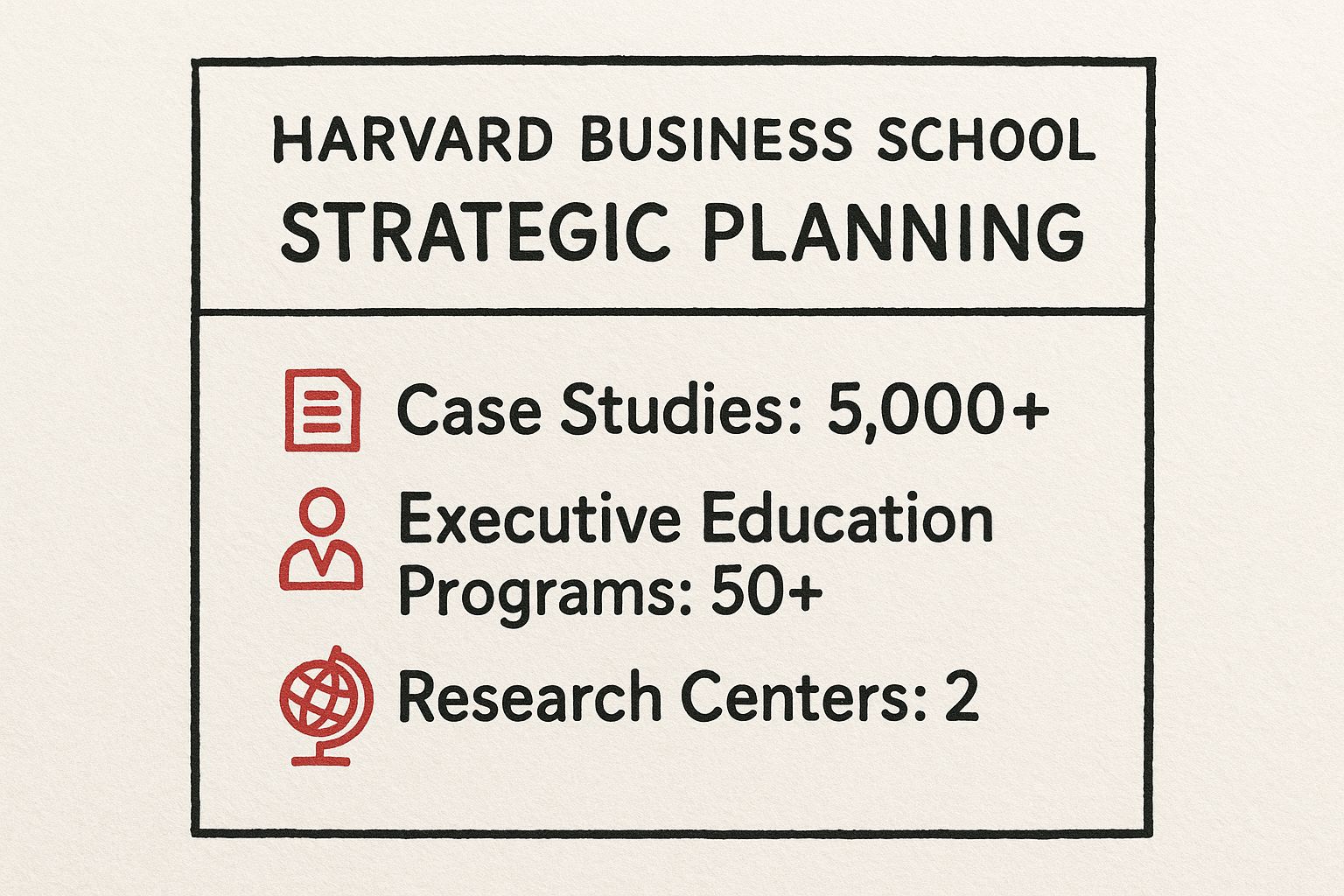
The infographic provides a quick reference overview of Harvard Business School’s strengths, highlighting its focus on case studies, influence on strategic thinking, and esteemed faculty. It visually reinforces the key aspects that make HBS a leading institution for strategic planning education.
The case method, a hallmark of HBS’s pedagogy, immerses students in complex business scenarios, fostering critical thinking and collaborative problem-solving skills essential for effective strategic planning. This approach, combined with a strong emphasis on competitive analysis frameworks, allows students to dissect industry dynamics, identify opportunities and threats, and develop robust strategic responses. Furthermore, HBS integrates strategy with leadership development, recognizing that successful strategy execution hinges on strong leadership.
Here's a summary box highlighting key takeaways about HBS:
Key Takeaways: Harvard Business School
- Focus: Case-based learning, rigorous analytical frameworks, leadership integration.
- Strengths: World-renowned faculty, global business connections, vast case library.
- Impact: Pioneering concepts like Porter's Five Forces and Disruptive Innovation.
- Best For: Individuals seeking a deep dive into strategic thinking and leadership.
This emphasis on both strategy formulation and execution is crucial for aspiring leaders and makes HBS a top choice for strategic planning schools.
HBS offers a range of programs, including executive education specifically tailored to strategic planning, providing seasoned professionals with the tools and insights to enhance their strategic thinking. The school’s publishing arm, Harvard Business Review (HBR), plays a significant role in disseminating cutting-edge strategic planning research, influencing both academic discourse and business practice. Examples of HBS's influential work include the development of the Value Chain concept by Michael Porter, the creation of the Blue Ocean Strategy framework in collaboration with INSEAD, and Clayton Christensen's research on Disruptive Innovation. These contributions have fundamentally changed how organizations approach strategy and innovation.
Pros:
- World-class faculty with extensive expertise in strategy.
- Strong connections to global business leaders and a powerful alumni network.
- Access to an unparalleled case library documenting strategic successes and failures.
- Cutting-edge research that continually shapes strategy practice.
Cons:
- High cost of attendance and a highly competitive admission process.
- Programs tend to favor established business models, potentially overlooking disruptive innovation.
- Some critics argue that HBS’s approach is too focused on large corporations.
Tips for Leveraging HBS Resources:
- Explore HBS Online for accessible strategic planning education resources.
- Delve into their extensive case studies to learn practical applications of strategic frameworks.
- Consider executive education programs for focused strategic development.
HBS has been popularized by influential figures like Michael Porter, known for his Five Forces framework; Clayton Christensen, who introduced the theory of Disruptive Innovation; and Robert Kaplan, co-creator of the Balanced Scorecard. Their contributions have solidified HBS's position as a thought leader in strategic management.
When and why should you consider HBS? If you are seeking a rigorous, immersive education in strategic planning, grounded in real-world business challenges and taught by leading experts, HBS is an excellent choice. However, consider the high cost and competitive admissions. While its focus on large corporations may be a drawback for some, the frameworks and concepts taught at HBS are applicable across various organizational contexts. HBS's contributions to the field, combined with its resources and network, make it a powerful force in strategic planning education and a worthy contender for the top spot among strategic planning schools. Visit the Harvard Business School website for more information.
2. INSEAD
INSEAD, a leading global business school with campuses in Europe, Asia, and the Middle East, distinguishes itself among strategic planning schools through its intensely international focus. Its approach to strategic planning blends analytical rigor with entrepreneurial thinking and a uniquely global perspective, making it a powerful choice for individuals and organizations seeking to navigate the complexities of the global marketplace. INSEAD emphasizes cross-cultural strategic thinking and equips students with the tools to understand and leverage global business dynamics. This focus is woven throughout their programs, from core MBA courses to specialized executive education offerings.

INSEAD's prominence in the realm of strategic planning is solidified by its distinctive features, including an accelerated one-year MBA program with a dedicated strategic management focus, a multi-campus structure providing unparalleled global perspective on strategy, and a strong emphasis on international business strategy. Furthermore, the presence of the Blue Ocean Strategy Institute, founded by INSEAD professors W. Chan Kim and Renée Mauborgne, highlights the school's commitment to innovative strategic thinking. The diverse international faculty and student body enrich the learning environment with a multitude of cultural perspectives. This global ecosystem fosters a deep understanding of diverse markets and business practices, crucial for effective strategic planning in today’s interconnected world.
Examples of INSEAD's impact on strategic planning:
- Development of Blue Ocean Strategy: This groundbreaking framework, created by Professors W. Chan Kim and Renée Mauborgne, provides a systematic approach to creating uncontested market space and making the competition irrelevant.
- Research on digital transformation strategies: INSEAD conducts cutting-edge research on how businesses can effectively leverage digital technologies to transform their strategies and compete in the digital age across global markets.
- Corporate partnerships: INSEAD partners with multinational corporations to implement strategic frameworks developed at the school, providing real-world application and impact.
Pros:
- Truly global perspective on strategic planning
- Strong focus on innovation in strategic thinking
- Diverse cohort providing multiple cultural perspectives
- Practical application of strategy in varied international contexts
- Strong connections to multinational corporations
Cons:
- Intensive program pace may limit deep exploration of certain strategic concepts
- Less emphasis on North American business contexts
- Geographic distance from Silicon Valley may impact tech strategy exposure
Tips for leveraging INSEAD's resources:
- Leverage INSEAD's extensive global alumni network for valuable strategic insights and networking opportunities.
- Explore their specialized strategy courses in executive education for focused professional development.
- Study their published case studies focused on international strategy to gain practical knowledge and analytical skills.
When and why to consider INSEAD:
INSEAD's strategic planning approach is ideal for individuals and organizations seeking a truly global perspective. If you aim to develop a deep understanding of international business dynamics and cross-cultural strategic thinking, INSEAD is an excellent choice. This approach is particularly relevant for professionals targeting leadership roles in multinational corporations or organizations operating in global markets. Educational administrators and K-12 school marketing leaders can benefit from understanding these global strategic frameworks to better prepare students for a globally competitive future.
Popularized By: W. Chan Kim and Renée Mauborgne (Blue Ocean Strategy), Erin Meyer (Culture Map framework), Laurence Capron (Build, Borrow, or Buy framework)
INSEAD Website
INSEAD earns its place on this list of top strategic planning schools due to its unwavering commitment to a global perspective, its emphasis on innovative strategic thinking, and its strong connections to the international business community. Its unique multi-campus structure, diverse student body, and renowned faculty make it a powerful hub for developing the strategic leadership skills needed to thrive in today’s complex global landscape.
3. Wharton School, University of Pennsylvania
The Wharton School of the University of Pennsylvania (https://www.wharton.upenn.edu/) holds a prominent position among the top strategic planning schools, renowned for its rigorous, quantitative, and analytical approach. For K-12 school marketing leaders, communications professionals, educational administrators, and professional development seekers, Wharton's focus on data-driven decision-making offers valuable insights applicable to strategic planning in the education sector. This approach empowers educational leaders to move beyond intuition and develop strategies grounded in solid data analysis.
Wharton's strategic planning education seamlessly blends deep financial expertise with strategic thinking, emphasizing data analysis as the cornerstone of effective strategy formation. This integration of financial analytics with strategic management concepts makes it particularly relevant for educational institutions grappling with budget constraints and resource allocation decisions. Understanding the financial implications of strategic choices is crucial for long-term sustainability and success in any educational context.
Key Features and Benefits:
- Quantitative Approach to Strategic Planning: Wharton emphasizes data analysis, financial modeling, and rigorous methodologies to inform strategic decisions. This data-driven approach provides a solid framework for assessing the effectiveness of different strategic options and making informed choices aligned with institutional goals.
- Integration of Finance and Strategy: Unlike some programs that treat finance and strategy as separate disciplines, Wharton emphasizes their interconnectedness. This is especially valuable for educational leaders who must consider the financial viability of strategic initiatives.
- Specialized Strategic Planning Courses for Different Industries: While not specifically K-12 focused, these specialized courses offer adaptable frameworks and models that can be applied to the education sector.
- Strong Emphasis on Entrepreneurial Strategy: Wharton fosters innovation and an entrepreneurial mindset, equipping educational leaders with the skills to navigate a rapidly changing educational landscape and implement innovative solutions.
- Mack Institute for Innovation Management: This institute provides cutting-edge research and resources on innovation management, providing valuable insights for educational leaders seeking to foster a culture of innovation within their institutions.
Pros:
- Rigorous analytical foundation for strategic decisions: Provides a structured approach to strategic planning based on data analysis and financial modeling.
- Strong emphasis on financial implications of strategy: Ensures that strategic decisions are financially sound and sustainable.
- Excellent resources for entrepreneurial strategy development: Encourages innovative thinking and provides the tools to develop and implement new initiatives.
- Deep connections with corporate strategic leaders: Offers networking opportunities and access to industry best practices.
- Cutting-edge research on digital strategy: Equips educational leaders with the knowledge to leverage digital technologies effectively.
Cons:
- Highly quantitative approach may not suit all learning styles: Individuals who prefer a more qualitative or intuitive approach to planning might find Wharton's approach challenging.
- Less emphasis on soft leadership skills in strategy implementation: While crucial for successful strategy execution, soft skills like communication and collaboration might receive less attention compared to the analytical aspects.
- Focus can sometimes tilt toward financial optimization over innovation: While financial considerations are important, an overemphasis on optimization might stifle creativity and risk-taking.
Examples of Wharton's Strategic Planning in Action:
- Research on strategic value creation through M&A: While directly applicable to the corporate world, the underlying principles of value creation can inform strategic partnerships and collaborations within the education sector.
- Development of the Strategic Value Curve methodology: This framework can be adapted to analyze the competitive landscape in education and identify opportunities for differentiation.
- Application of game theory to competitive strategy: Understanding game theory can help educational leaders anticipate the actions of competitors and develop proactive strategies.
Actionable Tips for Educational Leaders:
- Utilize Wharton's extensive online resources on strategic planning: Access valuable articles, case studies, and research publications on their website.
- Explore their executive education programs focused on strategy: Consider enrolling in executive education programs to gain in-depth knowledge and practical skills.
- Study their research publications on strategy and innovation: Stay informed about the latest research and trends in strategic planning and innovation management.
Why Wharton Deserves its Place on this List:
Wharton's rigorous, data-driven approach to strategic planning, coupled with its deep financial expertise and emphasis on innovation, makes it an invaluable resource for educational leaders. While its quantitative focus might not suit everyone, its emphasis on analytical rigor and financial sustainability provides a strong foundation for effective strategic planning in the complex and ever-evolving world of education. The insights and frameworks offered by Wharton can empower educational leaders to make data-informed decisions, optimize resource allocation, and drive innovation within their institutions. Influential figures like George Day (market-driven strategy), Harbir Singh (corporate strategy), and Peter Fader (customer-centric strategy) further solidify Wharton’s impact on the field of strategic planning.
4. London Business School
London Business School (LBS) earns its place among the top strategic planning schools due to its distinctive focus on global strategy, particularly within European and emerging markets. This makes it an ideal choice for individuals and organizations seeking to understand and navigate the complexities of international business. LBS’s approach blends analytical rigor with a practical understanding of implementation challenges, equipping students with the tools they need to formulate and execute successful strategies in diverse international contexts. London Business School
LBS’s strategic planning methodology centers on integrating strategy with organizational behavior and international business dynamics. This recognizes that successful strategy isn't just about market analysis; it's also about understanding how to manage people and navigate different cultural and regulatory landscapes. The school's Strategy and Entrepreneurship department emphasizes both established business strategies and the development of new ventures, offering a holistic view of the strategic landscape. This approach is particularly relevant in today's dynamic global market, where organizations need to be both adaptable and innovative to thrive.
Features and Benefits:
- European perspective on strategic planning: LBS provides a unique lens through which to analyze strategic challenges, drawing on the rich history and diverse business environment of Europe.
- Strong emphasis on global strategy: The school's curriculum and research are deeply intertwined with global business issues, preparing students for leadership roles in multinational corporations.
- Integration of strategy with organizational behavior: LBS recognizes the critical role of people in strategy execution and emphasizes the human element of strategic planning.
- Highly diverse international faculty and student body: This creates a dynamic learning environment that exposes students to different perspectives and prepares them for cross-cultural collaboration.
- Practical approach balancing theory and application: LBS utilizes case studies, simulations, and real-world projects to bridge the gap between academic theory and practical application.
Examples of Successful Implementation:
- Research on strategic transformation in legacy industries provides valuable insights for organizations navigating disruptive change.
- Development of frameworks for strategy in multinational contexts helps businesses tailor their strategies to different markets and cultures.
- Case studies on strategic pivots in European corporations offer practical examples of how companies have successfully adapted to changing market conditions.
Pros:
- Strong focus on implementing strategy across diverse international contexts.
- Excellence in teaching strategy for multinational corporations.
- Practical approach balancing theory and application.
- Strong connections to European business leadership.
- Leading research on strategy in service industries.
Cons:
- Less emphasis on technology strategy compared to some US schools.
- Higher cost relative to other European institutions.
- Focus more on established businesses than disruptive models.
Tips for Leveraging LBS's Expertise:
- Explore their executive education programs specifically focused on strategic planning.
- Leverage their strong connections to European corporate leadership for networking and career opportunities.
- Study their research on global strategy implementation to gain valuable insights.
Popularized By:
LBS's strategic planning expertise is exemplified by the work of prominent figures such as Costas Markides (strategic innovation expert), Dominic Houlder (strategic leadership), and Julian Birkinshaw (strategy and innovation). Their contributions to the field have shaped the school's curriculum and influenced the practice of strategic planning globally.
When and Why to Choose LBS:
LBS is an excellent choice for individuals seeking a global perspective on strategic planning, especially those interested in working in Europe or with multinational corporations. Its emphasis on practical application and its strong connections to the business world make it a valuable resource for both aspiring and experienced leaders. If you are looking for a program that emphasizes strategic planning within a complex, international context, LBS is a strong contender among strategic planning schools.
5. MIT Sloan School of Management
MIT Sloan School of Management stands out among strategic planning schools for its distinctive fusion of technological innovation and management science. This approach equips leaders to navigate the complexities of the modern digital landscape. Instead of relying solely on traditional strategic planning models, MIT Sloan emphasizes the crucial roles of technology, systems thinking, and data analytics in shaping robust and adaptable strategies. This makes it an ideal choice for those seeking to understand how technology can drive and disrupt industries.

MIT Sloan's strategic planning education delves into several key areas, including platform strategies, digital transformation, and innovation ecosystems. The school’s systems dynamics approach encourages a holistic understanding of how different parts of an organization, and the larger environment, interact and influence each other. Data-driven strategic decision-making is also a core tenet, empowering leaders to base their choices on robust analysis rather than intuition. This approach is particularly relevant in today's data-rich environment.
Features:
- Integration of technology and strategy
- Systems dynamics approach to strategic planning
- Focus on digital transformation strategy
- Strong emphasis on innovation ecosystems
- Data-driven strategic decision making
Pros:
- Cutting-edge approach to technology strategy
- Strong connections to technology innovators
- Excellent research on platform business models
- Integration with MIT's broader technical expertise
- Forward-looking strategic frameworks
Cons:
- Technical emphasis may not suit all strategic planning needs
- Less focus on traditional industry strategies
- Highly competitive admission to programs
Examples of MIT Sloan's Influence:
- Development of platform strategy concepts by faculty, impacting how businesses design and manage multi-sided markets.
- Research on digital business models and transformation, providing valuable insights for organizations navigating digital disruption.
- Work on innovation ecosystems and strategic partnerships, highlighting the importance of collaboration in driving innovation.
Actionable Tips:
- Explore their executive education courses on digital strategy for professional development opportunities.
- Utilize their open courseware resources on strategic planning to access valuable learning materials.
- Follow their research publications on technology strategy to stay abreast of cutting-edge thinking.
When and Why to Use This Approach:
MIT Sloan's approach is best suited for individuals and organizations operating in technology-driven industries or those undergoing significant digital transformation. Educational administrators and K-12 marketing leaders can benefit from understanding how technology is reshaping the educational landscape and how to leverage it for strategic advantage. For example, understanding platform strategies can help schools develop innovative online learning platforms or community engagement tools. MarCom team members can learn how to leverage data analytics to optimize their marketing campaigns and measure their impact. Professional development seekers in education can benefit from MIT Sloan's forward-thinking frameworks to prepare for the future of education.
Popularized By:
- Peter Senge (systems thinking and learning organizations)
- Erik Brynjolfsson (digital strategy)
- Michael Cusumano (platform strategy)
MIT Sloan’s focus on technology and innovation earns it a well-deserved place on this list of top strategic planning schools. Its unique approach offers valuable insights for leaders seeking to navigate the challenges and opportunities of the digital age. For more information, visit the MIT Sloan School of Management website.
6. Stanford Graduate School of Business
Stanford Graduate School of Business (GSB) earns its place among the top strategic planning schools due to its unique approach that blends classic strategic planning with the dynamism of Silicon Valley. It offers a distinct perspective, equipping students with the tools to not just navigate, but thrive in today's rapidly evolving business landscape. For K-12 school marketing leaders, communications professionals, educational administrators, and professional development seekers, understanding Stanford GSB's approach can offer valuable insights into developing innovative and adaptable strategies.
Stanford GSB’s strategic planning education emphasizes entrepreneurial thinking, disruptive innovation, and design thinking. This approach goes beyond traditional strategic planning models, focusing on transformative business models and fostering close connections with tech industry leaders. The school fosters a mindset of anticipating change and proactively shaping the future, rather than simply reacting to it.
Features and Benefits:
- Integration of design thinking with strategic planning: This human-centered approach ensures strategies are not only sound from a business perspective but also address the needs and desires of the target audience – a critical consideration for K-12 schools aiming to connect with students, parents, and the community.
- Strong emphasis on entrepreneurial strategy: This encourages a proactive and innovative approach to problem-solving and resource allocation, essential for schools navigating changing educational landscapes.
- Silicon Valley ecosystem connections: Access to this network provides invaluable insights into cutting-edge trends and potential partnerships, opening doors to innovative solutions for schools.
- Focus on disruptive business models: Stanford GSB encourages challenging the status quo and exploring new operational models. This can inspire K-12 leaders to rethink traditional educational delivery and explore innovative learning models.
- Strategic leadership development: The program cultivates leadership skills necessary for driving strategic change and managing complex organizations, which are crucial for effective school administration.
Pros:
- Direct access to Silicon Valley strategic thinking: Gain insights from leading thinkers and practitioners.
- Cutting-edge approaches to innovation strategy: Learn the latest methodologies for driving innovation.
- Strong venture capital connections for growth strategies: Although less directly applicable to K-12, this exposure can inspire creative approaches to resource acquisition and development.
- Emphasis on transformative business models: Develop strategies that fundamentally reshape the educational landscape.
- Integration of human-centered design in strategy: Ensure strategies are aligned with the needs of students, parents, and the community.
Cons:
- Very competitive admission process: Direct enrollment in GSB programs is highly selective.
- High cost of attendance: Formal programs can be financially prohibitive.
- Silicon Valley focus may not translate to all business contexts: While the principles are broadly applicable, some specific strategies may require adaptation for the K-12 environment.
- Less emphasis on traditional strategic planning tools: The focus on disruptive innovation may mean less attention is given to some traditional planning frameworks.
Examples of Successful Implementation:
- Research on scaling strategic innovations: Understanding how to effectively scale successful initiatives is critical for school districts looking to implement system-wide changes.
- Development of strategic leadership in high-growth environments: This is particularly relevant for charter schools and rapidly expanding districts.
- Case studies on platform business strategies: While not directly analogous to K-12, these case studies can offer insights into leveraging technology and building collaborative ecosystems.
Tips for K-12 Leaders:
- Explore their executive education programs on strategic leadership: These programs offer a more accessible entry point to Stanford GSB’s expertise.
- Study their research on scaling innovative business models: Learn how to effectively implement and expand successful initiatives within your school or district.
- Leverage their connections to technology industry leaders: Seek opportunities to connect with and learn from innovators in the tech sector.
Popularized By:
- Jeffrey Pfeffer (power and strategic leadership)
- Kathleen Eisenhardt (strategy in high-velocity environments)
- Charles O'Reilly (strategic organizational change)
While direct access to Stanford GSB programs might be challenging, leveraging their publicly available resources, research, and executive education programs can provide valuable insights and inspiration for K-12 leaders seeking to develop and implement effective strategic plans. This approach to strategic planning provides a framework for not just surviving, but thriving in a dynamic and ever-changing educational landscape.
7. Kellogg School of Management, Northwestern University
Kellogg School of Management at Northwestern University (www.kellogg.northwestern.edu/) distinguishes itself among strategic planning schools with its unique emphasis on collaborative strategy and the integration of marketing principles. This approach positions Kellogg as an excellent choice for educational leaders seeking to develop and implement effective, customer-centric strategies for their institutions. For K-12 school marketing leaders, communications professionals, administrators, and professional development seekers, Kellogg offers a valuable perspective on strategic planning.
Kellogg's methodology centers around a team-based approach to strategic development. They believe that effective strategies emerge from collaborative efforts, incorporating diverse perspectives and expertise. This aligns perfectly with the collaborative nature of educational environments, where buy-in from teachers, staff, parents, and the community is crucial for successful implementation of any strategic initiative. Furthermore, Kellogg deeply integrates marketing insights into its strategic planning framework. This means that strategies are developed with a keen understanding of the target audience – in the case of schools, this could be prospective students, current families, or even the broader community. The focus is on creating value for all stakeholders, a critical component of successful school leadership.
Features and Benefits:
- Collaborative approach to strategic planning: Facilitates buy-in and ownership of strategic initiatives among diverse stakeholders.
- Integration of marketing and strategy: Ensures that strategies are aligned with the needs and preferences of the target audience.
- Focus on growth strategies: Provides frameworks for achieving enrollment growth, program expansion, and fundraising goals.
- Emphasis on customer-centric strategy: Prioritizes understanding and meeting the needs of students, families, and the community.
- Strong focus on strategic leadership: Develops leadership skills necessary for effective strategy execution.
Examples of Successful Implementation:
- Development of growth strategy frameworks: Kellogg’s frameworks can be adapted to create strategic plans for increasing student enrollment or expanding educational programs.
- Research on strategic marketing integration: Provides valuable insights into effectively communicating the value proposition of a school to its target audience.
- Case studies on collaborative strategy implementation: Offers practical examples of how collaborative approaches can lead to successful outcomes in educational settings.
Pros:
- Excellence in teaching collaborative strategic development: Equips educational leaders with the skills to foster collaboration and build consensus.
- Strong marketing perspective in strategy formation: Ensures that strategic decisions are informed by market research and audience insights.
- Practical tools for strategy implementation: Provides actionable frameworks and methodologies for translating strategic plans into concrete actions.
- Strong industry connections for applied strategy: Offers opportunities to connect with and learn from leaders in various fields, including education.
- Balanced approach between analytics and human factors: Recognizes the importance of both data-driven decision-making and the human element in strategic planning.
Cons:
- Less emphasis on quantitative approaches than some competitors: May not be the ideal choice for those seeking a heavily data-driven approach to strategic planning.
- Marketing focus may overinfluence strategic direction: It’s important to ensure that the marketing perspective complements, rather than dominates, the overall strategic vision.
- Less prominent in technology strategy: While important, technology strategy isn't a primary focus of Kellogg’s approach.
Tips for Educational Leaders:
- Explore their executive education programs on strategic marketing: Gain specialized knowledge in applying marketing principles to educational contexts.
- Study their frameworks for collaborative strategy development: Learn how to effectively engage stakeholders in the strategic planning process.
- Leverage their expertise in growth strategy planning: Develop strategies for achieving sustainable growth and expansion in your school or district.
Popularized By:
- Philip Kotler (marketing strategy pioneer): Kotler's work has significantly influenced Kellogg's marketing-centric approach to strategy.
- Mohanbir Sawhney (innovation and growth strategy): Sawhney's research provides valuable insights into developing innovative growth strategies for organizations.
- Benjamin Jones (innovation strategy): Jones's work focuses on the role of innovation in driving organizational success.
Kellogg School of Management offers a unique and valuable approach to strategic planning that emphasizes collaboration, marketing integration, and customer-centricity. For educational leaders seeking to develop and implement effective strategies in today's competitive landscape, Kellogg deserves serious consideration among strategic planning schools.
Strategic Planning Schools Comparison
| School | Implementation Complexity 🔄 | Resource Requirements ⚡ | Expected Outcomes 📊 | Ideal Use Cases 💡 | Key Advantages ⭐ |
|---|---|---|---|---|---|
| Harvard Business School | High 🔄🔄 (case method, analytical rigor) | High ⚡⚡ (cost, faculty expertise, extensive cases) | Strategic leadership, competitive analysis frameworks | Established large corporations, leadership development | World-class faculty, case library, research impact |
| INSEAD | Medium-High 🔄🔄 (intensive, globally focused) | Medium ⚡⚡ (global campuses, diverse faculty) | Global strategic perspective, innovation in strategy | International business, cross-cultural strategy | Global network, innovation focus, Blue Ocean Strategy |
| Wharton School, University of Pennsylvania | High 🔄🔄 (quantitative and analytical focus) | Medium-High ⚡⚡ (data-driven tools, finance integration) | Financially optimized and analytic strategic decisions | Quantitative strategy, finance-driven industries | Strong finance-strategy integration, entrepreneurial focus |
| London Business School | Medium 🔄 (practical, balanced theory and application) | Medium ⚡ (global perspective, diverse faculty) | Strategy implementation across multinational contexts | European and emerging markets, organizational behavior | Practical approach, European business connections |
| MIT Sloan School of Management | High 🔄🔄 (technology and systems thinking integration) | High ⚡⚡ (tech and data resources, innovation focus) | Tech-driven and digital transformation strategies | Technology strategy, platform and innovation ecosystems | Cutting-edge tech strategy, strong innovation ecosystem |
| Stanford Graduate School of Business | High 🔄🔄 (entrepreneurial, design thinking, innovation focus) | High ⚡⚡ (Silicon Valley ties, selective programs) | Disruptive innovation, transformative business models | Tech startups, innovation-driven and high-growth ventures | Silicon Valley access, venture capital connections |
| Kellogg School of Management, Northwestern University | Medium 🔄 (collaborative, marketing integration) | Medium ⚡ (team-based resources, marketing tools) | Customer-centric and collaborative strategic solutions | Growth strategy, marketing-driven strategic planning | Marketing-strategy blend, collaborative approach |
Putting These Insights into Action
From Harvard Business School's emphasis on case studies to Stanford's design thinking approach, the strategic planning schools highlighted in this article offer a wealth of knowledge for K-12 leaders. The key takeaway is that effective strategic planning isn't a one-time event but a continuous process of analysis, adaptation, and execution. Mastering these concepts empowers schools to anticipate challenges, identify opportunities, and effectively allocate resources to achieve their long-term vision. This understanding is crucial in today's dynamic educational landscape, enabling institutions to not just survive, but thrive.
For schools looking to implement these strategic planning insights effectively, a strong leadership development framework is essential. This framework, from Kirke Leadership, can provide a structured approach to cultivating leadership skills within the school community, ensuring that the strategic plan is implemented successfully and that its impact is maximized.
By embracing the principles learned from these strategic planning schools, K-12 institutions can strengthen their competitive edge and achieve lasting success. The insights gleaned from these institutions can help schools create a truly impactful educational experience for their students. To further elevate your school's strategic marketing and communication efforts, explore the resources available through The MarCom Society. They provide valuable support and best practices specifically tailored for K-12 professionals navigating the ever-evolving world of educational marketing and strategic planning.