We've all been there: staring at a blank screen, tasked with launching the next big marketing campaign. That initial paralysis is real. This is precisely where a solid marketing campaign planning template becomes your most valuable asset. It’s not just about filling in boxes; it’s about turning that jumble of ideas into a clear, actionable roadmap that leads to predictable success.
Think of it as the strategic framework that gets your entire team on the same page, clarifies what success actually looks like, and keeps all the moving parts humming along smoothly.
From Guesswork to a Documented Strategy
Let's be honest, winging it is a recipe for disaster. A template forces you to do the critical thinking upfront—defining your goals, getting intimately familiar with your audience, and allocating your budget before a single dollar is spent. This foundational planning is what separates campaigns that merely make noise from those that deliver real, repeatable results.
The data doesn't lie. Marketers who take the time to formally document their strategy are a staggering 538% more likely to report success than their counterparts who don't. It’s a powerful reminder that a structured approach, guided by a template, has a direct and massive impact on your outcomes.
To help you get started, here’s a breakdown of the essential elements every marketing campaign plan needs for comprehensive and strategic execution.
Core Components of an Effective Campaign Plan
| Component | Purpose | Example |
|---|---|---|
| Campaign Goal | Defines the primary, measurable objective of the campaign. | Increase new student enrollment inquiries by 15% during Q3. |
| Target Audience | Specifies the exact group of people the campaign aims to reach. | Parents of children aged 10-14 living within a 15-mile radius of the school. |
| Key Messaging | The core value proposition and story you want to communicate. | "Discover a hands-on approach to learning that prepares your child for the future." |
| Channels & Tactics | The specific platforms and methods you'll use to deliver your message. | Facebook ads, local parenting blog partnerships, and a school open house event. |
| Budget & Resources | Outlines the financial and human resources allocated to the campaign. | $5,000 ad spend, 20 hours of design time, 1 dedicated project manager. |
| KPIs & Metrics | The specific data points you'll track to measure success against your goal. | Clicks, landing page conversions, cost per inquiry, event attendance numbers. |
Each of these components builds upon the last, creating a comprehensive and logical plan that guides your team from start to finish.
From Chaos to Clarity
Without a documented plan, marketing efforts often feel scattered and reactive. You might have a brilliant idea for a social media post or a parent testimonial video, but without a unifying strategy, these tactics exist in a vacuum. A campaign template brings order to that chaos.
It creates a single source of truth for your whole team. Everyone, from your content writers to your social media coordinator, is aligned on:
- The primary campaign goals and what success truly looks like.
- The specific audience personas we’re trying to connect with.
- The core message and offer that will resonate most deeply.
- The channel strategy that puts our message in the right place at the right time.
This shared understanding prevents mixed messages and wasted effort, ensuring your audience has a seamless and compelling brand experience. For example, if video is a major part of your plan, having a winning video marketing strategy is essential before you even start storyboarding.
A great campaign plan does more than just organize tasks; it builds institutional knowledge. Each completed template becomes a case study, helping you refine your approach and make smarter decisions for the next campaign.
Defining Your Campaign Foundation
Before you can even think about launching a campaign, you need to pour a solid foundation. This is where your marketing campaign planning template comes in, helping you turn those big, ambitious ideas into a real, workable strategy. It’s all about getting granular—moving past a vague goal like "increase enrollment" and getting specific about what you want to achieve, who you’re talking to, and what makes your school special.
Every great campaign I've ever been a part of started with absolute clarity. Without it, you’re just throwing money and time at tactics that won’t get you where you need to go. A big part of this is knowing the difference between demand gen vs lead gen. Are you trying to build buzz and excitement for a new program, or are you focused on getting contact information for parents who are ready to talk now? The answer to that question will shape everything else you do.
Set Goals That Guide Your Actions
Your template pushes you to set SMART goals. I know, it sounds like corporate buzz, but this framework—Specific, Measurable, Achievable, Relevant, and Time-bound—is what keeps you honest and on track.
Let's ditch a fuzzy goal like "more engagement" and make it SMART:
- Specific: We need to generate more qualified leads for our Upper School STEM program.
- Measurable: Let’s aim for a 15% increase in those qualified leads.
- Achievable: Looking at our Q4 numbers from last year, a 15% lift is a stretch, but it's definitely possible.
- Relevant: This feeds directly into our school's bigger objective of boosting STEM enrollment.
- Time-bound: We need to hit this target by the end of Q4.
Key Insight: Think of a well-defined goal as your campaign’s North Star. It guides every single decision you make, from the ad copy you write to the channels you choose. Everything should point back to that one measurable outcome.
Truly Understand Your Target Audience
The next piece of the puzzle is knowing exactly who you're talking to. "Parents in the area" just won't cut it. Your template will force you to get more detailed by creating audience personas. What keeps these parents up at night when they're thinking about schools? Which social media feeds do they actually scroll through for advice? What kind of information helps them feel confident in their choices?
In K-12 communications, getting these details right is everything. If you're looking for more specific ideas, our guide on effective marketing strategies for schools has some great, targeted advice.
This infographic really nails the process of getting to know your audience on a deeper level.
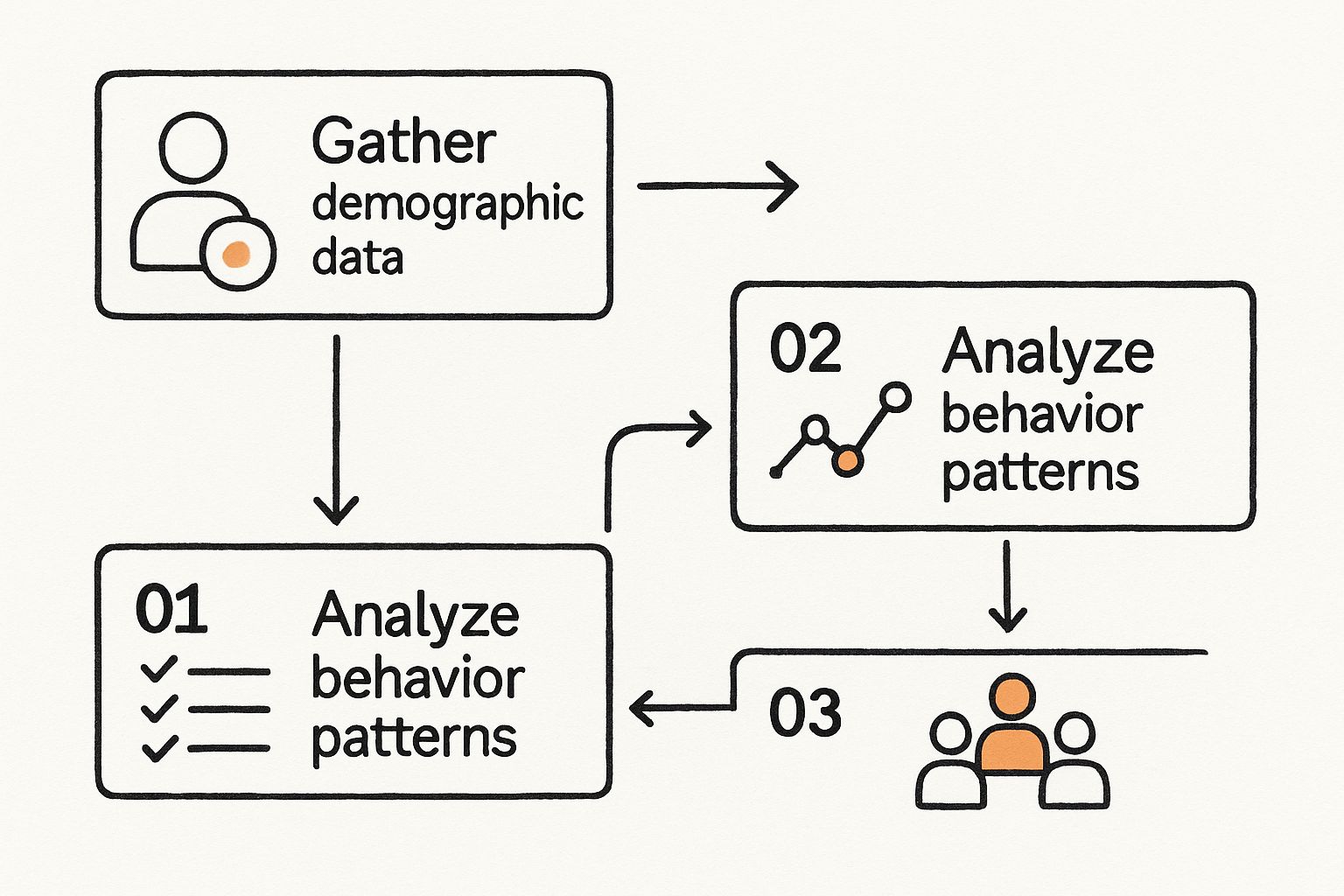
As you can see, it's a journey. You start with the raw data, but you end up with smart, actionable segments that tell you exactly how to shape your message.
Find Your Unique Angle
Finally, let’s talk about your competition. You don't need to commission an exhaustive, 50-page report for your campaign foundation. A quick, effective analysis will do. Just answer a few simple questions:
- Who are the top 2-3 other schools we're really competing with?
- What's their main marketing message? What are they always talking about?
- What are they doing well that we could learn from?
- More importantly, where are the gaps? Is nobody talking about their incredible arts program? Is there an opening to highlight a unique project-based learning model?
The point here isn't to copy what others are doing. It's about finding that open lane where your school can truly shine. By doing this foundational work in your marketing campaign planning template, you’ll have a crystal-clear picture of what you want to achieve, who you need to reach, and exactly how you're going to stand out from the crowd.
Shaping Your Story and Picking Your Platforms
Okay, you’ve got your goals set and you know exactly who you’re talking to. Now for the fun part: figuring out what to say and where to say it. This is where all that foundational strategy turns into real, tangible content that gets in front of the right families.
Think of this part of your marketing campaign planning template as bridging the gap between the "what" and "who" to the "how." It's all about making sure your message is sharp and that you’re putting your time and money into the channels where your community actually lives.
Nailing Your Core Message
Your message needs to be crystal clear and anchored to a single, powerful idea. This all starts with your campaign's core value proposition. What's the number one benefit or solution you're offering?
Once you have that main idea, you can flesh it out with key messaging pillars. These are the supporting arguments that make your big promise feel real and believable.
Let’s imagine a K-12 school launching a new STEM program. Their messaging could break down like this:
- Core Value Proposition: Our hands-on STEM program gives students the real-world skills to lead in a tech-driven future.
- Pillar 1 (Innovation): "From day one, students are building, coding, and creating—not just reading from a textbook."
- Pillar 2 (Career Readiness): "We've partnered with local tech firms to line up real mentorship and internship opportunities."
- Pillar 3 (Expert Faculty): "Our program is led by actual engineers and scientists, bringing their industry experience into the classroom."
These pillars aren't just fancy words; they're the wellspring for every piece of content you'll create, from a quick social media post to your email newsletters and website copy.
Choosing the Right Channels
Selecting your channels isn't about trying to be everywhere at once. That's a classic mistake. You'll stretch your budget and your team way too thin trying to cover a dozen platforms instead of truly owning the one or two that matter most.
Remember, the goal is to align your channels with your campaign objectives and your audience's behavior. Don't jump on TikTok just because it's popular if your target audience of parents gets their school information from community Facebook groups and local blogs.
Let your audience personas be your guide. Where do they really spend their time online? Which sources do they trust when making decisions about their children's education? This data-first approach helps you make smart choices that maximize your reach and impact.
This is where a solid framework becomes a lifesaver. A well-structured template helps marketing teams coordinate everything from messaging to channel selection, ensuring nothing falls through the cracks. If you're looking for more insight on this, Planful.com has a helpful guide on the structure of marketing campaign templates.
Tying Channels Directly to Your Goals
The final piece of this puzzle is mapping your chosen channels directly back to your SMART goals. This creates a straight line between your day-to-day activities and the big-picture results you're chasing.
Here’s how that might look in practice:
| Campaign Goal | Primary Channel | Secondary Channel | Rationale |
|---|---|---|---|
| Generate 50 qualified leads for the STEM program. | Facebook Ads | Local Parenting Blog | Target parents demographically on Facebook; build credibility and trust through respected local content. |
| Increase open house attendance by 25%. | Email Marketing | School Website Banners | Nurture your existing list of interested parents with event details; capture the attention of new visitors on your site. |
| Boost brand awareness in a new geographic area. | Instagram Reels | Local Event Sponsorship | Visually showcase the school's vibrant culture; create a physical presence and build relationships in the new community. |
When you plan this way, every action has a clear purpose. You’re no longer just "making content." You’re strategically placing that content where it will have the greatest effect, moving you one step closer to hitting your campaign goals.
Allocating Your Budget and Resources Smartly
Let's be honest: a brilliant campaign idea without a realistic budget is just a dream. This is where your plan gets real. You have to attach actual dollars and people to your big ideas. Without proper funding, even the most creative strategy is dead on arrival.
It’s about more than just pulling a total budget out of thin air. You need to get granular. Think about how you’ll split up funds by marketing channel and by specific activity. This means mapping out everything—from your monthly ad spend on Facebook and Google to the costs of hiring a freelance photographer for that open house event.
This is also where you build financial guardrails to keep your spending effective. For instance, you could decide on a firm Cost Per Acquisition (CPA) you're unwilling to exceed.
Expert Tip: Setting a specific target CPA, say $50 per new lead, changes how you operate. It forces you to make smarter, data-driven decisions. If you see one channel consistently hitting a $100 CPA, you know it's time to either fix it fast or move that money somewhere that's actually working.
Mapping Your Financial and Human Resources
This kind of meticulous financial planning isn't just about crunching numbers; it's how you prove your ROI and justify your team's existence to the board. It’s your safety net. Think of it as setting clear, measurable financial goals for every single part of your campaign.
For example, a school might earmark $1,500 per quarter for Google Ads. The matching SMART goal isn't just to spend that money, but to get a CPA under $25 for each new family that submits an inquiry form. This level of detail keeps you efficient and on-budget. You can find more great advice on aligning your marketing budget with SMART goals on Shopify.com.
Money is only half the equation. You also have to map out your people. Who on your team is handling each part of this campaign?
- Content Creation: Is Sarah writing the blog posts and social media updates?
- Graphic Design: Does Mark have the bandwidth for the ad visuals and social graphics?
- Ad Management: Who's in the weeds, actively managing and optimizing the paid campaigns day-to-day?
- Project Lead: Who is the ultimate owner, the person making sure all the pieces come together on schedule?
Aligning Resources with K-12 Goals
Assigning these roles clearly from the start prevents bottlenecks and, more importantly, team burnout. You ensure the right people are on the right tasks.
For those of us in school marketing, this step is absolutely crucial. If you need a more structured way to think about this for a K-12 environment, take a look at our guide on building a school marketing plan template. By clearly defining both the financial and human resources required, your campaign shifts from a hopeful wish list to a fully resourced, actionable plan ready for launch.
Bringing Your Campaign to Life: Execution and Tracking
You’ve done the hard work of planning, and now it’s time for the exciting part—launching your campaign. But hitting "go" is just the starting line. The real magic happens in the day-to-day execution, careful monitoring, and smart adjustments you make along the way. This is the moment your marketing campaign planning template stops being a document and becomes your operational playbook.
This phase is all about bringing your strategy to life. Your first priority should be locking down a detailed timeline with clear milestones. This isn't just a simple list of dates; it's a shared commitment that keeps your whole team rowing in the same direction and on schedule.
Turning Plans into Action
A solid timeline is the backbone of your execution. It maps out every single critical task, from the moment your first ad goes live to the day your final follow-up email is scheduled to send. When everyone on the team knows exactly what they’re responsible for and when it’s due, things just happen.
For a K-12 school campaign, this rhythm might look something like this:
- Week 1: Launch the targeted Facebook ads and publish the first "Meet Our Faculty" blog post.
- Week 2: Send the initial email newsletter to your inquiry list, driving traffic to the new blog post.
- Week 3: Host a Facebook Live Q&A session with the head of the department you just featured.
- Week 4: Dig into the initial data and start A/B testing your ad creative based on what’s working.
Following a cadence like this ensures all the moving parts of your campaign work together. You're creating a cohesive journey for prospective families, not just throwing a bunch of random tactics at them. It's the difference between a symphony and just a lot of noise.
Tracking the Metrics That Actually Matter
If you don't measure it, you can't improve it. Simple as that. The Key Performance Indicators (KPIs) you identified in your template are now your north stars. To really know if you're on the right track, you have to consistently monitor your content performance metrics and see what the data is telling you.
It's so important to track the right KPIs for each channel. Don't get distracted by vanity metrics like impressions or page views that don't directly impact your goals. Focus on the numbers that tie directly back to enrollment inquiries and applications.
Here are a few examples of meaningful KPIs you should be watching:
| Channel | Key Performance Indicator (KPI) | Why It Matters |
|---|---|---|
| Email Marketing | Click-Through Rate (CTR) on Calls-to-Action | This shows your message is compelling enough to make someone act, not just open an email. |
| Social Media Ads | Cost Per Lead (CPL) or Cost Per Inquiry | This directly measures how much you're spending to generate a tangible inquiry from a prospective family. |
| Website / Blog | Conversion Rate on Landing Pages | This tells you how well your page persuades visitors to take the next step, like filling out an RFI form. |
| Organic Social | Engagement Rate (comments, shares) | This indicates your content is actually resonating and building a community, not just being passively seen. |
My biggest piece of advice: Establish a regular review cadence and stick to it. For something fast-moving like paid social ads, that might mean a quick daily check-in. For your blog content, a weekly review is probably enough. This rhythm helps you spot trends early.
This constant feedback loop of executing, monitoring, and adjusting is what truly drives campaign success. If an ad set is underperforming, don't just let it burn through your budget for another week. Pause it, figure out what went wrong, and move that money to an ad that's delivering results. That kind of agility is what separates the good campaigns from the great ones.
Common Questions About Campaign Planning
Even with the best marketing campaign planning template in your hands, you're bound to run into a few questions or roadblocks. That’s perfectly normal. Let's walk through some of the most common ones I see so your planning process is as smooth and effective as possible.
A question I get all the time is, "How often should we really be looking at this plan?" It’s a fantastic question because it cuts right to the chase of what a plan is for.
Think of your plan as a living document, not a static file set in stone. It’s a guide, not a gospel. The real value comes from using it to adapt and respond.
You’ll want to do a major review at least quarterly to make sure your campaign still tracks with your school's bigger goals. But for things that move quickly, like paid ads, you need to be in there checking performance metrics weekly, if not daily. This is what allows you to be nimble and make smart adjustments, like pulling budget from an ad that’s flopping and pushing it toward one that’s getting great engagement.
What Is the Biggest Mistake Planners Make?
The single biggest mistake I see teams make is treating the template like a homework assignment. They'll spend a ton of time filling it out, get it approved, and then it gets filed away on a server, never to be looked at again. The whole point of the template is to guide your day-to-day actions and measure your progress—continuously.
Another huge pitfall is being way too vague. A goal like "Increase brand awareness" is practically useless because it's impossible to measure and offers no real direction. A much better, more actionable goal would be, "Increase organic searches for our school’s name by 20% in Q3." Now your team has a clear target to hit. This level of detail needs to apply everywhere, from your target audience profiles to your key messages.
This is especially critical for schools. When you're running something like a re-enrollment campaign, you need to go far beyond just sending a few generic emails. For a deeper dive on this topic, check out our guide on leveraging email marketing for schools to see what I mean.
Can This Template Work for a Small Team?
Absolutely. In fact, I'd argue that strategic planning is even more critical when you have limited resources. Whether you’re a small business, a freelancer, or a one-person school marketing department, a solid plan provides the structure and focus you desperately need.
You probably won't be active on every single channel, and your budget is going to be tighter, but the core principles don't change one bit:
- Define clear, measurable goals.
- Get to know your audience inside and out.
- Craft a message that truly connects.
- Track your results relentlessly.
The marketing campaign planning template is designed to scale with you. Just focus on the channels and tactics that make the most sense for your school and your budget. It’s all about making sure every dollar and every hour you invest is working as hard as possible to move the needle.
At The MarCom Society, we provide K-12 marketing professionals with the tools, expert guidance, and peer support needed to build and execute successful campaigns. Discover how our community can help you achieve your goals.