A solid marketing plan for your school is much more than just a list of ads to run. It's your strategic roadmap—the guide that spells out how you'll share your school's unique story, connect with prospective families, and ultimately, hit your enrollment targets. This goes way beyond simple advertising, blending brand storytelling, digital outreach, and data analysis to build a community that lasts.
Why Your School Needs a Modern Marketing Plan

Let's be honest, the old ways of promoting a school just don't cut it anymore. Relying on glossy brochures and the occasional newspaper ad is like using a flip phone in an iPhone world. Today’s parents are researchers. They’re savvy consumers and digital natives who unconsciously compare their experience with your school to brands like Amazon and Netflix.
They expect easy-to-use websites, instant access to information, and communication that feels personal. A modern school marketing plan isn't a "nice-to-have"; it's an essential tool for survival and growth. Without a smart strategy, your school's incredible story gets lost in all the noise.
The Shift in Educational Marketing
The competition among schools has become incredibly fierce. The global education market is projected to hit a staggering $10 trillion by 2030, which gives you an idea of the sheer scale and rivalry out there.
This new reality means that marketing plans that worked even a decade ago are now collecting dust. Today, school marketing hinges on smart digital strategies. We're talking about using automation to create personalized journeys for families from their very first click. You can dive deeper into these evolving trends over at Ed2Market.com.
A great marketing plan does more than just fill seats for next year. It builds a powerful brand identity that attracts right-fit families, engages the current community, and secures your school’s future for years to come.
This new environment demands a plan built on a few core pillars. It's not about abstract theories; it's about a practical framework that pulls your website, social media, community events, and brand story into a single, cohesive strategy.
The Core Pillars of a Modern Plan
Thinking about your marketing in terms of these core pillars helps simplify everything and makes sure you're not missing any crucial pieces. Each one supports the others, creating a stable foundation for everything you do.
Here’s a quick breakdown of the essential components that should form the foundation of your plan.
Core Pillars of a Modern School Marketing Plan
| Pillar | Focus Area | Key Objective |
|---|---|---|
| Brand & Story | Unique Value Proposition | Clearly define what makes your school the best choice. |
| Digital Presence | Website & Social Media | Create an engaging and easy-to-navigate online experience. |
| Community Engagement | Events & Communication | Build strong relationships with current and prospective families. |
| Data & Analytics | KPIs & ROI | Measure what matters to prove value and refine your strategy. |
These pillars provide the structure for success.
This guide is designed to be the roadmap you need to build out a plan based on these pillars. We'll walk through everything from big-picture thinking to the specific, actionable steps you can take, giving you the clarity to build a marketing strategy that delivers real, measurable results.
Doing a Real-World SWOT Analysis for Your School
Before you can really sell your school’s story, you need to know exactly where you stand. A SWOT analysis—Strengths, Weaknesses, Opportunities, and Threats—is the classic tool for this, but it's only useful if you get practical. This isn't just a box-ticking exercise; it's the bedrock of your entire marketing strategy.
The whole point is to turn this analysis into an actual advantage. When you know what you do best and where you're dropping the ball, you can build marketing campaigns that highlight your strengths and create solid plans to fix your weaknesses. It’s how a simple chart becomes your roadmap for growth.
Looking Inward: Strengths and Weaknesses
Strengths are the internal, unique things that give your school a leg up. Think about what makes you special from the inside. What do your current families absolutely love?
- Standout Programs: Do you have a robotics club that constantly brings home trophies? A celebrated arts program? A one-of-a-kind language immersion track?
- Amazing Faculty: Are your teachers known for their incredible classroom engagement or do they hold specialized, hard-to-find certifications?
- Vibrant Community: Is there a real sense of belonging on campus, a super-active PTA, or an alumni network that stays connected and gives back?
Weaknesses are the flip side—the internal hurdles you need to tackle. You have to be brutally honest here. A very common weakness I see is a clunky, outdated enrollment portal that frustrates parents before they even apply. Other examples could be limited athletic facilities, high teacher turnover in one department, or a lack of variety in after-school clubs.
Don’t just list your findings—put numbers to them. Instead of a vague "good parent engagement," be specific: "85% of parents attended the last open house." Instead of just "outdated website," note that your site's bounce rate is a staggering 70% on mobile devices. This kind of data turns fuzzy feelings into clear action items.
The graphic below walks through the first steps of data collection, which is fundamental to understanding your audience and, by extension, your school's current position.
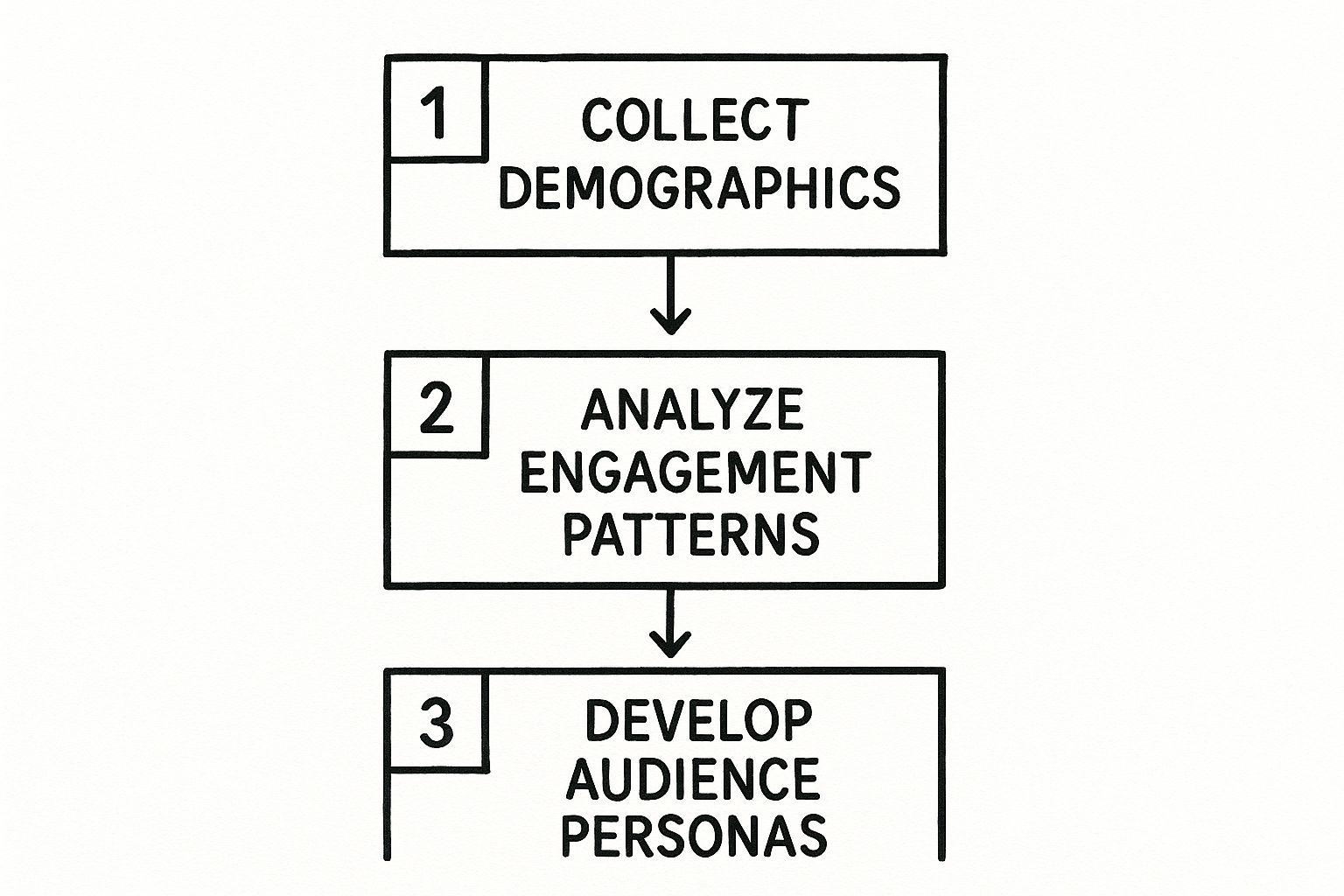
As you can see, pulling real demographic and engagement data is what lets you build accurate personas, which are absolutely crucial for marketing that actually connects with people.
Looking Outward: Opportunities and Threats
Opportunities are the external tailwinds you can catch. These are trends happening completely outside your school's control. For example, a big corporation opening a new headquarters nearby means a flood of new families looking for schools. That’s a massive enrollment opportunity. You might also spot a growing local demand for STEM programs or new government grants available for classroom technology.
Threats, of course, are the external factors that could cause real problems. The most common threat is another school—maybe a new charter school just opened up or a competing private school just dropped its tuition. Other threats might be demographic shifts in your district, falling property values, or even a negative public perception of private education in your area.
It's smart to go beyond just your own gut feelings here and use formal competitor analysis frameworks to really dig into what other schools are doing. This gives you a structured way to see where you stand in the market. You're not looking to copy them. You're looking for gaps and insights that help you build stronger marketing plans for schools that truly set you apart.
Finding Your Audience and Defining Your Unique Story

Any strong marketing plan for a school really boils down to two questions: Who are we trying to reach, and why should they pick us over everyone else? If your answer is "parents in our city," you're not digging deep enough to stand out. To make a real connection, you have to get to know the families you want to attract on a much more personal level.
This all starts with building out detailed audience personas. Think of these as semi-fictional profiles of your ideal families, pieced together from real-world data, conversations, and observations. These go way beyond basic demographics to uncover what drives them, what keeps them up at night, and what they truly value in an education.
Creating Your Ideal Family Personas
Forget vague descriptions. Your personas need names, jobs, and specific goals. This small step transforms an abstract "target audience" into a group of relatable people, which makes crafting messages that actually hit home infinitely easier.
Let’s get practical with a few examples I’ve seen work well:
- "The STEM-Focused Family": These parents are often engineers, doctors, or tech professionals. They’re hunting for a curriculum packed with science, technology, and advanced math. What gets their attention? Things like state-of-the-art labs, a competitive robotics team, and clear proof of where your graduates go for STEM degrees.
- "The Dual-Income Professionals": For this family, life is a logistical puzzle. Academics are a given, but they desperately need robust after-school programs and streamlined communication. Their biggest pain point is juggling schedules, so they’ll gravitate toward schools offering extended-day care, all-inclusive fees, and a slick parent portal app for on-the-go updates.
- "The Arts-Driven Household": These parents see creative expression as essential, not just an elective. They’re looking for a vibrant arts scene: dedicated studios, ambitious theater productions, and a wide array of musical groups. For them, a school that nurtures creativity is a non-negotiable.
Developing just two or three of these rich personas forces you to get specific. It ensures your marketing speaks directly to the unique hopes and needs of your best-fit families, making your school feel like the only choice that truly gets them.
Crafting Your Unique Value Proposition
Once you know exactly who you’re talking to, you’re ready to define your Unique Value Proposition (UVP). This is your promise—a clear, compelling statement that explains the unique value you deliver. It’s the single most important message that sets you apart from every other school in town.
What is the one thing your school does better than anyone else for your specific audience? That’s your UVP. It’s not a catchy tagline; it’s the heart of your school’s identity and the golden thread that should run through every piece of your marketing.
Take the international K-12 education market. With over 14,000 international schools operating today, the entire sector is shifting. It’s moving away from a purely exclusive, high-cost model. Many schools are now building their UVP around affordability and accessibility through hybrid learning, which appeals to middle-income families who were previously priced out. It's a smart pivot that's dramatically expanding their reach.
A great UVP is always specific and focused on the benefit to the family. Let's sharpen some common, vague statements:
| Vague Statement | Strong UVP | Why It Works |
|---|---|---|
| "We have small class sizes." | "Our 12:1 student-teacher ratio means your child gets the personal attention and mentorship they need to build academic confidence and find their love for learning." | It ties a feature (the ratio) directly to a powerful emotional benefit (confidence). |
| "We offer a great arts program." | "We are the only school in the county with a dedicated digital arts lab and a curriculum co-designed by working professional artists." | It’s specific, provable, and highlights an exclusive advantage. |
| "Our community is inclusive." | "Our project-based learning and student-led restorative justice program create a culture where every student truly feels seen, heard, and valued." | It explains how the community is inclusive, offering tangible proof points. |
Your UVP becomes your North Star. Every blog post, social media update, and open house tour should echo this core promise. This kind of consistency is how you build a powerful, recognizable brand. In fact, using a UVP to drive your content is a central pillar of great content marketing for schools and helps you tell a story that sticks. By locking in who you’re talking to and what makes you special, you build the strongest possible foundation for a marketing plan that actually delivers results.
Choosing Your Best Marketing Channels and Tactics
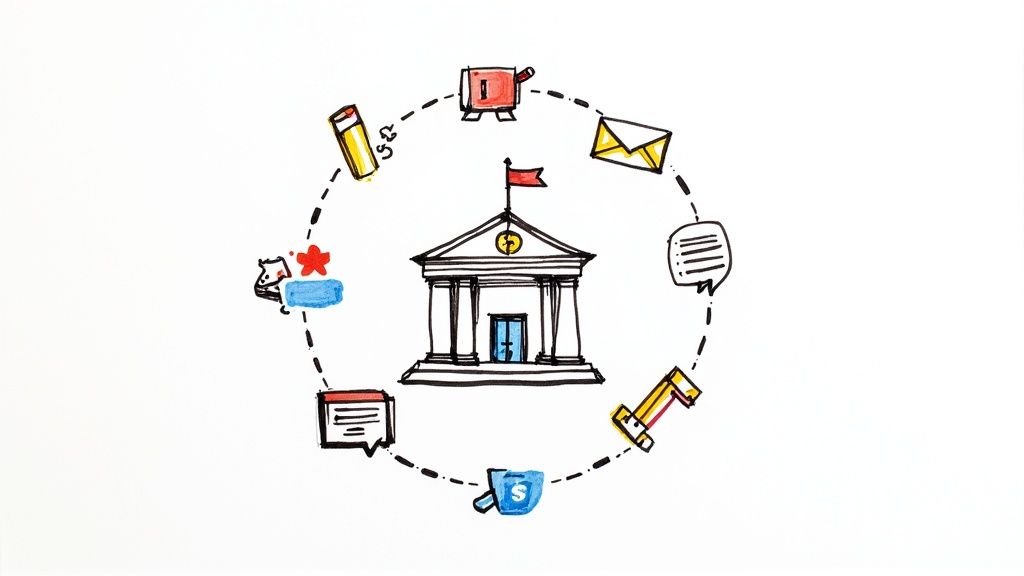
You've done the hard work of understanding who you're talking to and what makes your school stand out. Now, where do you actually tell your story?
Choosing the right marketing channels isn't about shouting from every rooftop. It’s about having meaningful conversations in the right places, consistently. The real magic happens when your channels work together, creating a smooth and compelling experience for prospective families.
Think of it like this: You wouldn't use an email newsletter to share a quick, candid video of a fun moment on the playground. That’s what Instagram is for. A successful plan blends digital platforms with real-world interactions to connect with families at every step of their decision-making process.
Your Digital Front Door: The School Website
Let's be clear: your school's website is the anchor of all your marketing. It’s your digital campus, and for many families, it's the very first impression they'll have of you. In fact, research shows that nearly 94% of first impressions are tied directly to your site’s design.
If your website is slow, confusing to use on a phone, or looks like it was built a decade ago, you're losing families before you’ve even had a chance to say hello.
Today, a mobile-first approach isn't optional. A staggering 52% of users say a bad mobile experience makes them less likely to engage with an organization. Your site has to be fast, beautiful, and simple enough for a busy parent to navigate on their smartphone while waiting to pick up their kids.
Beyond looking good, your website must be an engine for Search Engine Optimization (SEO). When a family searches for "private schools near me" or "best STEM program for middle school," you need to show up. This means doing the research to find the keywords your ideal families are using and weaving them naturally into your website's content, from page titles to blog posts. SEO is a long game, but it’s absolutely essential for being found.
Bringing Your School to Life on Social Media
Social media is where you show—not just tell—what makes your school a special place. It’s where your school's personality shines.
Facebook is fantastic for community-building, sharing important announcements, and promoting events. Instagram, on the other hand, is perfect for giving a vibrant, behind-the-scenes look at daily life—think photos from the art show or a short video of a science experiment in action. Those visuals communicate your school's energy far more effectively than text alone.
Don't try to be everywhere at once. Pick one or two platforms where you know your target families are spending their time. It's much better to create high-quality, consistent content on those channels than to post sporadically across five different networks.
Targeted social media ads can also be a powerful tool for growth. You can run campaigns aimed at "lookalike audiences" to reach new families who have similar interests and demographics to your current ones. This is a cost-effective way to build awareness and drive traffic to your next open house or online application portal. For more content ideas, this guide on marketing techniques for schools is a great resource.
Nurturing Leads with Email and Offline Events
Most families won't be ready to apply after just one visit to your website. That’s perfectly normal. This is where a thoughtful follow-up strategy using email and in-person events becomes crucial for nurturing that initial spark of interest.
An email workflow (often called a drip campaign) is one of the most effective tools in your kit. When a family requests information, they can be automatically entered into a pre-written series of emails sent over several weeks. These messages can share student testimonials, highlight a specific program, or invite them for a campus tour, keeping your school top-of-mind without you having to lift a finger.
Let's break down how these core channels fit together:
Comparing Core Marketing Channels
| Channel | Primary Goal | Key Tactic | Best for Reaching |
|---|---|---|---|
| Website/SEO | Attract & Inform | Keyword optimization, fast mobile design | Families actively searching for schools. |
| Social Media | Engage & Showcase | Behind-the-scenes video, targeted ads | Families in the awareness stage. |
| Email Marketing | Nurture & Convert | Automated welcome series, event invites | Families who have shown initial interest. |
| Offline Events | Connect & Impress | Themed open houses, community partnerships | Families ready for a personal connection. |
Finally, never underestimate the power of a fantastic open house. This is your moment to make your school’s mission and community feel real and tangible. When you treat your open house like a major event, applying proven event marketing strategies, you can dramatically increase engagement and applications. Consider partnering with local businesses or real estate agents to cross-promote. These offline connections build priceless community goodwill and fuel the most powerful marketing of all: word-of-mouth.
Budgeting Smart and Measuring What Matters
Let’s talk about the two things that make or break any marketing plan: money and results. A brilliant strategy is just a nice idea on paper without the budget to bring it to life and the right metrics to prove it’s actually working. Whether you're working with a healthy budget or stretching every dollar, how you handle your spending and measurement is everything.
This is exactly where I see a lot of school marketers stumble. They get caught up chasing "vanity metrics"—things like social media likes or a spike in website traffic. While those numbers aren't totally meaningless, they don't tell you what your head of school or board really wants to know: are we getting more students?
The real game-changer is connecting every dollar you spend to a tangible outcome, like an application or, even better, an enrolled student. This isn't just about justifying your budget; it's about making smarter decisions quarter after quarter, ensuring your hard work is always focused on what truly drives growth.
We need to shift our thinking to the Key Performance Indicators (KPIs) that actually matter. These are the numbers that paint a clear picture of a family's journey, from their first flicker of interest to becoming a proud part of your school community.
Moving Beyond Vanity Metrics
To budget effectively, you first have to define what success really looks like. Forget the fluffy numbers and get laser-focused on the data points that directly link back to enrollment. This means tracking the entire admissions funnel, from the very first click to the final handshake.
Here are the KPIs that should absolutely be on your dashboard:
- New Inquiries: The number of families who take that first step by filling out a form, calling the admissions office, or asking for more information. Think of this as the pulse check for the top of your funnel.
- Campus Tour and Open House Attendance: How many of those initial inquiries are genuinely curious enough to visit? This metric shows how well your initial pitch converts interest into real engagement.
- Applications Started vs. Completed: This one is critical. A big gap here might point to a clunky online application form or a follow-up process that’s letting potential families slip through the cracks.
- Cost Per Inquiry (CPI) and Cost Per Application (CPA): When you divide your marketing spend by the number of inquiries or applications you receive, you get a crystal-clear view of how efficiently each of your channels is performing.
Ultimately, all these numbers feed into the single most important metric: your Cost Per New Student. This is the bottom-line figure that measures your marketing return on investment (ROI) and the one your leadership team will care about most. If you're looking for more ways to connect your efforts to results, our guide on a variety of marketing strategies for schools can offer additional insights.
Benchmarking Your Marketing Budget
So, the big question: how much should you actually be spending? While every school’s budget is different, checking out industry benchmarks can give you a solid starting point.
In the broader education space, for instance, the average cost to enroll a single student is $2,849. That figure can swing pretty dramatically—costing $3,804 for a graduate student but only $599 for someone in a non-credit program.
Even with an average annual digital ad spend around $800,970, a staggering 29% of marketers feel confident they can even track their campaign success, according to data from Search Influence. That’s a huge disconnect between spending and understanding. But here’s the interesting part: 92% of the marketers who are satisfied with their tracking also report being happy with their results. It’s proof that good data builds both confidence and success.
To give you a clearer picture, here’s a look at what some of these average costs look like across different segments.
Education Marketing Cost Benchmarks
This table offers a comparative look at average digital marketing costs in the education sector. It's a useful tool to help you benchmark your own budget and performance against wider industry trends.
| Metric | Average Cost (Undergraduate) | Average Cost (Graduate) | Average Cost (Non-Credit) |
|---|---|---|---|
| Cost Per Enrolled Student | $1,505 | $3,804 | $599 |
| Common Ad Spend % of Revenue | ~3.6% | ~3.6% | ~3.6% |
| Tracking Confidence Level | Low (29%) | Low (29%) | Low (29%) |
Treat these numbers as guideposts, not gospel. The real power comes when you start tracking your own costs. Over time, you’ll build a historical baseline that is far more valuable than any industry average. This data-driven mindset is what transforms your marketing plan from a list of hopeful tactics into a predictable engine for enrollment growth.
Your Questions About School Marketing Plans Answered
https://www.youtube.com/embed/rk8Gx4kOuiw
Even with a perfect roadmap in hand, it's completely normal for questions to bubble up when you're putting together something as critical as your school's marketing plan. In fact, it's a good sign—it means you're thinking deeply about getting it right.
We've been in the trenches and have heard just about every question there is from school leaders and marketing teams. So, we’ve gathered the most common ones right here to give you direct, no-fluff answers that will help you push forward with confidence.
How Often Should We Update Our Marketing Plan?
Thinking of your marketing plan as a "one-and-done" document is a common mistake. The best plans are living, breathing guides that evolve. A great rhythm to get into is a major annual refresh paired with lighter quarterly check-ins.
The Annual Refresh: This is your deep dive. Once a year, usually over the summer or right before your big enrollment push, it's time to take a hard look at the entire strategy. Go back to your SWOT analysis, refresh your parent personas with any new insights, and set your big-picture goals for the school year ahead. This is for making those major strategic shifts.
Quarterly Check-ins: Think of these as quick, tactical tune-ups. Every three months, pull up your key metrics. Is one social channel blowing the others out of the water? Are your email open rates taking a nosedive? These regular check-ins are your chance to reallocate resources, tweak campaigns, and respond to what the data is telling you right now.
This cycle keeps your marketing plans for schools from getting stale and ensures you’re always putting your effort where it counts.
What Is the Most Important Part of the Plan?
If I had to boil it all down to one essential thing, it would be the marriage of two elements: a deep, almost obsessive understanding of your target audience and a crystal-clear Unique Value Proposition (UVP). Everything else you do stems from this foundation.
Seriously, think about it. If you don't know exactly who you're talking to and what makes your school the undeniable best choice for them, every marketing dollar is a gamble. Your website copy will feel flat, your social media ads won't connect, and your open house tours will lack that compelling narrative that gets families excited.
Your UVP is the core reason a family chooses your school over another. It's the "aha!" moment when they realize your school is the perfect fit. Nailing this foundational element makes every other marketing activity exponentially more powerful and efficient.
Once you have that, every photo you post, every story you share, and every email you send should reinforce that UVP and speak directly to the hopes and worries of your ideal family. Get this right, and you've already won half the battle.
What Tactics Work Best on a Small Budget?
A tight budget isn’t a roadblock; it's a call for creativity. You can get incredible results by doubling down on high-impact, low-cost strategies that truly move the needle.
First, own your digital front door: your website. Get laser-focused on Local SEO. This just means optimizing your site so that when local parents search for schools in your town, you're the first one they see. It costs time, not a ton of money, and is absolutely critical for discovery. Make sure your Google Business Profile is polished and packed with great reviews.
Next, you need to activate the most powerful marketing engine you have: your current community.
- Empower Your Parents: Your current families are your most believable and passionate advocates. Set up a simple referral program that rewards them for bringing new, like-minded families to your school. A genuine recommendation from a happy parent is worth more than any paid advertisement.
- Engage Your Alumni: Don’t let your graduates become a forgotten resource. Weave their success stories into your content and invite them to speak at events. Their achievements are powerful social proof that your school delivers on its promises.
Finally, get smart with social media. You don't need to be everywhere. Find out where your target parents are actually hanging out online—it might be a specific local Facebook group or Instagram—and pour your energy there. You don’t need slick production, either. Authentic, behind-the-scenes glimpses of your school's unique culture often perform far better. A small budget forces you to prioritize, which ultimately leads to smarter marketing.
Are you ready to stop guessing and start building a marketing plan that delivers real results? The MarCom Society provides K-12 marketing professionals with the expert guidance, practical resources, and supportive community you need to succeed. Elevate your strategy by joining our network of peers and learning from the best in the business. Learn more and become a member.