If you want to run truly effective meetings, it all comes down to one powerful mindset shift: stop holding discussion-focused meetings and start running decision-driven ones. It’s about transforming that calendar slot from a time-consuming obligation into a focused session that actually moves the needle on your school's goals.
Why So Many School Meetings Miss the Mark (And How to Fix It)
Let's be real for a moment. As a K-12 MarCom professional, you've probably sat through more than your fair share of meetings that felt like a complete waste of time. We’ve all been there—the agenda-less ramble that goes nowhere, or the meeting that ends with a collective shrug and no clear next steps.
This isn't just a feeling; it's a structural problem. The issue is that most meetings are built around topics, not outcomes. A simple list of "things we'll talk about" isn't a real agenda. A powerful agenda answers the question, "What will we have decided or accomplished by the time we walk out of this room?"
To see this in action, let's look at the difference between a meeting that just spins its wheels and one that gets things done.
The Shift From Ineffective to Effective Meetings
| Ineffective Meeting Trait | Effective Meeting Practice |
|---|---|
| Vague Agenda: "Discuss Fall Open House" | Action-Oriented Agenda: "Finalize the digital ad campaign for the Fall Open House" |
| Discussion-Focused: The goal is just to talk about a topic. | Decision-Driven: The goal is to make a specific, documented decision. |
| Runs Overtime: Lacks structure, leading to circular conversations. | Stays on Schedule: Clear objectives and a facilitator keep the meeting focused. |
| Ends with Ambiguity: "We'll circle back on this." | Ends with Clarity: "Jen will draft the ad copy by Friday; Mark will secure the budget." |
| Low Engagement: Attendees are passive listeners. | High Engagement: Attendees are active participants, prepared to contribute. |
The table above isn't just theory—it’s the blueprint for turning frustrating meetings into productive work sessions. By reframing every agenda item as a decision to be made, you inject purpose and accountability from the very start.
Adopt a Decision-Driven Agenda
For your MarCom team, this means every single item on your agenda should be directly tied to a specific enrollment or communications goal.
Instead of: "Social Media Update"
Try: "Approve the social media content calendar for next month"
Instead of: "Website Brainstorm"
Try: "Decide on the top 3 new features for the 'Admissions' section of the website"
This small change is a game-changer. It forces everyone to come prepared to contribute to a specific outcome.
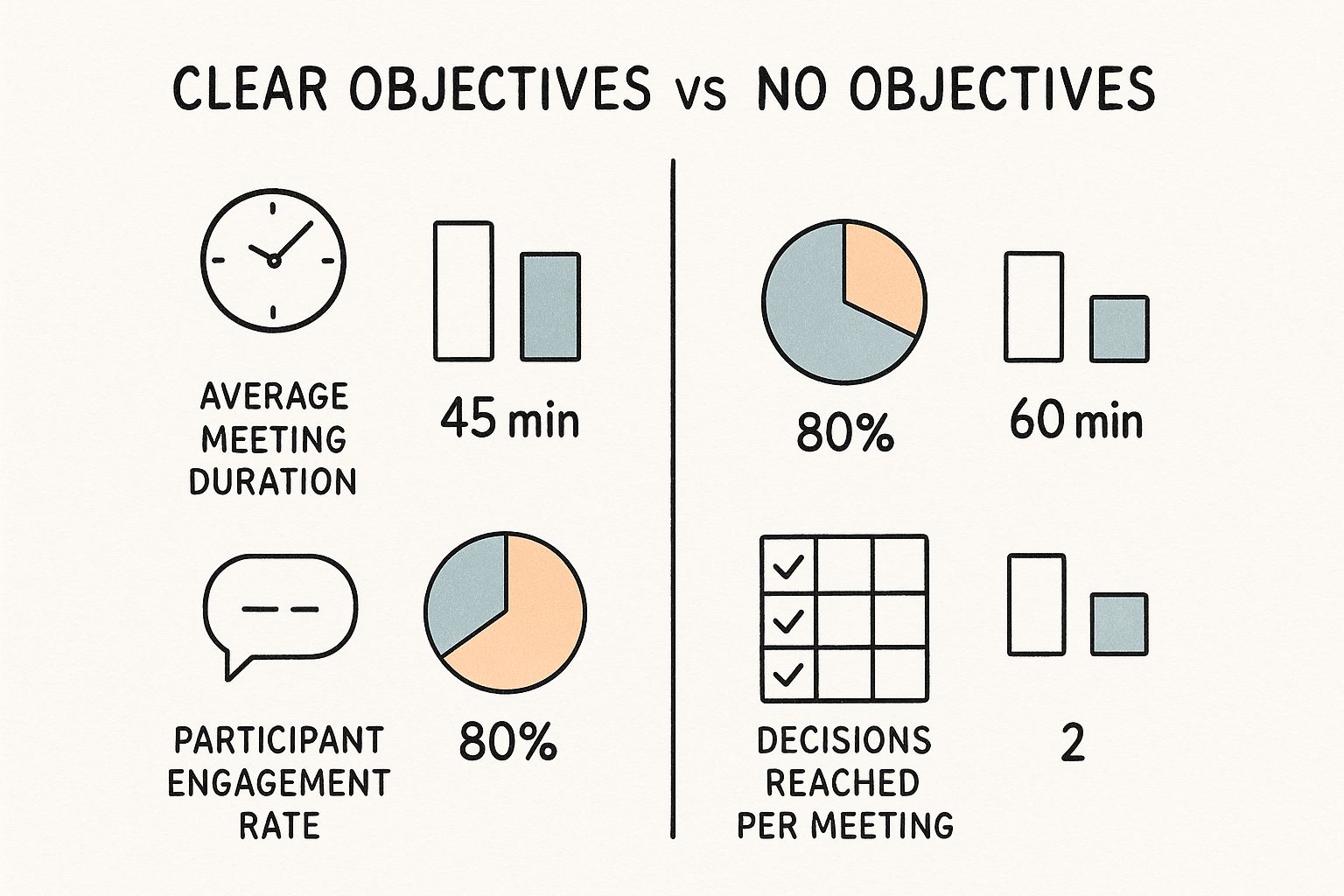
The data here speaks for itself. When you run meetings with clear objectives, you get more done in less time. It’s that simple.
Overcoming the Meeting Malaise
This isn't just a problem in education, by the way. It's a universal struggle. Top executives openly admit that a staggering 67% of the meetings they attend are failures. That's a huge disconnect between intention and reality.
But there’s good news. When organizations get serious about fixing their meeting culture, the results are dramatic. For instance, employee satisfaction with work-life balance can leap from 62% to an incredible 92% simply by implementing better meeting processes.
If you're looking to dive deeper into this, there are some great strategies for mastering modern team meetings that can help you tackle these common pitfalls head-on.
The goal isn't just to have meetings; it's to make decisions. By anchoring every meeting to a specific, action-oriented outcome, you break the cycle of pointless gatherings and start building momentum.
Better meetings also have a ripple effect on your team's communication and morale. Strong meeting habits are a cornerstone of a healthy work environment. For a closer look at how this fits into the bigger picture, explore our guide on https://blog.marcomsociety.org/internal-communications-best-practices/. When you fix the meeting, you start to fix the culture.
Your Pre-Meeting Blueprint for Success
We’ve all been in meetings that felt like a complete waste of time. The good news? The success of any meeting is almost always decided before anyone even walks into the room. For those of us in K-12 MarCom, this is our chance to turn routine check-ins into powerful strategy sessions that actually move the needle on enrollment and communication goals.
It all comes down to having a solid pre-meeting blueprint. This means ditching the simple list of topics for a purpose-driven agenda where every item is a question to answer or a decision to make. A huge part of this is knowing how to set goals effectively before you even start planning.
Crafting a Purpose-Driven Agenda
Your agenda is your single most important tool for a productive meeting. It's shocking, but some studies show that only 37% of workplace meetings actually use a formal agenda, which is a massive missed opportunity for focus and efficiency. Without one, conversations wander, and precious time gets lost.
To build an agenda that truly works for your school's MarCom team, you need to connect every single item back to a tangible outcome.
- Open House Strategy: Instead of a vague "Discuss social media," try something actionable like, "Finalize the Facebook ad targeting and budget for the upcoming open house." This immediately signals that a decision is needed.
- Weekly Content Check-in: Don't just list "Review blog posts." Frame it for action: "Approve final drafts of the next two alumni success stories for the website."
This simple shift in framing forces everyone to come prepared to contribute, not just to listen.
An effective agenda isn't just a schedule; it's a contract with your attendees. It promises that their time will be respected and used to make tangible progress on shared goals.
Selecting Participants and Distributing Materials
With a sharp agenda in hand, your next move is to decide who really needs to be there. The temptation to invite the whole department is common, but it's rarely the right call. For each item on your agenda, ask yourself: who are the absolute essential decision-makers and contributors?
If you're meeting to approve the new viewbook design, you absolutely need the graphic designer and the admissions director. Do you need the entire social media team? Probably not for that specific conversation. Keeping the invite list lean makes for a much more focused and efficient discussion.
The final piece of this pre-meeting puzzle is sending out materials ahead of time. This is non-negotiable. Whether it's campaign analytics, draft copy, or budget proposals, get those documents into people's hands at least 24 hours in advance. This one step ensures everyone arrives ready to discuss and decide, instead of seeing the information for the very first time.
Mastering these skills is an ongoing process, and it's always a good idea to brush up on your team's broader communication skills training. By making this pre-meeting blueprint a standard part of your workflow, you're setting the stage for a meeting that’s focused, productive, and respectful of everyone's time.
Mastering Facilitation to Keep Everyone on Track
Once your meeting kicks off, your hat switches from planner to facilitator. This is truly where the magic happens. It’s less about commanding the room and more about steering the conversation so it stays focused, productive, and inclusive for everyone involved. Without someone actively in the driver's seat, even the most perfectly planned agenda can go off the rails.
And let's be honest, the challenge is real. We’re all fighting for attention. An eye-opening 73% of professionals admit to doing other work during meetings. Even more telling? 52% of attendees say their focus starts to wander in the first 30 minutes. These aren't just numbers; they're a clear signal that we need to actively manage the room.
Guiding the Conversation Productively
We’ve all been there. A great discussion suddenly takes a nosedive down a rabbit hole. A relevant point morphs into a completely separate issue, and before you know it, you’re way off-topic. As the facilitator, it's your job to gently—but firmly—bring everyone back to the agenda.
Imagine your team is supposed to be finalizing the design for a new fundraising brochure. A colleague pipes up, "You know, the way this logo looks here reminds me that we really need to update the school-wide branding guidelines." It’s a valid thought, but it’s not what you’re there to do today.
This is a perfect moment to pull out the "Parking Lot" technique.
The Parking Lot is simply a designated space—a whiteboard, a spot in your shared doc, or even a sticky note—where you can "park" important but off-topic ideas. It validates the idea without derailing the meeting.
You can jump in with, "That's a fantastic point, Maria, and you're right, we need to get on that. I'm adding 'Review branding guidelines' to our parking lot to make sure we don't lose it. For now, let's get this brochure layout locked in." You’ve acknowledged their contribution and smoothly returned to the task at hand.
Encouraging Balanced Participation
Every team has its talkers and its thinkers. A good facilitator makes sure the conversation isn’t a monologue. If you notice one or two people are dominating the discussion, you have to create an opening for others.
A few phrases I keep in my back pocket:
- "Thanks, David. I'd love to hear from someone who hasn't had a chance to speak yet. Sarah, what are your thoughts on this?"
- "That's a really interesting take. Let's do a quick round-robin so everyone can share their initial reaction."
On the flip side, if a key person is staying quiet, don't be afraid to invite them in directly. A simple, "Chris, as our social media guru, how do you see this new messaging playing out on Instagram?" can draw out critical insights that the team might have missed. For a deeper dive, there's a great resource on effective meeting facilitation techniques that covers even more scenarios.
Sticking to the Clock with Timeboxing
Finally, you have to be the guardian of the clock. Timeboxing is your best friend here. It’s just the practice of assigning a strict time limit to each agenda item.
When you put those time estimates on the agenda, you have to honor them. If a 15-minute discussion on email subject lines is hitting the 14-minute mark without a clear decision, you need to make a call. You can either table it and follow up later or ask the group, "Can we take another three minutes to decide, or should we move on?"
Whatever you do, don't let one topic hijack the entire meeting. Sticking to the clock shows you respect everyone's time, and it's a true hallmark of a well-run meeting.
Turning Talk into Action: How to Make Decisions and Define Next Steps
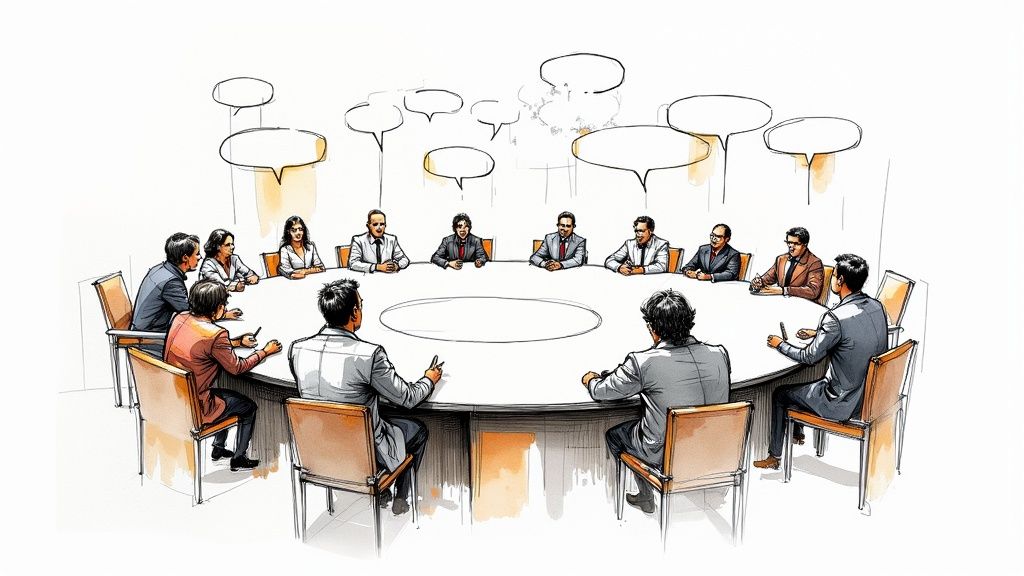
A great discussion is wonderful, but a meeting without a decision is just a conversation. This is the moment where momentum is either built or lost forever. The real skill is guiding the conversation from ideas to tangible outcomes, especially when a clear consensus feels just out of reach.
For any K-12 MarCom team, this is a familiar challenge. You might be hashing out a campaign budget where everyone has a different priority, or trying to get final approval on website copy that needs to please the admissions team, the Head of School, and the athletics department. Getting stuck in that endless loop of indecision is one of the most common frustrations in our line of work.
Pick the Right Tool for the Decision
A powerful way to break through the gridlock is to be upfront about how a decision will be made. I've found that not every choice requires universal, enthusiastic agreement. Sometimes, you just need a clear path forward.
There are a couple of models I lean on:
- Consensus: This is the gold standard where everyone actively agrees with the final decision. It’s fantastic for big, strategic moves that will shape your work for months, but it’s also slow and can be tough to land. If you aim for consensus on every little thing, your meetings will drag on forever.
- Consent: This is a much more practical approach for day-to-day work. The question isn't, "Does everyone love this?" Instead, you ask, "Can everyone live with this and support it moving forward?" Consent doesn't demand passion; it just requires a commitment not to stand in the way. It's perfect for things like approving a social media ad or picking a vendor for the new viewbook.
By simply stating which model you're using for a specific agenda item, you manage expectations and give everyone a clearer path to making a call.
From Decision to Action Items
Okay, so you've made a decision. Great! But the job is only half done. The final, make-or-break step is turning that decision into specific, assigned tasks. Without this, brilliant ideas and firm commitments tend to vanish the second the Zoom call ends. It's no wonder a shocking 72% of meetings are seen as ineffective—most of them probably fizzle out without clear next steps.
I’ve learned that the single best way to ensure things actually get done is to end every meeting by clarifying action items with a simple question: Who is doing what, and by when?
This isn't just about jotting down notes for yourself. It's about creating shared accountability in the room. Before anyone signs off, go around and confirm each action item out loud.
The Who-What-When Framework in Action
Let's say your team just decided to finally launch that new parent newsletter you've been talking about. Here’s what defining the next steps would look like in the meeting notes:
| Who (Owner) | What (The Specific Task) | When (The Deadline) |
|---|---|---|
| Sarah | Draft the welcome copy for the first newsletter. | By EOD this Friday. |
| Mark | Research and recommend an email platform. | By next Tuesday. |
| Jen | Pull together a list of content ideas for the first three issues. | By next Wednesday. |
This simple table, dropped right into the meeting summary email, becomes your project roadmap. It eliminates any "I thought you were doing that" confusion and channels all that great meeting energy directly into measurable progress for your school.
The Follow-Up: Where Progress Actually Happens
The meeting isn't really over when the Zoom call ends. Honestly, what you do in the next few hours is what separates a productive session from a forgotten conversation. Think of your follow-up as the glue that makes decisions stick and turns good ideas into tangible progress.
Without this step, even the most dynamic meeting loses steam. All that energy and all those great ideas just evaporate. A quick, clear summary shows everyone you value their time and creates the paper trail we all need for accountability. For any serious marketing project, this isn't optional—it's essential.
Get the Summary Out Within 24 Hours
Momentum is a fragile thing. To keep it from disappearing, you need to send out your meeting notes while the conversation is still fresh. I always aim for just a few hours after we wrap up, but you absolutely have to get it into everyone’s inbox within 24 hours.
If you wait any longer, the details start to get fuzzy and that sense of urgency completely vanishes. A fast follow-up sends a clear signal: this meeting mattered, and we're acting on it now.
A meeting without a summary is just a chat. A good summary is a tool for action. It’s the official record of what we decided and who’s on the hook for what’s next.
This doesn't mean you need to write a novel or transcribe the whole thing. The goal is to be brief and crystal clear. Your summary should be like a one-page brief that someone who wasn't even there can scan in two minutes and know exactly what happened.
What a Great Follow-Up Looks Like
Forget long, clunky paragraphs. Your summary email or Slack message needs to be built for speed. Use headings, bullet points, and bold text so the most important info practically leaps off the screen.
Here’s a breakdown of what to include every single time:
- A Quick Recap of Big Decisions: Start with the bottom line. Don't walk through the whole debate; just state the final calls. Something simple like, "We've officially approved the final design for the spring fundraiser mailer."
- A Crystal-Clear List of Action Items: This is the heart of the follow-up. I swear by the "Who-What-When" format because it leaves zero room for confusion. List the task, who owns it, and when it’s due.
- Links to Everything: Make it easy for your team. Include direct links to the meeting recording, the slide deck you presented, any shared Google Docs, or the analytics report you reviewed. It creates one central spot for everything.
This kind of structured follow-up is also a critical piece of a much larger puzzle. It ensures the small steps you take after one meeting are perfectly aligned with the big goals in your overall school communication plan.
Let’s put this into practice. Imagine your team just nailed down the theme for the annual gala. The action items in your follow-up could look exactly like this table:
| Who (Owner) | What (The Specific Task) | When (The Deadline) |
|---|---|---|
| Jessica | Draft "Save the Date" copy using the new theme. | Friday, EOD |
| Michael | Create a mood board for the gala's visual identity. | Next Tuesday |
| Admin Team | Confirm and book the venue for our chosen date. | End of Month |
This simple, clean format is your insurance policy against stalled projects. It takes the decisions you made in the room and turns them into a clear, accountable roadmap for everyone on your team.
Frequently Asked Questions About School Meetings
Even with the best game plan, trying to shift your school's meeting culture can feel like an uphill battle. Let's be honest, you're going to hit some snags.
Here, I'm tackling some of the most common questions and tricky situations I hear from K-12 MarCom pros who are on this exact journey. Think of this as a field guide for navigating everything from a colleague who’s stuck in their ways to the unique chaos of hybrid meetings.
How Do I Know If I Really Need a Meeting?
This is it. The single most important question you can ask yourself. Answering it honestly is your first step toward getting your team’s valuable time back. Meetings should never be the default setting for communication.
Before you even think about sending that calendar invite, pause and ask: "Do I need a decision, or do I just need to share information?"
Sharing Information: Got an update on the latest social media campaign numbers? Need to pass along a new quote from the print vendor? This stuff belongs in an email, a shared document, or even a quick Loom video. It respects everyone's focus and creates a paper trail.
Making a Decision: This is when you call a meeting. If you need to hash out creative concepts for the new viewbook, get the team to agree on a final tagline, or solve a tricky scheduling problem for the open house, you need that real-time, collaborative energy.
My rule of thumb is simple: If the conversation requires genuine back-and-forth to land on an answer, book it. If you're just broadcasting information one way, write it down instead.
What If My Team Resists the New Meeting Structure?
Let's face it, change is hard. When you start introducing agendas with time blocks and clear objectives, you can expect some pushback. People get used to the way things have always been done.
You might hear things like, "This feels too corporate," or "A strict agenda stifles our creativity." Your job isn't to argue, but to frame the change around a benefit they actually care about: getting more time back for the work that matters.
Explain that the goal isn't to be a drill sergeant. It's to make your time together so focused and productive that you can have fewer and shorter meetings. That means more time for deep, creative work.
The best way to win hearts and minds? Run a pilot program. Pick one or two of your regular team meetings and try the new format. After a couple of weeks, ask for feedback. Once your team experiences the magic of ending on time and walking away with a crystal-clear to-do list, they’ll become converts.
Any Tips for Managing Hybrid Meetings?
Ah, the hybrid meeting. Part of your team is in the conference room, the other half are floating heads on a screen. It’s a recipe for disconnection if you’re not careful. The absolute key is to actively fight against creating an "A team" (in the room) and a "B team" (at home).
Here are a few things that have worked for me:
- Assign a Remote Advocate: Pick someone in the physical room to keep an eye on the remote folks. Their only job is to watch for digital hand-raises, spot someone trying to jump in, and make sure their voices are heard.
- Tech Is Your Co-Pilot: Everyone—in-person and remote—needs to be looking at the same shared screen. Don’t just point a laptop camera at the whiteboard. Use a proper conference camera and ensure the main video feed clearly shows the entire room.
- Facilitate with Intention: As the leader, you have to be deliberate. Call on remote team members by name. A simple, "Sarah, from where you sit on the marketing team, what are your thoughts on this?" makes a world of difference. It pulls them right into the center of the conversation.
At The MarCom Society, we know that mastering meetings is just one piece of a much larger puzzle. Our community is built to give you the support, expert training, and accountability you need to excel in every part of your school communications role. Come join us to level up your strategies and connect with peers who just get it. Learn more and become a member today at https://marcomsociety.org.