Why Every School Needs a Strong Social Media Presence
The educational landscape is evolving, and families now prioritize transparency and authenticity when selecting a school. Traditional marketing methods like print and direct mail are often less effective in today's digital age. Schools must adapt and connect with prospective families where they spend their time: on social media. Forward-thinking institutions are already utilizing platforms like Facebook and Instagram as key elements of their marketing strategies.
A robust social media presence allows schools to showcase their unique culture, values, and accomplishments in a compelling way. Short videos of students participating in classroom activities, extracurriculars, or celebrating athletic victories can vividly portray the school community. Social media also facilitates two-way communication, enabling schools to directly engage with families, answer questions, and address concerns.
This direct engagement builds trust and strengthens relationships with families. Sharing behind-the-scenes glimpses of daily life highlights student achievements, faculty expertise, and special programs. Social media empowers schools to tell authentic stories. Sharing student success stories, celebrating teacher accomplishments, and highlighting community impact allows families to connect emotionally and envision their children thriving within the school environment.
Social media has become essential for school recruitment strategies. As of 2025, an estimated 5.42 billion people globally use social media, offering schools a vast platform to connect with potential students. For more detailed statistics, visit: Discover more insights about social media statistics.
Building Community Through Social Media
Social media marketing for schools is not solely about boosting enrollment; it's about cultivating a thriving online community. This involves creating engaging content that fosters connection and encourages interaction.
Schools can use social media to:
- Share important announcements and updates
- Promote upcoming events and activities
- Highlight student and faculty achievements
- Solicit feedback and engage in discussions
- Create contests and giveaways
By actively participating in online conversations and responding to comments and questions, schools demonstrate their commitment to open communication and community engagement. This fosters a sense of belonging and encourages family participation in the school's online presence.
The Consequences of Inaction
Schools lacking a strong social media presence risk being overlooked by prospective families. In today’s digital landscape, limited online visibility can negatively impact a school's reputation and enrollment efforts, particularly among younger generations who rely heavily on social media for information. Without a robust online presence, schools miss valuable opportunities to:
- Reach a broader audience of prospective families
- Build relationships and foster trust
- Showcase unique strengths and programs
- Control their narrative and manage their reputation
By embracing social media marketing, schools can actively shape their public image, engage with their community, and attract future students.
Choosing Platforms That Actually Drive Enrollment
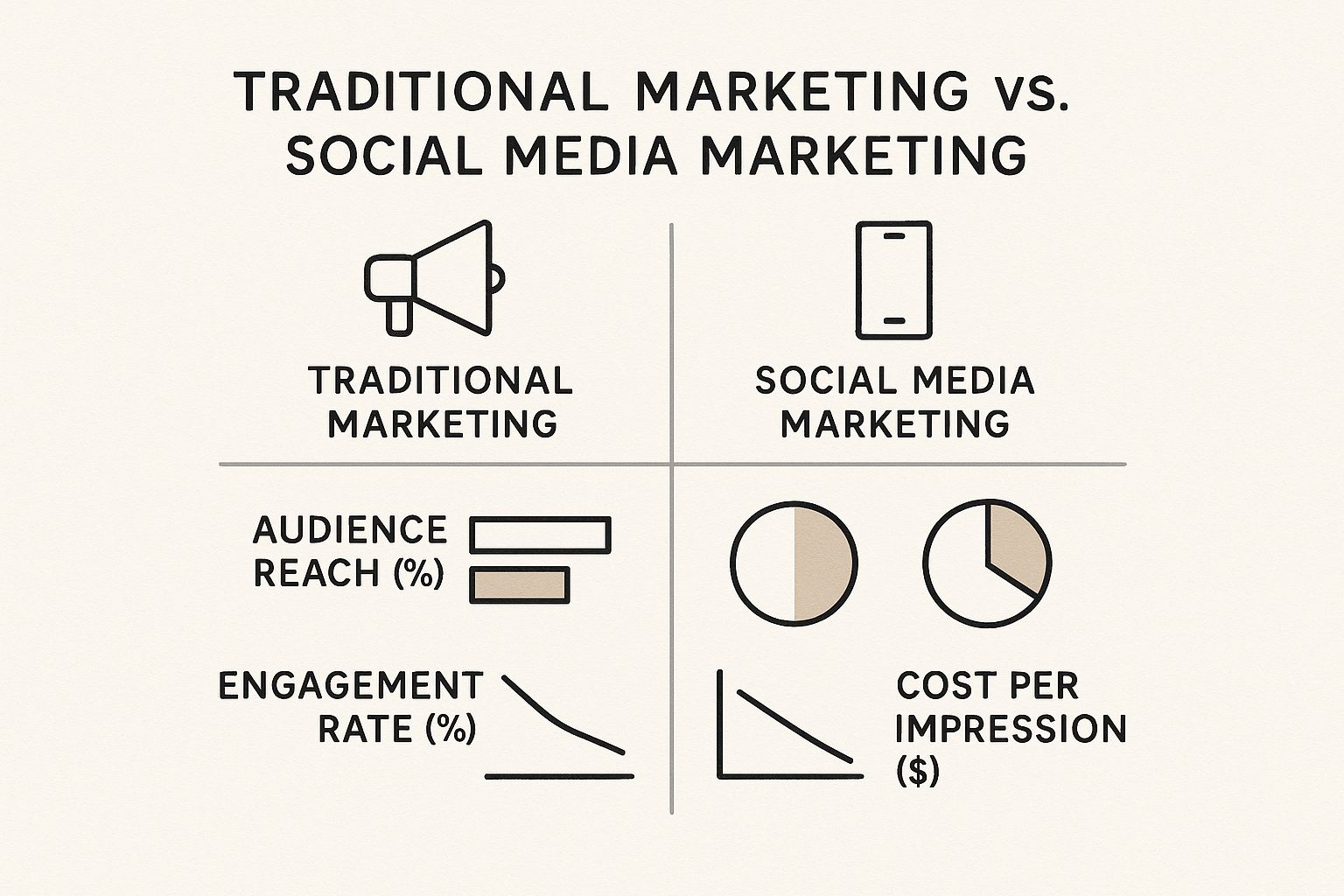
The infographic above illustrates a comparison between traditional marketing and social media marketing. Three key metrics are highlighted: audience reach, engagement rate, and cost per impression. Social media offers significantly greater engagement and reach, while simultaneously lowering costs. This makes a strategic social media presence crucial for schools aiming to boost their marketing ROI. For a more in-depth look at effective strategies, explore our guide on marketing strategy for schools.
Matching Platforms To Your Audience
Not all social media platforms yield the same results for every school. Understanding your target audience and their online habits is paramount. Facebook, for example, remains a valuable tool for connecting with parents, especially those of elementary and middle school students.
The continued expansion of social media usage presents a significant opportunity. Projections estimate 6 billion social media users by 2028, with Facebook alone anticipating around 3 billion monthly users. For more detailed information on this trend, visit: Learn more about social media trends.
However, Instagram and TikTok often prove more effective for engaging high school students and young alumni. These platforms emphasize visual content and short-form videos, which resonate strongly with younger demographics. Therefore, schools should customize content and platform selection based on the specific audience they hope to reach. You may also be interested in: How to master social media marketing.
Exploring Emerging And Underutilized Platforms
While some platforms are obvious choices, others offer untapped potential. LinkedIn, for example, can be a powerful tool for engaging with alumni, showcasing student career success, and connecting with prospective families interested in professional development programs. This strategy positions schools not just as educational institutions, but also as springboards for future career success.
Conversely, some popular platforms may not offer the expected return on investment for schools. Twitter, while useful for announcements and real-time updates, often generates lower engagement rates than visually oriented platforms like Instagram or TikTok. Careful evaluation of platform performance and strategic resource allocation are essential. This involves analyzing metrics beyond simple likes and shares, focusing instead on meaningful engagement and conversions tied to enrollment objectives.
The following table provides a concise comparison of various social media platforms, outlining their strengths and potential applications in school marketing.
To help schools choose the right social media platform for their marketing efforts, we've compiled a comprehensive comparison table.
| Platform | Primary Audience | Best Content Types | School Marketing Strength | Engagement Rate |
|---|---|---|---|---|
| Parents, Alumni | Text, Images, Videos | Reaching older demographics, building community | Varies, generally lower than Instagram and TikTok | |
| Students, Young Alumni | Images, Short Videos, Stories | Visual storytelling, showcasing campus life | Relatively high | |
| TikTok | Students | Short-form Videos, Trends | Reaching younger audiences, creative content | Very high |
| Alumni, Professionals | Articles, Professional Networking | Career development, alumni engagement | Moderate, focused on professional networking | |
| General Public, Media | News, Announcements, Updates | Real-time communication, public relations | Lower than other platforms |
This table highlights the diverse strengths of each platform. While Instagram and TikTok excel at visual engagement with younger audiences, Facebook remains relevant for reaching parents. LinkedIn offers a unique avenue for career-focused outreach, and Twitter serves as a channel for real-time communication. By understanding these distinctions, schools can tailor their social media strategies for maximum impact.
Creating Content That Builds Community and Trust
Great school marketing isn't about polished promotional materials. It's about sharing genuine stories that resonate with families and helping them envision their children thriving in your school's unique environment. This requires a strategic approach to content creation, carefully balancing the celebration of student achievements with essential privacy considerations.
Showcasing Your School's Culture Authentically
Building trust begins with authenticity. Parents are looking for genuine insights into your school's culture, not just marketing slogans. Compelling behind-the-scenes content offers a glimpse into daily life, fostering emotional connections with prospective families. Short videos of students engaged in classroom projects or participating in extracurricular activities can effectively convey the vibrancy of your school community.
User-generated content campaigns can also be incredibly effective. Encourage students, parents, and staff to share their experiences, amplifying authentic voices and building a sense of shared pride. However, it's crucial to establish clear guidelines for user-generated content to maintain privacy and ensure appropriate messaging. This might involve creating a dedicated hashtag and actively moderating submissions. For more detailed guidance, check out this resource: How to master content marketing for schools.
Balancing Transparency and Privacy
While transparency is key to building trust, protecting student privacy is paramount. Develop a clear policy regarding student media releases and ensure all content adheres to these guidelines. This demonstrates your commitment to responsible social media practices. For example, when sharing photos or videos of student achievements, always obtain appropriate permissions and avoid disclosing sensitive personal information.
Consider using broader shots of classrooms or event settings, focusing on the overall atmosphere rather than individual students. This allows you to showcase your school's culture while safeguarding student privacy. This approach also promotes inclusivity by representing the diverse experiences within your school community.
Handling Sensitive Topics and Crisis Communication
Social media isn't always a platform for positive news. Be prepared for potential crises or sensitive topics by developing a clear communication plan. This plan should outline procedures for responding to negative feedback, addressing community concerns, and managing sensitive situations. This proactive approach helps maintain trust and prevents the spread of misinformation.
If faced with negative comments or criticism online, respond promptly and professionally. Acknowledge the concern, offer a solution if possible, and redirect the conversation to a private channel for further discussion. This demonstrates your commitment to open communication and responsible community management.
Seasonal Content and Maintaining Consistency
Keep your content calendar dynamic by incorporating seasonal themes and events. This maintains audience engagement and offers opportunities to highlight different aspects of your school. This could involve sharing back-to-school tips, celebrating Teacher Appreciation Week, or showcasing holiday festivities.
Amidst these variations, however, maintain consistent branding and messaging. This reinforces your school's identity and ensures all content aligns with your overall marketing strategy. A consistent online presence builds familiarity and reinforces your school's image within the community. By strategically planning content and adhering to best practices, you can build a thriving online community that fosters trust and supports your enrollment goals.

Building a Strategy That Scales With Your Resources

Effective social media marketing for schools doesn't require a massive budget or a large dedicated team. What it does require is a well-defined strategy and efficient execution. This section will show how schools with limited resources can successfully compete with larger institutions through strategic planning and focused efforts.
Defining Your Value Proposition and Setting Clear Goals
Begin by identifying your school's unique strengths. What sets you apart? This becomes the core of your value proposition. Do you offer specialized programs? Perhaps a close-knit community is your hallmark, or maybe it's your exceptional faculty.
Once you’ve defined your value proposition, translate it into measurable social media goals. These goals should directly support your overall enrollment objectives.
These goals might involve increasing brand awareness by a certain percentage. They might also include driving traffic to your website or generating a specific number of inquiries from prospective families. Well-defined goals provide crucial direction and help you measure the effectiveness of your social media activity. This allows you to refine your strategy over time and prioritize the activities that provide the greatest return.
Developing a Sustainable Content Calendar
A content calendar aligned with your resources is essential. This involves planning and scheduling posts in advance, ensuring consistency without overburdening your staff. Think of your content calendar as your social media roadmap.
Prioritize quality over quantity. Posting less frequently with high-quality, engaging content is more effective than overwhelming your audience with irrelevant or rushed posts. Consider using a project management tool like Asana or even a simple spreadsheet to organize your content calendar and facilitate collaboration.
Streamlining Approval Processes and Building Efficient Systems
Establish clear approval processes for social media content. This maintains quality and ensures timely posting. You might designate specific individuals to review and approve posts before they go live.
Efficient systems prevent bottlenecks and ensure quick turnaround times, essential in the fast-paced world of social media. Think of it as a well-oiled machine. Each person has a designated role, ensuring the smooth and efficient creation and distribution of content. This also minimizes errors and maintains consistent branding and messaging.
Integrating Social Media With Broader Marketing Efforts
Social media shouldn't operate in a vacuum. Integrate it with your broader marketing strategy to amplify your message and extend your reach. This might involve coordinating social media campaigns with other marketing initiatives.
For example, promote upcoming school events on social media, including links to your website for registration and further information. Encourage families attending events to share their experiences using a dedicated hashtag. This cross-promotion boosts engagement and reach across multiple platforms. By strategically integrating social media, you can create a powerful, efficient system that drives results without overextending your resources.
Measuring What Matters: ROI Beyond Likes and Shares

Vanity metrics such as likes and shares provide a surface-level view of your social media performance. They don't, however, tell the full story. To truly grasp the impact of your school's social media marketing, you need to look beyond these superficial indicators. Focusing on metrics directly tied to enrollment success is key.
This involves tracking key performance indicators (KPIs) throughout the entire enrollment cycle. It also means connecting social media activity to concrete, tangible results.
Identifying Key Metrics for Enrollment Success
Shifting your focus from vanity metrics to actionable metrics is crucial. Instead of simply counting likes, delve deeper. Track website clicks that originate from your social media posts. Monitor the number of inquiries you receive from prospective families who first connected with your school on social media.
The ultimate metric? The number of enrollments influenced by your social media marketing. This data provides invaluable insights. You'll learn what content resonates with your target audience and which platforms effectively drive conversions. The effectiveness of these campaigns is evident: about 96% of marketers report positive ROI from social media, averaging around 250% return on investment. For more detailed statistics, Explore this topic further.
Setting Up Tracking Systems for Actionable Insights
Implementing the right tracking mechanisms is essential. Using UTM parameters in your social media links helps pinpoint the source of website traffic. This allows you to accurately measure which platforms and campaigns generate the most valuable leads.
Using a CRM system (Hubspot) is also beneficial. A CRM can track inquiries and connect them to specific social media interactions. This data paints a clear picture of your social media ROI and informs your ongoing strategy.
Interpreting Engagement Data and Demonstrating ROI
Analyzing engagement data goes further than simply counting clicks and inquiries. Look for patterns in the types of content that generate the most interest. Do videos outperform images? Are certain topics or themes more engaging? This knowledge informs future content creation and helps you connect with your community.
When presenting results to stakeholders, focus on the link between social media activity and tangible results. Show how increased engagement translates into more inquiries, higher event attendance, and ultimately, more enrollments. Quantify your results to demonstrate the value of your strategy and justify continued investment.
The following table provides a framework for understanding key social media metrics for schools:
Key Social Media Metrics For Schools
Essential KPIs and metrics that schools should track to measure social media marketing success and ROI
| Metric Category | Specific Metrics | Measurement Method | Target Benchmark | Business Impact |
|---|---|---|---|---|
| Awareness | Reach, Impressions | Social media analytics platforms | Increase year over year | Expanded brand visibility |
| Engagement | Likes, Shares, Comments, Click-Through Rate | Social media analytics platforms | Increase engagement rate | Deeper audience connection |
| Conversion | Website clicks, Inquiries, Event registrations, Application submissions | UTM parameters, CRM system | Track conversion rates by platform and campaign | Increased lead generation and enrollment |
| Advocacy | Shares, Mentions, Reviews | Social listening tools | Monitor positive sentiment and brand mentions | Improved brand reputation and trust |
This table summarizes the vital metrics schools should monitor to gauge their social media marketing effectiveness. By tracking these metrics, schools can better understand their audience, optimize their content, and ultimately, drive enrollment growth.
Metrics to Track Throughout the Enrollment Cycle
Different metrics are relevant at different stages of the enrollment journey.
Awareness Phase: Focus on reach and impressions to understand how many people are seeing your content.
Consideration Phase: Track website clicks, inquiries, and event registrations as families begin actively researching schools.
Decision Phase: Monitor application submissions and enrollments directly linked to social media engagement.
By tailoring metrics to each stage, you gain a comprehensive view of how social media influences families throughout their decision-making process. This data-driven approach empowers you to optimize your strategy, demonstrate ROI, and achieve your enrollment goals. By focusing on what truly matters, you can transform your social media presence into a powerful tool for growth.
Avoiding Common Mistakes That Hurt School Reputations
Social media marketing offers incredible opportunities for schools, but also presents potential risks. A single misstep can damage a school's reputation and undo months of positive relationship building. This section explores common pitfalls and offers actionable strategies to protect your school's image. You might be interested in: How to master school reputation management.
Navigating Negative Feedback and Privacy Concerns
Negative feedback is inevitable on social media. The key is addressing it constructively. Respond promptly and professionally to online criticism, acknowledging the concern. When possible, offer a solution or next steps. Moving the conversation to a private channel for a more detailed discussion shows a commitment to resolving issues effectively. This proactive approach can even turn critics into advocates, demonstrating your school’s responsiveness and dedication to community concerns.
Student and staff privacy is another critical area. Establish clear guidelines for featuring individuals in your social media content. Always obtain the necessary permissions before sharing photos or videos. Avoid disclosing sensitive personal information. Focusing on broader shots of classrooms or events can effectively showcase your school’s environment while protecting individual privacy.
Maintaining Authenticity While Upholding Professionalism
Authenticity is crucial for school social media marketing. However, it's vital to maintain professionalism at all times. Develop clear social media guidelines for both staff and students. Ensure all content aligns with your school's values and mission. Regularly review and update these guidelines. This keeps them aligned with evolving best practices and addresses emerging platform features.
Content Approval, Staff Training, and Community Management
Establish a streamlined content approval process. This maintains quality control and prevents accidental release of inappropriate or inaccurate information. The process should be efficient without hindering timely posting. This allows your school to respond quickly to trending topics and engage in real-time conversations. Training staff on social media best practices, such as using Hootsuite for management, is essential. This ensures everyone understands their role in managing your school's online presence and maintains a consistent brand voice.
Active community management is also vital. Regularly monitor your social media channels for comments, questions, and mentions. Respond promptly and thoughtfully to foster a sense of community. Show your school’s commitment to open communication. This includes addressing both positive and negative feedback, engaging in conversations, and actively participating in relevant online discussions.
Building a Resilient Social Media Program
Building resilience into your social media program is essential. This involves establishing clear policies that protect your school while encouraging genuine engagement. A comprehensive crisis communication plan is also crucial. This provides a framework for responding effectively to unforeseen events or negative publicity. This proactive approach can minimize damage and help your school navigate challenging situations with professionalism and transparency. By focusing on these key areas, schools can cultivate a strong, positive social media presence that strengthens their reputation and enhances community engagement.
Key Takeaways
Social media marketing is no longer a supplementary activity for schools; it's a vital component of thriving in the competitive education sector. This section offers practical takeaways to help transform your school's social media presence into a powerful tool for driving enrollment.
Building a Strong Foundation
Understanding your target audience is paramount. Where do prospective families spend their time online? What are their key priorities when selecting a school? Tailoring your content and choosing the right platforms based on these insights is crucial.
Don't overextend your resources by trying to maintain a presence on every platform. Instead, concentrate on the platforms where your target audience is most active. Facebook might be the best way to connect with parents, while platforms like Instagram and TikTok are often more effective for engaging with students.
Even with limited resources, a well-defined strategy is essential for success. Begin by defining your school's unique value proposition. Then, establish measurable goals that align with your overall enrollment objectives.
Creating Engaging Content
Move beyond polished, promotional content. Share authentic stories that showcase your school's culture, values, and student accomplishments. Offering behind-the-scenes glimpses into daily school life can help forge strong emotional connections with prospective families.
While transparency is important, it’s crucial to balance it with student privacy. Always obtain necessary permissions before sharing photos or videos featuring students. Focus on capturing the overall atmosphere of school events rather than highlighting individual students.
Consistent posting of high-quality content is key to keeping your audience engaged. A content calendar can help ensure a steady flow of valuable information and captivating stories. Consider incorporating seasonal themes and relevant school events into your content plan.
Measuring and Optimizing Your Efforts
Avoid getting caught up in superficial metrics like likes and shares. Instead, concentrate on actionable metrics such as website clicks, inquiries from prospective families, and the number of enrollments influenced by your social media activity.
Regularly review your social media performance to identify what content resonates most effectively with your audience. Adapt your strategy accordingly. This data-driven approach enables continuous improvement and optimization of your results.
Be prepared for occasional negative feedback or unforeseen crises. Having a communication plan in place for handling sensitive situations and responding professionally to online criticism is essential for maintaining a positive online presence.
Ready to elevate your school's marketing efforts? The MarCom Society provides valuable resources and support for K-12 school marketing and communications professionals. Join their exclusive community today for access to expert presentations, workshops, online courses, and a dynamic network of peers.