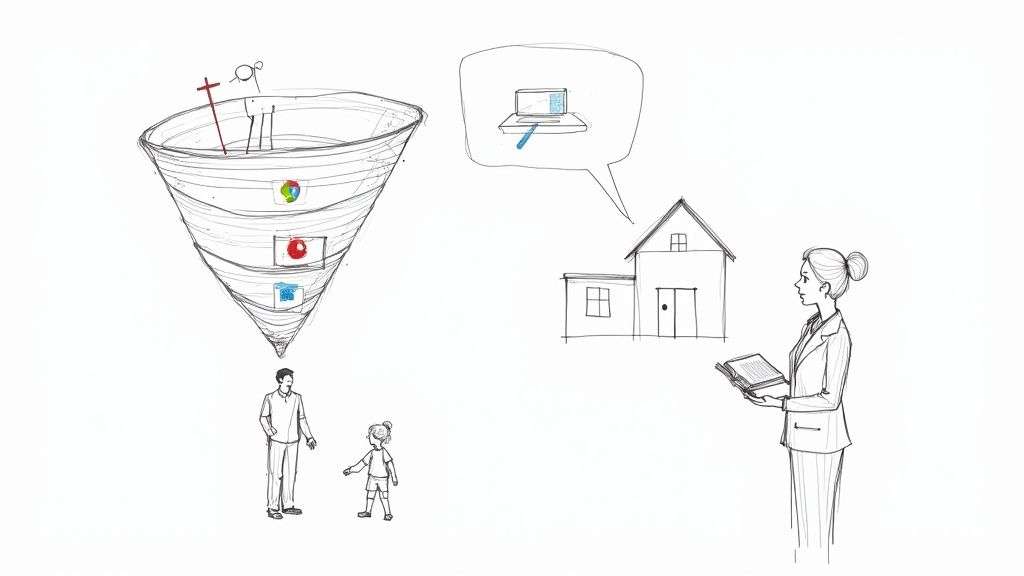
Educational content marketing is a fundamental shift in how schools approach their audience. Instead of just talking about yourself, you become a go-to resource for families. You’re not just promoting your institution; you're becoming a trusted guide, answering the tough questions parents have and helping them navigate the complexities of their child’s education. This approach builds genuine trust, often long before a family even thinks about filling out an application.
Why Educational Content Marketing Is Non-Negotiable for Schools Today
Let's face it: the old marketing playbook is broken. In a world where parents are more researched and skeptical than ever, just broadcasting your school's accolades won't cut it anymore. Today’s families don’t want a sales pitch; they want support and guidance. This is exactly where educational content marketing becomes your school’s most powerful tool for building real, lasting connections.
Think about it from a parent's perspective. A family is feeling anxious about their child's jump to middle school. Instead of seeing yet another ad for an open house, they stumble upon a thoughtful guide on your school's blog called, "5 Ways to Ease the Middle School Transition." That one article provides more genuine value than a hundred advertisements ever could. It shows you understand, you have expertise, and you truly care.
Building Trust Before Enrollment
This strategy is all about playing the long game. When you consistently publish high-quality, helpful content, you start building a relationship with families well before they're ready to make a decision. You're laying a foundation of trust that other schools, still stuck in the old advertising model, simply can't compete with.
The benefits are tangible and directly impact your enrollment goals:
- Establishes Authority: You position your school as the local expert on education.
- Nurtures Prospective Families: It keeps your school top-of-mind by engaging families early in their journey.
- Attracts Mission-Fit Families: Content that highlights your school’s philosophy naturally attracts families who share your values.
- Boosts Your SEO: Answering the questions parents are actually searching for helps you rank higher on Google, driving more organic traffic to your site.
A Market That Can't Be Ignored
This isn't just a clever tactic; it's part of a massive global trend. The content marketing market is projected to explode from $413.2 billion in 2022 to an estimated $2 trillion by 2032. That incredible growth highlights a simple truth: providing real value through content is the future of marketing, for every industry. You can read more about these school marketing statistics to see just how critical it is for your institution to adapt.
The core idea is simple but incredibly powerful: Stop interrupting what people are interested in and be what they are interested in. For schools, this means becoming a beacon of guidance for parents, not just another choice in a long list of options.
Ultimately, this guide will unpack why educational content marketing is so vital, echoing many of the principles found in Mastering Content Marketing Lead Generation. By moving from a "selling" mindset to a "helping" one, your school doesn't just get more applications—it builds a loyal, engaged community from the ground up.
Building Your School's Content Strategy Framework
A great educational content marketing plan doesn't just happen. It’s built on a deliberate, strategic framework that acts as the blueprint for every article you write and video you produce. Without this foundation, even the most creative content can miss the mark, failing to connect with families or drive real action.
To get started, it's worth brushing up on the fundamental aspects of a robust content marketing strategy. This isn't just about promotion; it's about turning your school's marketing into a genuinely helpful resource for prospective families. Let's break down how to build that framework.
Know Your Audience Deeply
The first—and most important—step is getting a crystal-clear picture of who you're talking to. Generic messages aimed at "all parents" just don't work anymore. You need to develop detailed parent personas.
Think of these not as simple demographic snapshots, but as rich, story-driven profiles. They should capture a family's unique goals, their anxieties about choosing a school, and the specific things they look for when making a decision.
- The Data-Driven STEM Parent: This parent wants the numbers. They’re looking for hard data on academic outcomes, details about advanced curricula, and proof that your school prepares students for high-tech careers.
- The Nervous First-Time Kindergartner Parent: For this parent, it’s all about feeling safe and supported. They need reassurance, so your content should spotlight your nurturing environment, caring teachers, and focus on social-emotional development.
- The Arts and Humanities Advocate: This persona cares deeply about creativity, critical thinking, and a well-rounded education. You can win them over with stories about student performances, unique arts programs, and a philosophy that champions curiosity.
When you create content for these specific personas, your message lands with much more impact.
Define Your Core Message and Voice
Once you know your audience, you need to nail down what you want to say and how you want to say it. Your core message is your school's unique value proposition, boiled down to a single, compelling idea. What truly sets you apart from the school down the street?
Just as crucial is your brand voice. Are you authoritative and academic? Warm and nurturing? Your voice needs to be consistent everywhere—from your website to your social media posts—to build a recognizable and authentic school personality.
At its heart, educational content marketing is a simple cycle: help families, build their trust, and ultimately, earn their enrollment.
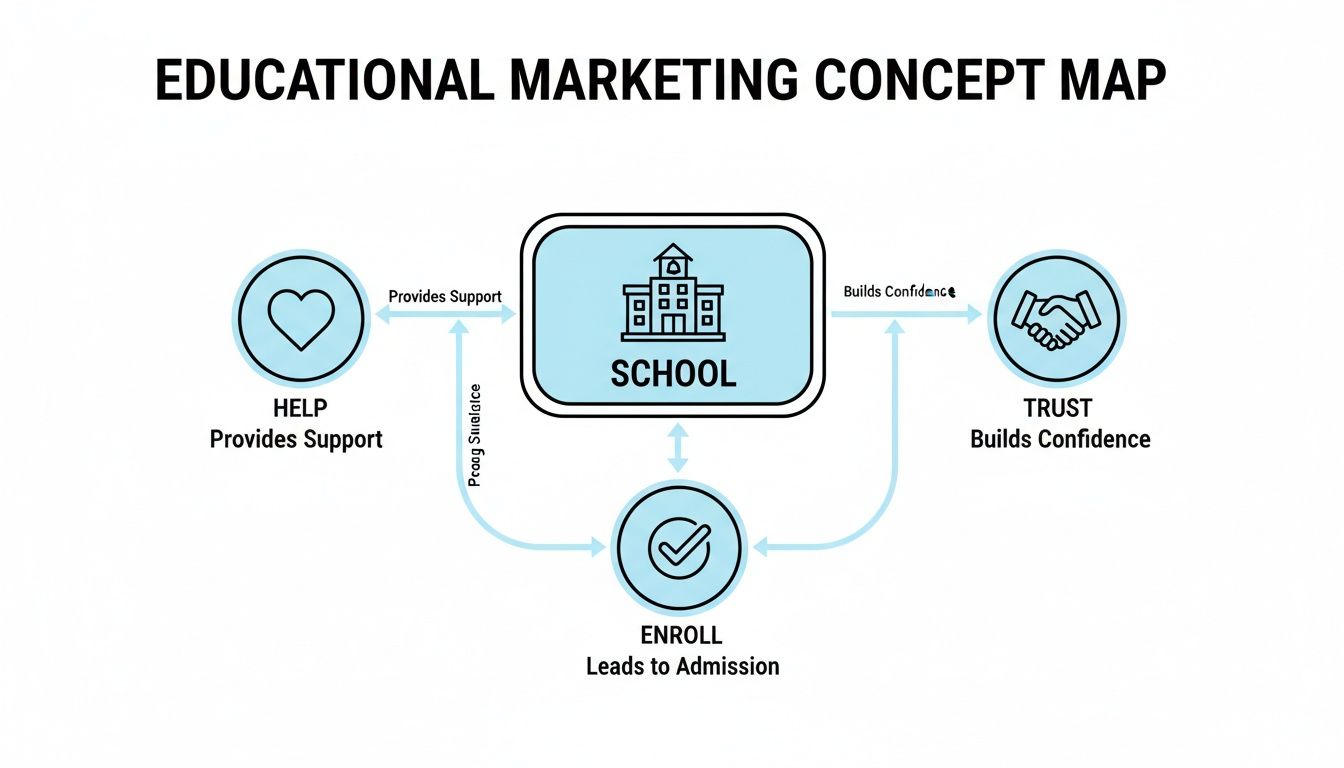
This simple diagram says it all. Genuine helpfulness is the seed from which trust grows, and that trust is what ultimately influences a family's enrollment decision.
Mapping Content to the K-12 Enrollment Journey
To be truly effective, your content needs to meet parents where they are in their decision-making process. The questions a parent has during their initial research are very different from the ones they have right before submitting an application. The table below maps specific content types to each stage of the K-12 enrollment journey, helping you deliver the right message at exactly the right time.
| Enrollment Stage | Parent Question | Effective Content Types |
|---|---|---|
| Awareness | "What are the best school options in my area?" | Blog posts on local education, school comparison guides, social media Q&As, community event recaps. |
| Consideration | "What makes this school different or better for my child?" | Virtual tour videos, detailed program pages, "day in the life" student stories, curriculum guides, teacher spotlight articles. |
| Decision | "Is this school the right fit for our family's values and my child's needs?" | Parent testimonials, alumni success stories, financial aid explainers, detailed FAQs, invitations to open houses or tours. |
| Enrollment | "What do I need to do to apply and prepare for the school year?" | Application checklists, enrollment guides, new family welcome packets, uniform/supply lists, "meet the staff" videos. |
By aligning your content this way, you create a seamless and supportive experience that guides families from their first Google search all the way to their first day of school.
Set Measurable and Meaningful Goals
Your content efforts have to be tied to tangible outcomes. Vague goals like "increase engagement" won't cut it. Instead, use the SMART (Specific, Measurable, Achievable, Relevant, Time-bound) framework to set clear targets that directly support your school's enrollment objectives.
A SMART goal isn't just a wish; it's a commitment with a deadline. It transforms your marketing from a series of random activities into a focused campaign designed for results.
Here are a few examples of strong, content-driven goals:
- Increase organic traffic to our "Admissions" pages by 20% in the next six months.
- Generate 50 qualified inquiries for campus tours from our "Kindergarten Readiness Guide" by the end of Q2.
- Boost our newsletter subscriber list by 300 families through our new parent resource hub before the fall enrollment deadline.
Setting clear goals also helps justify your budget. A common allocation for educational marketers might look something like this: 30% for SEO-optimized website content, 25% for video, 20% for student-generated posts, 15% for distribution, and 10% for personalization tools.
For a deeper look at building out your plan, check out our complete guide on https://blog.marcomsociety.org/how-to-create-content-strategy/. This methodical approach ensures every dollar and hour you invest in content serves a clear, strategic purpose.
Choosing Content Formats That Connect with Modern Parents
Once you've got a solid strategy mapped out, the real work begins: turning those ideas into content that actually connects with today's parents. This isn't about just picking a format out of a hat. It's about choosing the right vehicle to carry your school's unique story and value. The goal is to create resources that families genuinely want and seek out, not just another post they scroll past in their feed.
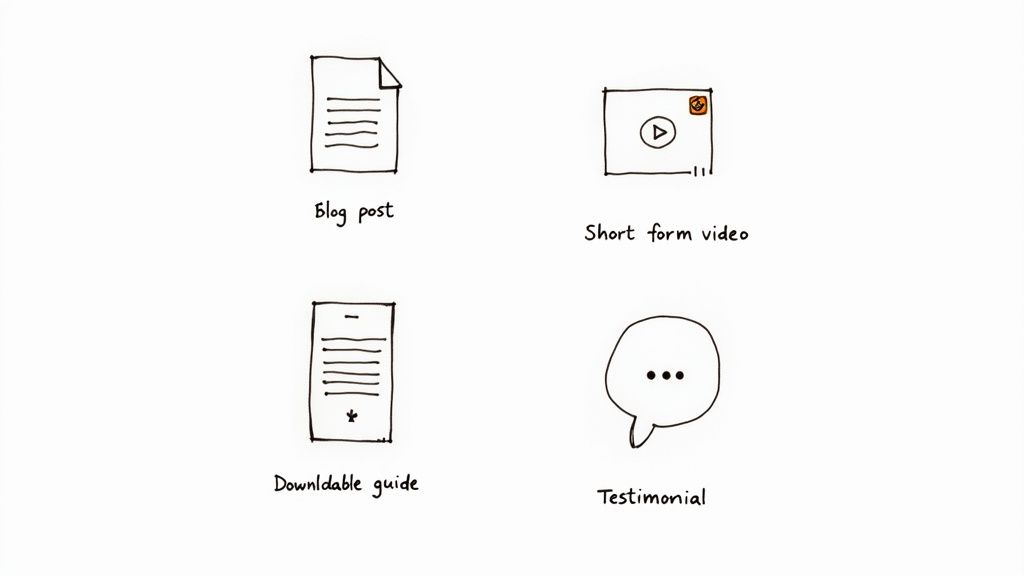
Let's break down the most effective content formats for school marketing. Each one plays a specific role, from answering a parent's late-night Google search to providing undeniable proof that your school's community is as special as you say it is.
SEO-Driven Blog Posts
Think of your school's blog as the foundation of your entire content strategy. It's your most powerful tool for attracting families through search engines by answering the exact questions they're typing into Google. When a parent searches for "how to foster a love of reading in early elementary," you want your school's blog post to be right there at the top of the results.
This approach immediately positions you as a helpful expert, not just another school trying to sell something.
- Builds Topical Authority: Consistently publishing high-quality articles on educational topics tells search engines that your school knows its stuff.
- Drives Organic Traffic: Every well-written post is like a new digital front door for prospective families to find their way to you.
- Provides Evergreen Value: A truly helpful article can attract families for years to come, giving you an incredible return on that initial time investment.
Authentic Short-Form Videos
Let's be clear: video is no longer a "nice to have." For many families, it's the primary way they absorb information. It gives them a peek into your school's daily life and culture that photos and text just can't replicate. The key here is authenticity. Parents want to see real students in real classrooms, not a slick corporate ad.
Short-form video, in particular, is a powerhouse, getting a staggering 12 times more shares than text and images combined. This is especially true on platforms like TikTok, where educational accounts can see an average weekly follower growth of 2.28%—double the rate of other platforms.
If you're looking to get started, our guide on how to create video content can walk you through capturing your school’s unique spirit on camera.
In-Depth Downloadable Guides
While blog posts are perfect for quick questions, downloadable guides are where you can really flex your expertise. These meatier resources—often offered in exchange for an email address—are perfect for families who are further along in their decision-making process.
Imagine creating a "Comprehensive Kindergarten Readiness Checklist" or a "Parent's Guide to Navigating the Middle School Years." These high-value downloads do two crucial things at once: they provide genuine, tangible help to parents and, in turn, help you build a list of engaged families you can continue the conversation with.
Downloadable content is a trust-building transaction. A family gives you their contact information, and you give them an expert resource that makes their life easier. That simple exchange is the start of a strong relationship.
This approach shows you're committed to supporting families long before they ever enroll, reinforcing the entire principle of educational marketing.
Student and Parent Testimonials
At the end of the day, the most powerful voices promoting your school aren't yours—they belong to your current families. Testimonials, whether in a short video or a written quote, provide the powerful social proof that backs up all your other marketing claims. They turn abstract promises about "community" and "support" into real, relatable stories.
To make them as effective as possible:
- Get Specific: Instead of a generic "We love this school," ask a parent to talk about a specific program, a particular teacher, or a memorable experience that made a real difference for their child.
- Use High-Quality Video: A short, heartfelt video from a parent or a confident student can be incredibly persuasive. You don't need a film crew, just good lighting and clear audio.
- Showcase Diversity: Feature a range of voices. Hearing from new kindergarten families, proud parents of graduating seniors, and everyone in between shows the true breadth of your school's impact.
By strategically mixing these formats, you create a rich, multi-layered content experience. You'll meet parents where they are, answer their questions with authority, show them your authentic culture, and give them the proof they need to make a confident decision. Each piece of content plays its part in building the trust that turns a curious website visitor into a committed member of your school community.
Your Guide to Content Creation and Smart Distribution
Creating fantastic content is only half the battle. If your insightful guides and inspiring videos sit unseen on a forgotten corner of your website, they aren't helping families or boosting enrollment. This is where a deliberate workflow for creation and a smart plan for distribution come in, transforming your efforts from a hopeful shot in the dark into a reliable engine for growth.
Great content doesn't just appear out of thin air; it’s the result of a structured, repeatable process. A solid workflow ensures your team isn't constantly scrambling for ideas but is instead executing a well-laid plan that lines up perfectly with your school's goals. It brings a sense of calm and order to the creative process.
Building a Practical Content Workflow
A successful workflow doesn't need to be complicated. It just needs to be consistent. The key is to establish a simple, repeatable system that involves the right people without creating unnecessary bottlenecks.
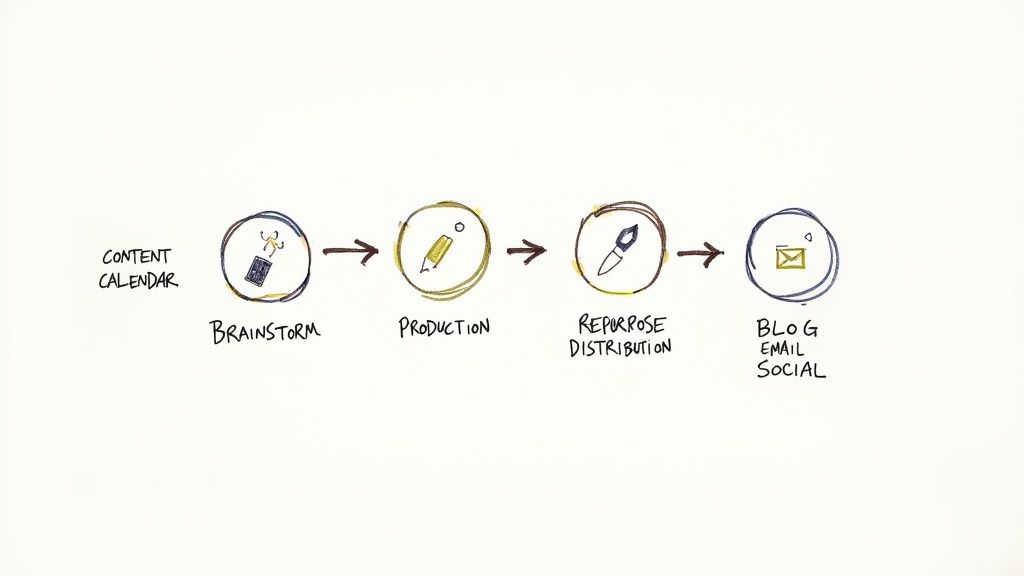
Your process could look something like this:
- Quarterly Brainstorming: Get your MarCom team, admissions staff, and a few engaged faculty members in a room together. The entire focus should be on your parent personas' biggest questions and challenges for the upcoming season.
- Content Calendar Planning: Turn those great ideas into a manageable content calendar. Be realistic. A good starting point is aiming for one high-quality blog post, two short videos, and one downloadable guide per month.
- Production and Review: Assign who is creating what and set clear deadlines for drafts and final versions. A simple review process ensures everything is high-quality and consistent with your school's voice.
This structured approach removes the guesswork and produces a steady stream of valuable content that speaks directly to the families you want to attract.
Smart Distribution: Maximizing Your Reach
Once a piece of content is finalized, its journey is just beginning. Smart distribution is all about getting your content in front of the right families, on the right channels, at the right time. Your school's blog, email list, and social media accounts are your primary owned channels—your most powerful tools for building a direct relationship with your audience.
Strategically using a blog can increase a school's organic website traffic by as much as 55%. And with 71% of parents following their child's school on social media, these platforms are absolutely essential for connection. You can explore more compelling content marketing statistics and trends to see the full picture of their importance.
Think of distribution not as shouting into the void, but as delivering a helpful, handwritten note directly to the person who needs it most. Each channel requires a slightly different approach to make that delivery feel personal and welcome.
By focusing on these core channels, you can create a powerful and integrated distribution strategy that truly works.
The Art of Content Repurposing
The secret to a sustainable educational content marketing strategy isn't just creating more content—it's getting more mileage out of the content you already have. This is the magic of repurposing. It allows even a small team to have a big impact without burning out.
Think about the lifecycle of a single, in-depth guide, like "A Parent's Guide to Middle School Success":
- The Core Asset: A comprehensive, SEO-optimized blog post that lives on your website.
- The Video Series: Break the guide's main points into five short, shareable videos for social media.
- The Infographic: Create a visually engaging graphic that summarizes the key tips and stats from the guide.
- The Email Nurture Sequence: Send a series of three emails to your subscriber list, each one highlighting a different section of the guide.
- The Social Media Campaign: Pull quotes, stats, and questions from the guide to create a month's worth of posts and polls.
Suddenly, one piece of cornerstone content becomes dozens of touchpoints. This approach maximizes your investment of time and resources, ensuring every great idea reaches the widest possible audience in the formats they prefer. It’s the key to maintaining consistency and momentum.
Measuring Your Content's Impact on Enrollment
You're creating great content—that's the first big step. But how can you prove it's actually helping fill your classrooms? Answering that question is how you secure your budget and show school leadership that your work is paying off.
It’s time to look past "vanity metrics" like social media likes. Instead, we need to focus on the key performance indicators (KPIs) that draw a straight line from your content to your admissions pipeline. The real goal is to connect the dots between a blog post a parent read and the inquiry form they submitted.
From Awareness to Action
Tracking performance isn't about getting lost in a sea of data. It's about monitoring the right metrics at each stage of a prospective parent's journey. When you organize your data this way, you can tell a powerful story about how your content is building trust and generating real leads.
Think of it in three distinct phases:
- Awareness Metrics: This is all about reach. How many new families are finding your school because of the content you're putting out there?
- Engagement Metrics: Once they find you, are they sticking around? These numbers tell you if your content is actually capturing their attention.
- Conversion Metrics: This is the bottom line. These metrics track how many families are taking that crucial next step toward enrollment.
Key Metrics for Your Content Dashboard
To get a true feel for performance, you need a dashboard that gives you the complete picture. The old way of doing things just isn't cutting it anymore. In fact, conversion rates from purchased contact lists plummeted by 67% between 2019 and 2023.
On the flip side, school-owned assets that deliver real value are thriving. For instance, virtual tours have been shown to generate 40% more qualified leads. This shift makes it crystal clear why valuable, engaging content is no longer a nice-to-have.
The most powerful data tells a story. Your goal is to create a clear narrative that shows how an initial spark of interest, nurtured by your content, blossoms into a formal application.
Here are the essential KPIs you should have on your radar:
Organic Traffic and Keyword Rankings: How many people are finding your website through a simple Google search? If your blog post on your unique STEM program is ranking for local searches, you know your awareness strategy is hitting the mark.
Time on Page and Bounce Rate: A parent lands on your virtual tour page. Do they spend several minutes exploring, or do they click away after ten seconds? A high time on page and a low bounce rate are fantastic signs that your content is genuinely useful and compelling.
Newsletter Subscriptions and Open Rates: Offering a downloadable curriculum guide in exchange for an email is a classic mid-funnel win. High open rates and click-through rates on your follow-up newsletters prove you're successfully keeping those families engaged.
Inquiry Form Completions: This is where things get really exciting. You need to track how many parents who read a specific blog post or watched a particular video then go on to fill out an inquiry form. This is how you directly connect content to a brand-new lead.
Application Starts and Completions: The ultimate prize. With the right analytics in place, you can attribute new applications directly back to the content that influenced the decision, giving you undeniable proof of ROI. For a deeper dive, check out our guide on the most important content marketing metrics you should be tracking.
Real-World Examples of Content Marketing for Schools
Frameworks and theory are great, but seeing how other schools put content marketing into practice is where it all starts to make sense. Let's look at three realistic examples of schools that are knocking it out of the park.
Each one uses content to build trust and attract the right families for their community. These mini-case studies break down what they did, how they did it, and the results they saw, giving you a clear playbook you can adapt for your own school.
Maple Creek Elementary: The Kindergarten Authority
Maple Creek Elementary’s team noticed a pattern: local parents were stressed about getting their kids ready for kindergarten. Instead of just pushing their own program, they decided to become the go-to resource for this major life transition.
Their whole strategy was to own the "kindergarten readiness" conversation in their town.
- What they created: They launched a blog series called "Countdown to Kindergarten." It covered everything from "Fun Ways to Build Pre-Reading Skills at Home" to "Tips for Handling First-Day Separation Anxiety." To make it even more personal, they paired each post with a short, welcoming video from one of their kindergarten teachers.
- How they shared it: The team shared the articles in local parent groups on social media and ran targeted ads aimed at families with four- and five-year-olds.
- What happened: Within a year, their blog was one of the first things that popped up when parents searched for kindergarten questions online. This drove a 40% increase in tour requests from families who already felt like they knew and trusted Maple Creek.
Summit Preparatory Academy: The Student Voice
Summit Prep, a rigorous high school, needed a way to connect with teenagers who were genuinely excited about learning. They knew that the most powerful storytellers weren't the adults in the building—they were the students themselves.
The strategy was simple: showcase authentic student life and prove the value of a Summit Prep education through real-world outcomes.
By handing the microphone to their students and alumni, Summit Prep didn't just tell prospective families about their value—they showed it through compelling, real-life stories.
They essentially let their students and graduates run the show.
- What they created: The school backed a student-run Instagram account where different students would do "day-in-the-life" takeovers. They also produced a polished video series called "Alumni Career Spotlights," interviewing recent grads working in exciting fields like biotech and graphic design.
- How they shared it: The student content took off on its own on Instagram and TikTok. The alumni series was perfect for sharing on LinkedIn and in emails to prospective families.
- What happened: This approach got tons of engagement from teens. Even better, admission essays started mentioning specific student projects or alumni stories, proving that the content was attracting highly informed and mission-aligned applicants.
Riverbend Community School: The Child Development Expert
Riverbend, a PreK-8 school, is in a community full of parents who are passionate about progressive education and child psychology. To reach them, Riverbend decided to position itself as a thought leader on how children learn and grow.
Their goal was to become the first place parents turned to for expert, research-backed advice. They published in-depth guides on topics like "Why Play is Essential for Brain Development" and "How to Nurture Intrinsic Motivation in Your Middle Schooler."
These weren't just quick blog posts. They were deep, valuable resources that built incredible trust, making families see Riverbend as the undeniable expert—and the best educational choice—in the area.
Your Top Educational Content Marketing Questions, Answered
Even with a solid plan in place, jumping into educational content marketing is going to spark some real-world questions. I often hear school marketers ask how they can possibly manage the workload or what kind of content actually connects with the right families. Let’s tackle some of the most common hurdles you're likely to face.
How Can a Small Marketing Team Possibly Keep Up With Content Creation?
This is the big one, isn't it? The secret is to work smarter, not harder. Don't fall into the trap of thinking you need to be everywhere, doing everything, all at once.
Instead, start small and focus on doing one or two things exceptionally well. Maybe that's a really insightful monthly blog post or a weekly video diary of student life. Quality will always trump quantity.
The real game-changer here is content repurposing. Think of it as your ultimate efficiency hack. A single, well-researched blog post can be sliced and diced into:
- A whole week's worth of social media posts.
- A featured story in your next parent newsletter.
- The script for a quick, informative video.
And remember, you’re sitting on a goldmine of content creators: your people. Tap into your faculty and students for their stories and expertise. A quick chat with a passionate science teacher or a short video from a student club leader can give you amazing content and take a huge weight off your shoulders.
What Content Actually Attracts Mission-Fit Families?
If you want to attract families who truly get what your school is all about, your content has to be an honest mirror of your culture and educational philosophy. It’s not enough to just list your academic programs or show off your new science lab. Families are searching for a place where their child will be known, supported, and challenged.
Content that resonates most deeply is content that shows, not just tells. It’s what helps the right families see your school’s heart and soul and feel that instant sense of belonging.
Focus on creating content that bleeds character. This could be a video highlighting a quirky school tradition, an article that walks parents through your unique approach to social-emotional learning, or powerful testimonials from families who knew they found the place for their child. This kind of authentic storytelling is a natural filter for families who are already aligned with your vision.
How Long Until We Actually See Results From This?
Let’s be clear: educational content marketing is a marathon, not a sprint. You’re not just running an ad; you’re building a foundation of trust and establishing your school as an authority. That takes time and patience.
You’ll likely see some early wins in engagement—more shares on social media, a bump in newsletter sign-ups—within the first 3-4 months. But the results that really move the needle take a bit longer to ripen.
You can realistically expect to see a meaningful impact on metrics like organic website traffic and qualified admission inquiries within 6-12 months. The key ingredient is consistency. Every helpful article you publish, every authentic video you share, is another brick in that foundation. It's this steady effort that builds the reputation needed to drive sustainable, long-term enrollment.
At The MarCom Society, we provide the resources, expert guidance, and peer support you need to build and sustain a successful content marketing strategy for your school. Learn more about joining our community and accessing exclusive tools and workshops.