
Let's be real for a moment. When we talk about cross-departmental collaboration, we’re not just throwing around business buzzwords. For schools, it means getting different teams—like admissions, academics, and marketing—to actually talk to each other and work towards the same goals.
It’s about tearing down the invisible walls that have traditionally separated departments, creating a single, unified front that truly tells your school's story and attracts the right families.
Why School Department Silos Are Harming Your Growth
The old "stay in your lane" mentality is a relic. It simply doesn't work anymore, especially in the competitive world of K-12 admissions. When your teams operate in their own little bubbles, you create a confusing and disjointed experience for the very people you're trying to attract. This isn't just an internal headache; it actively sabotages your enrollment and retention.
Think about it from a parent's perspective. They see a compelling ad on social media that highlights your school's innovative, project-based learning and close-knit community. They're hooked. But when they arrive for a campus tour, the admissions director—completely unaware of the marketing campaign—only talks about test scores and the new gymnasium.
Suddenly, the story falls apart. The connection is lost. That family walks away feeling like they were victims of a bait-and-switch. This is the direct result of departmental silos.
The Real Cost of Inconsistent Messaging
When your teams aren't on the same page, your school's brand story becomes a fractured mess. This inconsistency erodes trust before you even have a chance to build it. The fallout is real and measurable:
- Wasted Marketing Spend: You’re burning through your budget on campaigns that don't reflect the actual school experience, which means they won't convert.
- Lower Enrollment Rates: Families can spot a disconnect from a mile away. If what you promise doesn't match what they see, they’ll look elsewhere.
- Poor Family Retention: The need for a unified experience doesn't stop once a student enrolls. When the communications team and academic staff are out of sync, current families feel disconnected and undervalued, which is a recipe for attrition.
Breaking down these walls isn't just a nice idea; it's a necessity. A stunning 83% of companies are already using cross-departmental collaboration to get ahead, and schools have a lot to learn from this trend. When you bring diverse perspectives together, your school becomes more agile and responsive. You can dig deeper into how organizations are adopting collaborative frameworks on blog.9cv9.com.
The biggest risk of working in silos is creating a brand identity that feels inauthentic. True collaboration ensures that the story you tell is the story families actually experience, from their first click on an ad to their hundredth day on campus.
Let's look at the difference between the old way and the new way of operating.
Comparing Siloed vs. Collaborative School Marketing
| Siloed Departments (The Old Way) | Collaborative Teams (The New Way) |
|---|---|
| Inconsistent messaging confuses prospective families. | A consistent, compelling brand story is told at every touchpoint. |
| Admissions has no idea what marketing is promising. | Marketing and admissions work together to create an authentic journey. |
| Marketing campaigns are based on assumptions, not reality. | Campaigns are informed by real student and faculty stories. |
| Budget and resources are often wasted on ineffective efforts. | Resources are pooled for maximum impact on enrollment goals. |
| Current families receive conflicting communications. | A unified communication strategy keeps current families engaged. |
| Problems are solved within departments, ignoring root causes. | Cross-functional teams tackle challenges from all angles. |
| Each team protects its own turf and data. | Data and insights are shared to improve the entire family experience. |
The contrast is stark. Collaboration isn't just about being more efficient; it's about being more effective and authentic in everything you do.
A Clearer Path Forward
Moving from isolated teams to an integrated, collaborative model creates a synergy that makes your school’s unique strengths shine. This shift is fundamental to achieving sustainable growth.
It ensures that every interaction a family has with your school—whether it’s online, in a brochure, or face-to-face—reinforces a single, powerful narrative about your community and value. Ultimately, effective cross-departmental collaboration transforms your entire staff into a cohesive enrollment and retention machine.
Building Your Collaborative School Team
Great cross-departmental collaboration doesn't just happen; it’s built with intention. To get this off the ground, you need a deliberate structure that brings the right people to the table and gives them a clear, shared purpose. It’s all about assembling a core team that sees the entire student journey, not just their little slice of it.
Your first move is to find your champions. Look for the influencers and respected voices in key departments. For any K-12 school, your dream team absolutely needs people from admissions, curriculum, finance, and, of course, marketing. These are the folks who can knock down silos within their own teams and really advocate for a more unified approach.
And let's be clear: this isn't about slapping another committee meeting onto everyone's already-packed calendar. It’s about creating a dedicated task force with a specific, high-stakes mission.
This image really drives home how different team members can rally around one central objective.
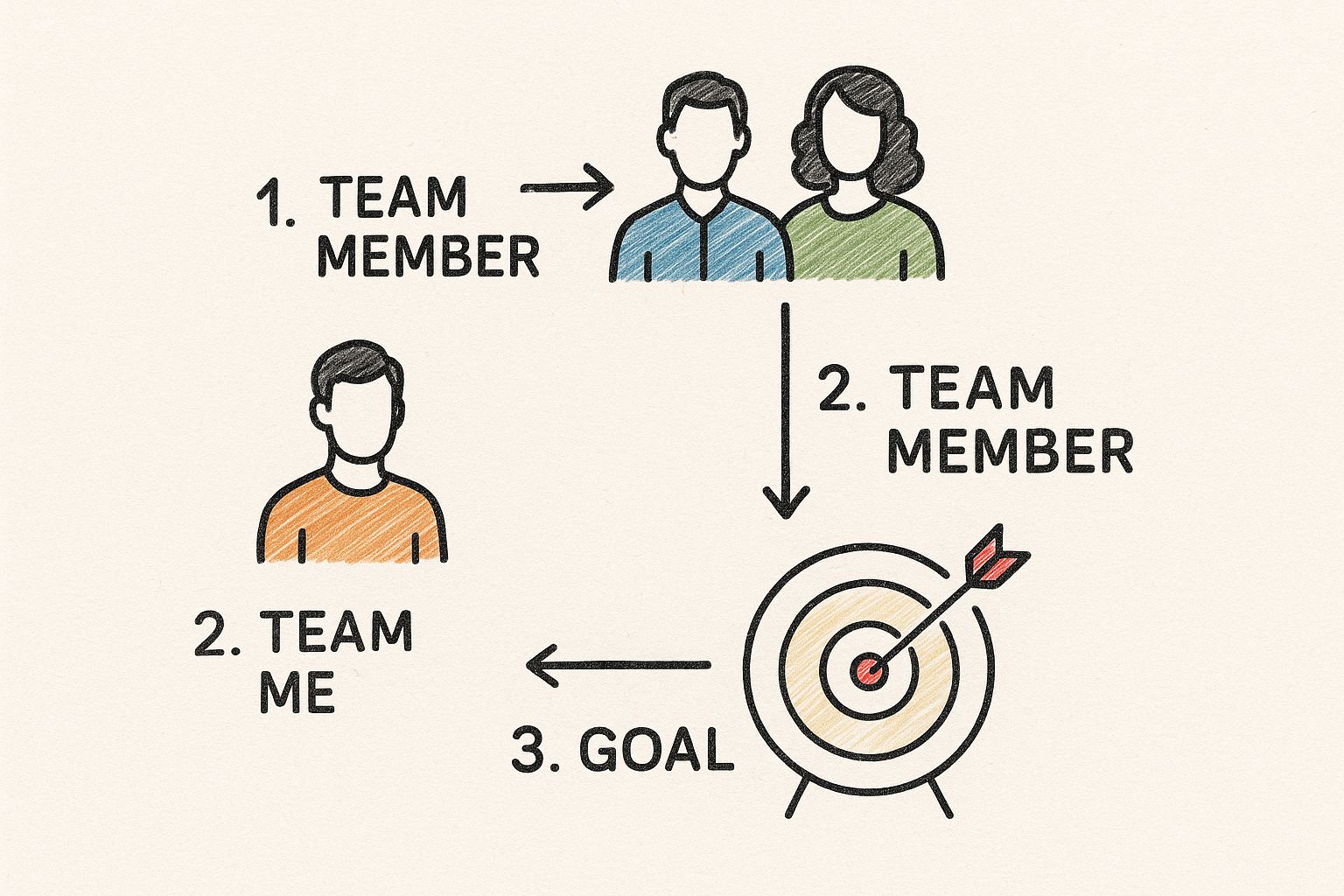
You can see that real collaboration is an active process where unique departmental viewpoints come together to push a common goal forward.
Set Goals Everyone Can Own
The effectiveness of your new team lives and dies by its goals. They have to be both ambitious and measurable. A vague objective like "improve enrollment" is a non-starter—it’s too broad and gives no one a clear sense of direction. You need to focus on specific outcomes that genuinely require input from every single person on the team.
For example, a fantastic shared goal could be to increase new family retention by 15% within the first year.
Think about it. That one number immediately pulls everyone into the same conversation:
- Marketing has to set accurate, honest expectations for new families from day one.
- Admissions needs to make sure the onboarding process is seamless, warm, and welcoming.
- Curriculum leaders must deliver on the academic promises that were made during the admissions cycle.
- Finance plays a crucial part in making tuition payments and financial aid feel transparent and stress-free.
Or how about this one: increase open house attendance by 20%. Marketing is on the hook for driving awareness, but admissions is shaping the actual event experience. And who are the stars of the show? The faculty, who bring the school’s academic vision to life. When everyone has skin in the game, you get real collaboration.
A goal isn’t truly "shared" until every department can clearly see its role in achieving it. The best collaborative goals are impossible for any single department to accomplish on its own.
Define Roles to Eliminate Confusion
Okay, you've got your team and your goals. What's next? You have to define who does what. Ambiguity is the absolute enemy of collaboration. Without clear roles, tasks get dropped, deadlines fly by, and resentment starts to build. This is where a simple framework like a RACI chart is worth its weight in gold.
A RACI chart is a straightforward tool that clarifies who is Responsible, Accountable, Consulted, and Informed for every task.
- Responsible: The person (or people) actually doing the work.
- Accountable: The one person who ultimately owns the outcome. There can only be one "A."
- Consulted: The experts you loop in for feedback and input.
- Informed: The people you keep in the loop on progress.
Let’s put this into practice with a common project: launching a new "Why Our School" landing page for your website.
| Task | Marketing | Admissions | Curriculum Head | Head of School |
|---|---|---|---|---|
| Draft Initial Page Copy | Responsible | Consulted | Consulted | Informed |
| Gather Student Testimonials | Consulted | Responsible | Informed | Informed |
| Approve Final Page Design | Accountable | Consulted | Informed | Consulted |
| Promote Page on Social Media | Responsible | Informed | Informed | Informed |
A simple chart like this eliminates all the guesswork. The admissions team knows they are responsible for getting those testimonials, not just waiting for marketing to ask. The Head of School knows they’ll be consulted on the design, but marketing is ultimately accountable for getting it approved. This clarity prevents bottlenecks and empowers everyone to act with confidence, turning a potentially chaotic project into a smooth, collaborative process where everyone knows exactly how they contribute.
Building the Communication Channels That Actually Work
You’ve got the right people in the room and you’ve agreed on the shared goals. Now comes the hard part: keeping everyone talking. When the school year gets chaotic, communication is always the first casualty. To make collaboration stick, you can't just hope people will connect—you have to build the infrastructure that makes it happen.
This isn't about jamming more meetings onto already-full calendars. It’s about creating a predictable rhythm for communication, a system that’s efficient, reliable, and genuinely productive. The goal is to open up the channels so information can flow freely, heading off the silos and miscommunications that can sabotage even the best-laid plans.
Set a Meeting Cadence Everyone Can Rely On
Nothing kills momentum faster than a barrage of last-minute, "can you hop on a quick call?" requests. A much smarter approach is to establish a predictable meeting schedule that your team can build their weeks around. It shows respect for everyone's time and ensures the important conversations don't get pushed aside.
I've found a two-tiered system works wonders:
- Bi-Weekly Campaign Syncs: Think of these as quick, 30-minute huddles. They are hyper-focused on active projects, like an upcoming open house or a new digital ad campaign. The agenda is ruthlessly tight: What’s our progress? What’s blocking us? What are the immediate next steps? This keeps things moving without getting bogged down in philosophical debates.
- Monthly Strategy Sessions: This is your 60-minute big-picture meeting. Here, the team can dig into campaign performance data, discuss feedback from recent admissions tours, and brainstorm what's next. It’s the perfect time for the curriculum head to share a new program detail that could become the cornerstone of your next marketing message.
This rhythm creates a healthy balance between in-the-weeds execution and high-level vision, making sure your daily work always ties back to your main enrollment goals.
The best communication plans aren't the most complex—they're the most consistent. When people know exactly when and where key conversations will happen, they show up ready to contribute.
Create a Space Where Every Voice is Heard
In any group, you’ll have a mix of personalities. Your marketing director might be a natural at leading the conversation, but the game-changing insight you need might come from the quiet-but-brilliant head of curriculum who has a deep understanding of what makes students tick. Your communication structure has to make room for both.
One simple but powerful technique is the "round-robin" check-in. Kick off every meeting by going around the virtual or physical table and asking each person to share one key update or challenge from their world. This small gesture immediately signals that every single perspective is valued and expected.
Another great strategy is to move feedback sessions offline. Not everyone is comfortable thinking on their feet. By using a shared Google Doc for a project brief, for example, team members can add their comments and suggestions on their own time. This captures their best thinking without the pressure of having to speak up in a crowded room. For more tips, check out our guide on how to improve your school's internal communications strategy.
Standardize How You Share Information with Templates
To keep the entire team on the same page and cut down on confusion, you need simple, standardized ways to share information. Vague email threads and quick hallway chats are where crucial details get lost. Instead, create a few go-to templates that everyone on the team uses.
A Project Brief Template is a must-have for kicking off any new initiative. It doesn't have to be a ten-page document, but it does need to answer the most critical questions right from the start to prevent scope creep down the line.
A Simple, Effective Project Brief Template
| Section | Description |
|---|---|
| Project Goal | What's the single most important thing we need to achieve? (e.g., Increase applications from a specific ZIP code by 10%.) |
| Key Audience | Who, specifically, are we talking to? (e.g., Parents of middle schoolers interested in advanced STEM programs.) |
| Core Message | What is the one thing we want our audience to know, feel, or do after seeing this? |
| Team Roles | Who is Responsible, Accountable, Consulted, and Informed (RACI)? Be specific with names. |
| Timeline & Key Dates | What are the major milestones and the final, non-negotiable deadline? |
It's no surprise that 75% of employees say teamwork is indispensable. Yet, the reality is that 41% of employees struggle to collaborate across departments. And what’s the main culprit? Poor communication, which 86% of professionals blame for workplace failures. These simple templates are your best defense against becoming another statistic. You can read more of these eye-opening workplace collaboration statistics from 10xhire.io.
Choosing Your School's Collaboration Tech Stack
Technology should be the bridge for your cross-departmental collaboration, not another barrier. The right collection of digital tools—your tech stack—acts as the central nervous system for your team, keeping information flowing and everyone on the same page. But with a sea of options out there, it's easy to feel overwhelmed.
The secret is to think about function before you think about brand names. Forget the latest shiny app for a moment and focus on the core jobs you need technology to do for your school. From what I've seen, this almost always boils down to three key areas.
The Three Pillars of a Collaborative Tech Stack
A solid tech stack isn’t about having a dozen different subscriptions. It's about having the right tools for the job, covering these essential functions:
Project & Task Management: Think of this as your mission control. Platforms like Asana, Trello, or Monday.com create a shared, visual roadmap of who is doing what and by when. This clarity is indispensable for big, multi-department pushes like an admissions campaign or a fundraising gala.
Real-Time Communication: This is your digital water cooler. A tool like Slack or Microsoft Teams is perfect for those quick questions, fast updates, and brainstorming sessions that would otherwise get lost in a formal email chain. It keeps the momentum going and your inboxes clean.
Shared Content & Asset Creation: This is your single source of truth. Cloud-based hubs like Google Drive or Microsoft SharePoint are non-negotiable. They put an end to the "which version is the final one?" nightmare that so often happens when teams work in silos.
If you’re ready to dive deep into specific options, this collaboration software comparison guide is a great place to start your research.
Putting the Tech Stack into Practice
Let's walk through a real-world scenario. Your school is planning its annual Open House—a massive undertaking that relies on admissions, marketing, faculty, and facilities all working in lockstep.
The marketing director kicks things off by creating an "Open House 2024" project in Asana. They map out the entire timeline, assign owners from different departments, and set clear deadlines for each task.
This visual approach is a game-changer. The admissions director can see instantly that their task to "Finalize Tour Route" is a dependency for the marketing team’s "Design Campus Map" task. No more guesswork or chasing people for updates.
For all the day-to-day chatter, the team creates a dedicated #open-house channel in Slack. When the head of facilities needs to know how many chairs to set up for the welcome session, he gets an answer in minutes from the admissions coordinator. No email clutter, no delays.
The point of a tech stack isn't to create more work; it's to remove friction. When the right tools are used consistently, they build a foundation of clarity that empowers everyone to contribute their best work.
Finally, every document, file, and asset for the event lives in a shared Google Drive folder. This is where you’ll find:
- The master presentation slides, which the Head of School and Curriculum Director can both edit at the same time.
- A spreadsheet tracking faculty volunteer schedules, managed by the admissions team.
- Final, approved versions of flyers, social media graphics, and other marketing materials.
With this setup, the admissions team isn't scrambling to find the latest event schedule, and faculty members know exactly where to find their talking points. The technology simply works in the background, allowing true cross-departmental collaboration to shine. The result? A polished, professional, and welcoming experience for every prospective family that walks through your doors.
A Case Study In High-Stakes Collaboration
It’s one thing to talk about theory, but seeing cross-departmental collaboration work in the real world—especially when the pressure is on—is where the real lessons are. To see what’s truly possible when teams unite, let's look at one of the most famous examples out there: Apple's secretive "Project Purple," the initiative that gave us the very first iPhone.
This wasn't just another project. It was a massive gamble that forced fiercely independent teams of hardware engineers, software developers, and designers to work together. Many of these groups were internal rivals, yet they were all tasked with creating a product no one had ever seen before, all under a strict code of silence.
The Challenge: Uniting a Divided Team
You can imagine the friction. The hardware and software teams had completely different workflows and priorities, which led to constant clashes over timelines, features, and what was even possible.
But they were all held together by one clear, powerful vision from the top: create a device that was beautiful, intuitive, and would completely change personal technology.
That relentless focus on the end-user experience became the ultimate North Star. When arguments broke out, the deciding question wasn't "Which team is right?" It was always, "What’s best for the person who will actually use this device?"
The success of Project Purple hinged on a non-negotiable, user-centric vision that transcended departmental loyalties. This shared purpose forced teams to solve problems together instead of retreating into their respective silos.
From Tech Giant to K-12 Schoolhouse
So, what can a school leader take away from Apple's billion-dollar moonshot? The core principles translate surprisingly well to the challenges of school marketing and enrollment.
- Define Your "User": Apple had the customer. You have the prospective family. Every single decision, from your website's navigation to the script for campus tours, needs to be seen through their eyes.
- Establish a Shared Vision: Your "iPhone" might be creating an authentic, seamless journey for new families. That goal has to be owned by admissions, marketing, faculty, and administration—everyone.
- Empower Collaborative Problem-Solving: When the marketing message doesn't quite match the classroom reality, the answer isn't to point fingers. It's to get everyone in a room to hammer out a story that is both compelling and true.
This level of intense teamwork is what creates incredible results. We know from historical accounts that Apple's cross-functional teams, working under immense pressure, led to breakthroughs that eventually accounted for 52% of its total revenue in the years that followed.
This idea of a unified mission is also fundamental to effective https://blog.marcomsociety.org/community-building-strategies/, which are the lifeblood of any school. For a different look at how these collaborative principles work in an educational context, check out this case study on revolutionizing education.
Your school might not be building a smartphone, but you're designing something far more important: a child's educational journey. And applying these lessons from high-stakes collaboration is how you make that journey exceptional from the very first hello.
How to Measure Your Collaborative Success
You've poured a ton of time and energy into getting your cross-departmental collaboration initiative off the ground. But how do you actually prove it’s working? To get leadership on board and keep your teams motivated, you have to show the tangible impact of all that effort. It's not enough to just say it feels better.
Measuring success isn't just about justifying the work, either. It’s about making it smarter. When you track the right things, you can see what’s landing and what needs a tweak, turning collaboration from a feel-good idea into a real engine for school growth.
Focusing on Quantitative Metrics
Hard numbers are your best friend when it comes to showing objective proof of success. The key is to avoid "analysis paralysis." Don't track dozens of data points; instead, zero in on a few key performance indicators (KPIs) that are clearly tied to the joint efforts of your marketing, admissions, and academic teams.
Let's say you launched a new webinar series featuring faculty members to attract middle school applicants. You'd want to track metrics that connect that specific campaign to enrollment outcomes:
- Lead Generation: How many new inquiries came directly from webinar sign-ups?
- Application Conversion Rate: Of those who attended, what percentage applied within 30 days?
- Website Engagement: Did traffic to the middle school curriculum pages jump right after the event?
Metrics like these draw a straight line from the collaborative effort to the admissions funnel. It’s a simple, powerful way to show cause and effect.
The most compelling data tells a clear story. Don't just report that applications are up. Show how the marketing and academic teams working together made that happen.
Gathering Qualitative Insights
Numbers are crucial, but they don't paint the whole picture. The human side of things—how your teams actually feel about these new ways of working—is just as vital for making this stick long-term. This is where you check the health of your collaborative culture.
Simple, anonymous surveys are a fantastic tool for getting honest feedback. A short poll sent out each quarter can give you a real pulse on morale and whether your communication channels are actually working.
Ask direct, focused questions:
- On a scale of 1-10, how easy is it to get the information you need from other departments?
- Does our current meeting schedule help or hinder your ability to get things done together?
- What’s one thing we could do to make our cross-departmental workflow smoother?
This kind of feedback is gold. It helps you celebrate wins and fix friction points before they become major problems. Building these feedback loops is a cornerstone of great internal communication. For more on this, check out these internal communications best practices that can really strengthen your school's culture.
And if you want to get more sophisticated in tracking the results of these efforts, it's worth learning more about outcome measurement.
Ultimately, measuring success creates a positive cycle. The data proves the value of working together, which encourages everyone to lean in even more, fostering deeper and more effective cross-departmental collaboration down the road.
Answering the Tough Questions
Even with the best-laid plans, shifting to a more collaborative culture is going to bring up some questions and a little bit of friction. It's totally normal. Here are a few of the most common hurdles we see K-12 leaders face and how to get over them.
"We're All Swamped. How Do We Get Buy-In From Staff Who Can't Add One More Thing?"
This is probably the biggest one. The key is to show, not just tell. Frame collaboration as a way to solve their biggest headaches, not as another meeting on the calendar.
For example, you could show the admissions director how early input from marketing can lead to more high-quality inquiries. That means they spend less time chasing down families who aren't a good fit and more time with those who are. It's about making their job easier, not harder.
Start small. A quick, successful joint project—even something simple like a new open house landing page—can build incredible momentum and prove the concept better than any presentation ever could.
"What Happens When Departments Have Different (or Competing) Priorities?"
It's bound to happen. The business office has its goals, admissions has theirs, and marketing has another set entirely. This is exactly why that shared vision we talked about is so crucial.
When priorities clash, the ultimate deciding factor has to be your school’s main enrollment and retention goals. Leadership's job is to constantly bring the focus back to that shared North Star.
Try creating a simple gut-check question for when teams are at a standstill. When you hit a roadblock, just ask: "Which option gets us closer to our goal of increasing new family retention by 15%?" This instantly shifts the conversation from a tug-of-war between departments to a shared problem-solving session focused on what's best for the school as a whole.
"Honestly, How Much Time Is This Going to Take?"
Let's be real: setting this up takes some initial effort. You'll need to invest time upfront to choose your tools, define your communication rhythm, and get everyone on the same page.
But the goal of cross-departmental collaboration isn't to add more meetings; it's to make the work you're already doing more effective. A well-run 30-minute weekly sync can easily replace hours of back-and-forth emails and confusing message threads.
Think of it as an investment. The time you spend building a solid collaborative foundation pays you back tenfold in efficiency, fewer mistakes, and less rework down the line.
Ready to build a powerful collaborative culture at your school? At The MarCom Society, we provide the resources, expert guidance, and supportive community K-12 marketing leaders need to break down silos and drive real growth. Join our network of forward-thinking professionals today.









