
A successful student recruitment strategy is far more than just a marketing plan. It's the blueprint your school uses to attract, engage, and ultimately enroll new students. This isn't about simply running ads; it's about creating a systematic, repeatable process that gets your entire admissions and leadership team pulling in the same direction. Getting this foundation right is what makes every subsequent action purposeful and effective.
Building Your Foundational Recruitment Framework
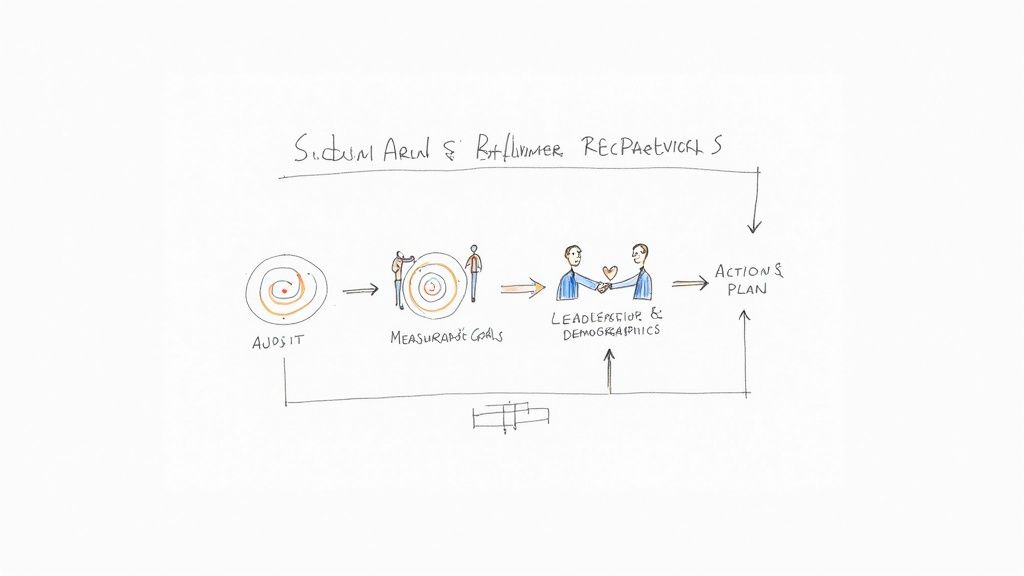
Before you even think about a new brochure design or a social media campaign, you have to lay the groundwork. From my experience, a winning recruitment strategy isn’t built on guesswork—it’s built on a solid foundation of data, clear objectives, and a team that’s completely on board. Think of this initial phase as building the engine, not just hitting the gas.
It all starts with an honest, hard look at your existing enrollment activities. This isn't about pointing fingers; it's about gaining absolute clarity. You need to get your hands dirty and dig into the data from your last one to three enrollment cycles to see what’s actually moving the needle and what's just draining your budget.
Auditing Your Current Enrollment Efforts
First, let's analyze your historical data to pinpoint your most valuable lead sources. Where did most of your enrolled families really come from? Was it your website's RFI form, a long-standing relationship with a feeder school, or that community fair you attend every year? Go deeper than just the source—calculate your cost per lead and, more importantly, your cost per enrollment for each and every channel.
This kind of analysis often uncovers some surprising truths. That glossy magazine ad might look great and generate a pile of inquiries, but if very few of them ever apply, its cost per enrollment could be astronomical. On the other hand, a highly targeted open house for a specific program might yield fewer initial leads but boast a 75% application rate, proving it's a far more efficient use of your time and money.
A critical mistake I see schools make all the time is chasing the volume of inquiries instead of the quality of enrollments. Your audit should laser-focus on which activities produce mission-aligned families who actually make it all the way through the admissions process.
Setting Clear and Measurable Goals
Once you have a firm grasp of your past performance, you can set goals that actually mean something. Vague ambitions like "increase enrollment" are useless. A truly powerful goal is specific, measurable, achievable, relevant, and time-bound (SMART).
Your goals need to be tied directly to your school's real-world, strategic needs. Here are a few examples of strong, actionable recruitment goals I've seen work well:
- Increase kindergarten applications from zip codes 90210 and 90211 by 15% before the February 1st application deadline.
- Boost enrollment in our high school STEM program by 10 students for the 2024-2025 academic year.
- Improve our inquiry-to-campus-tour conversion rate from 40% to 50% over the next six months.
- Generate 25 qualified applications directly attributable to our fall open house series.
Goals like these give your team a clear finish line and let you measure progress accurately. They also dictate which tactics and channels you should prioritize. Affordability is always a major factor, so don't forget financial aid. Beyond what your school offers, it’s a smart move to compile and highlight external financial aid and scholarship opportunities to proactively address those cost concerns.
Securing Team-Wide Alignment and Buy-In
Finally, a recruitment strategy gathering dust in a binder is worthless. To bring it to life, you need the full support of your entire team. I’m talking about everyone from the Head of School and board members down to the admissions counselors and the front-desk staff who are the first point of contact for prospective families.
Present your audit findings and proposed goals to your leadership. Use the hard data to make a compelling case for your budget and resource requests. Show them exactly why shifting funds from an underperforming print campaign to a targeted digital effort will deliver a much better return on investment.
For your admissions team, getting alignment means ensuring everyone knows the goals, understands the key messaging, and is crystal clear on their individual roles. When the whole team is working from the same playbook, the experience for prospective families becomes seamless and powerful. This is how you transform a scattered set of tactics into a focused, highly effective recruitment engine.
Getting to Know Your Prospective Families: Creating Personas That Work
If you try to speak to everyone, you end up connecting with no one. That’s the hard truth in school marketing. A truly effective student recruitment plan is built on a deep, almost personal understanding of the families you want to bring into your community. This goes way beyond surface-level demographics like zip codes and income brackets. We need to get to the heart of what they value, what worries them, and what really drives their school choice.
This is where creating prospective family personas becomes a total game-changer. These aren't just imaginary characters you invent. Think of them as composite sketches, brought to life with real data and stories from your current families, parent surveys, and even those candid conversations during admissions interviews. They give your entire team a shared language and a crystal-clear picture of who you're all trying to reach.
For example, your approach to "First-Time Foundations Fiona," a parent looking for a kindergarten spot, is going to be worlds apart from how you talk to the family of "Mid-Year Mover Marcus," a high school transfer. Fiona is laser-focused on safety, a warm and nurturing environment, and maybe your early literacy program. Marcus's parents? They're worried about credit transfers, whether he'll make friends quickly, and if your school has the specific AP classes or sports team he needs.
Digging Deeper Than Demographics
To build personas that actually help you, you have to get into the psychographics—the attitudes, values, and fears that shape their decisions. This is the difference between knowing a family lives three towns over and understanding why they're so unhappy with their current school that they're willing to make that drive every day.
When you're building out these profiles, try to uncover these key pieces of the puzzle for each one:
- Their Core Values: What's non-negotiable for them in an education? Is it academic rigor above all else? A faith-based community? Progressive, project-based learning? Or a heavy emphasis on character and leadership?
- Pain Points & Anxieties: What keeps them up at night? It could be anything from bullying at their child’s current school to a nagging fear that their daughter isn't being challenged enough, or that their son is getting lost in the crowd.
- Decision Triggers: What’s the one thing that will finally push them to take action, like filling out an inquiry form or booking a tour? It might be a powerful parent testimonial, seeing a story about a student's success, or discovering a unique program that feels like it was made just for their child.
- Where They Hang Out: Where do they actually look for information? Are they scrolling through local parent Facebook groups, do they religiously read email newsletters from community organizations, or are they more likely to show up at a local fair?
Once you map out these deeper motivations, you can make every single touchpoint—from your website's homepage to your social media ads—resonate on a much more personal level. Your school stops being just another option on a list and starts feeling like the only choice for them.
Using Personas to Sharpen Your Outreach
Once you have a few core personas fleshed out, you can start segmenting them for even smarter messaging. A simple and powerful way to start is by grouping them based on grade-level interest or a specific program you offer.
For instance, let’s say you have a "STEM-Focused Steve" persona. He represents parents who are all-in on technology and engineering. Any message you send his way should be packed with details about your robotics club, advanced science courses, and partnerships with local tech firms. That's a completely different conversation than the one you'd have with "Arts-Oriented Anna," who wants to hear all about your theater productions, see pictures of the art studio, and learn about your award-winning band. For a more detailed guide, check out our post on how to create buyer personas that actually drive results.
This kind of segmentation is also critical if you're recruiting internationally, where culture and economics play a massive role. For years, many schools have leaned heavily on students from India and China. While recent data shows India supplied around 363,019 students to U.S. campuses in 2024-25, the numbers from China have started to dip slightly. This is a perfect example of the risk involved in putting all your eggs in one or two baskets.
To build a more resilient enrollment pipeline, schools are now wisely diversifying their efforts into emerging markets like Vietnam, Nepal, and Ghana, where student interest is on the rise. It’s a strategic pivot backed by a ton of research showing that a broader recruitment base can smooth out the bumps in enrollment from year to year. You can get a better handle on these global student recruitment trends to see how they might inform your own strategy.
Choosing Your High-Impact Recruitment Channels
Okay, you’ve done the hard work of defining your family personas. Now for the fun part: figuring out where to actually find and connect with them.
It's easy to feel like you need to be everywhere at once—on every social media platform, at every community fair, and in every local publication. But that's a surefire way to burn through your budget and your energy. The real key isn't about being everywhere; it's about being in the right places with a smart, focused approach.
Think of it as creating a seamless journey for prospective families. Every single touchpoint, from a well-placed Facebook ad they see while scrolling to a warm conversation they have at an open house, needs to work in concert. This is how you build a cohesive experience that gently guides a family from initial curiosity all the way to hitting "submit" on their enrollment forms.
This diagram is a great reminder of how to tie it all together—connecting your personas, their values, and their triggers to the channels you choose.
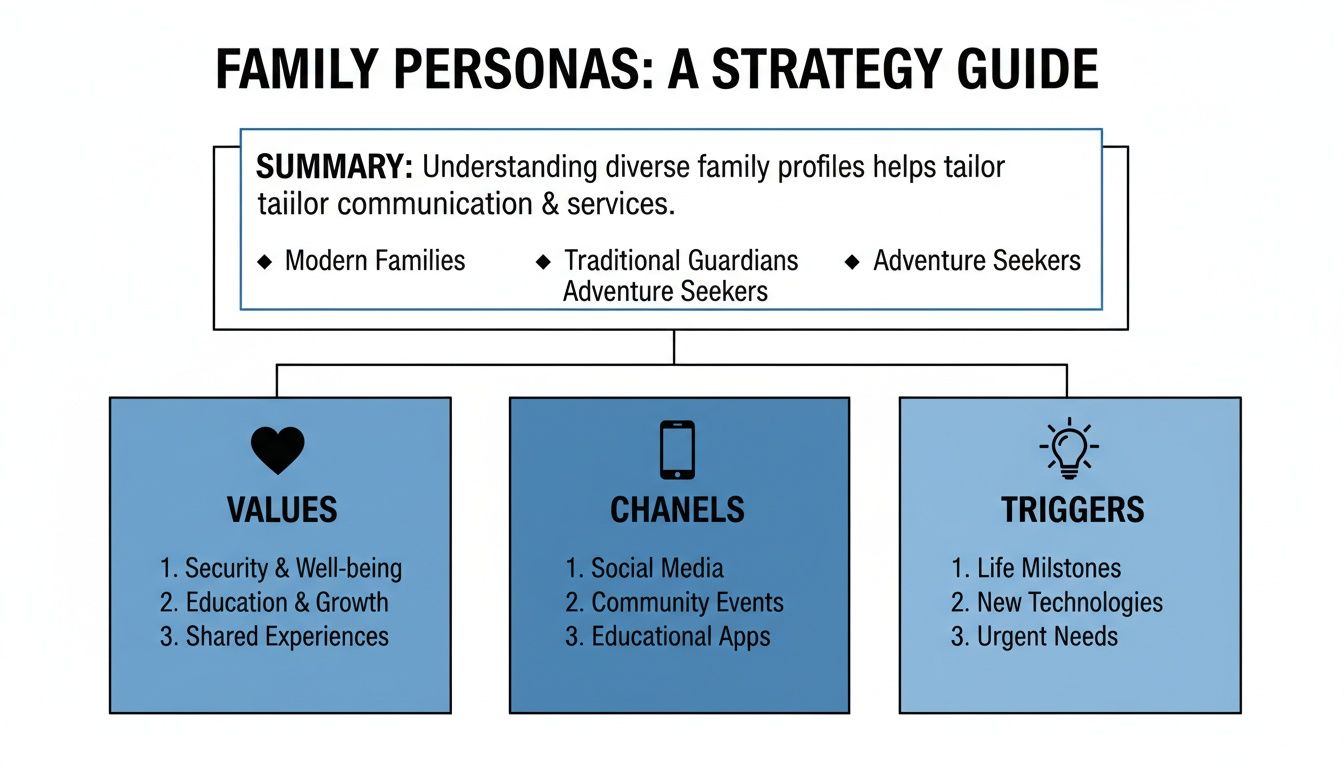
As you can see, aligning your channels with what families truly care about is what makes your message resonate.
Mastering Digital Recruitment Channels
For any K-12 school today, a strong digital footprint is absolutely non-negotiable. This is where modern families live. They research, compare schools, and form crucial first impressions online long before they ever consider setting foot on your campus. Your job is to be visible and valuable right where they're looking.
In my experience, three digital channels consistently punch above their weight when done right:
- Hyper-Targeted Social Media Ads: Platforms like Facebook and Instagram are goldmines for reaching niche audiences. You can target parents with incredible precision—by their kids' ages, their location, their interests (like "private education" or "youth soccer"), and even their online behavior. Imagine running a campaign for your kindergarten open house that only shows up for parents of 4- and 5-year-olds living within a 10-mile radius. That's power.
- Local Search Engine Optimization (SEO): When a parent types "best private schools near me" or "kindergarten programs in [Your Town]" into Google, you have to be there. Showing up at the top of those search results is what Local SEO is all about. It means optimizing your website and your Google Business Profile to capture this high-intent traffic. Honestly, it's one of the most cost-effective ways to get a steady stream of qualified inquiries.
- Search Engine Marketing (SEM): SEO is a marathon, but SEM (think Google Ads) is a sprint. It gets you immediate visibility. You can bid on specific keywords that signal a family is actively looking, ensuring your school is the first thing they see. This is perfect for driving traffic for time-sensitive things like application deadlines or upcoming tour dates.
Navigating the digital world means understanding what really drives a family's decision. Recent multi-country surveys reveal that financial worries, like affordability and scholarship availability, are huge factors that can either accelerate or halt an application in its tracks. For a deeper look at these decision drivers, you can explore the latest research on student decision-making.
A quick pro-tip: Don’t just run ads and hope for the best. Nurture the leads they bring in. A click on your ad should take them to a dedicated landing page that leads to an automated email sequence. This keeps your school top-of-mind by delivering value over time.
To help you weigh your options, here’s a breakdown of the most common channels we see schools using successfully.
K-12 Recruitment Channel Comparison
| Channel/Tactic | Primary Use Case | Best For Reaching | Cost Level | Key Metric (KPI) |
|---|---|---|---|---|
| Local SEO | Capturing high-intent search traffic from local families. | Parents actively researching school options in your area. | Low to Medium | Organic Traffic, Google Maps Views, Keyword Rankings |
| Paid Search (SEM) | Gaining immediate visibility for specific keywords and events. | Families in the decision-making stage. | Medium to High | Cost Per Click (CPC), Conversion Rate, Inquiry Form Fills |
| Social Media Ads | Building awareness and reaching highly specific demographics. | Targeted parent personas based on age, location, and interests. | Low to High | Reach, Engagement Rate, Click-Through Rate (CTR) |
| Email Marketing | Nurturing leads and communicating with interested families. | Prospects who have already shown interest (e.g., downloaded a guide). | Low | Open Rate, Click-Through Rate, Application Starts |
| Community Events | Building relationships and showcasing the school's personality. | Families in the local community; builds brand trust. | Low to Medium | Event Attendance, In-Person Inquiries, Lead Quality |
| Parent Ambassadors | Leveraging word-of-mouth marketing and authentic testimonials. | Networks of current families; high-trust audiences. | Low | Referral Inquiries, Enrollment from Referrals |
This table should give you a solid starting point for mapping out where to invest your time and budget. The magic really happens when you integrate a few of these channels to work together.
Supercharging Traditional Recruitment Efforts
While digital is essential, never, ever discount the power of a real, human connection. That personal touch is often the final piece of the puzzle that convinces a family your school is the right fit. The trick is to infuse these classic tactics with the same strategic thinking you apply to your digital marketing.
- Rethink Your Open House: Ditch the one-size-fits-all model. Host smaller, themed open houses that speak directly to your different family personas. You could hold a "STEM Discovery Night" for the academically-focused family or a "Fine Arts Showcase" for the creative one. It makes the whole experience feel more personal and valuable.
- Forge Strategic Community Partnerships: Think about who in your community already has the ear of your ideal families. Could you partner with local realtors, pediatricians, or even the town library? Co-hosting a small event or simply having them share your information can be a huge credibility boost.
- Leverage Your Current Families: Your happiest parents are your most powerful marketers. It's a fact. Create a formal parent ambassador program that gives them the tools and encouragement to share their stories online and in their own circles. A glowing, genuine review from a current parent is worth more than any ad you could ever buy.
In the end, the most successful student recruitment strategies artfully blend the scale and efficiency of digital marketing with the warmth and authenticity of personal connection. When a family sees your ad, loves your website, and then has an amazing experience at your open house, you've created a powerful journey that makes your school the obvious choice.
Once you’ve sparked their interest, a solid follow-up plan is critical. If you're looking for ideas on how to automate that communication, you might find our guide on email drip campaign examples really helpful.
Crafting Your School's Unique Story and Message

Alright, you’ve figured out who you're talking to. Now comes the real work: deciding what to say. Your school's message is its identity out in the wild. It’s the story that makes a family choose you over the three other schools on their list. A recruitment strategy lives or dies on a message that’s clear, compelling, and consistent everywhere a family might find you.
This isn't about just rattling off a list of your features, like small class sizes or that shiny new science lab. It's about translating those things into real benefits that solve a problem or meet a need for your parent personas. It's the difference between saying, "We have a 1:1 iPad program," and showing them, "We give your child the tech fluency to not just survive, but thrive in high school and beyond."
Identifying Your True Differentiators
First things first, you have to get brutally honest about what actually makes your school different. I’m talking about moving past the generic claims that every single school in a 20-mile radius is making. "A caring community" or "dedicated teachers"? Those are table stakes, not differentiators.
To find your unique angle, you need to ask some tough questions of your team:
- What do we do that no one else around here does? Maybe it’s a signature project-based learning program, a specific approach to character development, or a one-of-a-kind arts curriculum.
- What results do we consistently deliver? Think about where your alumni end up. Do they get into their top-choice high schools? Are they known as leaders, innovators, or compassionate citizens?
- What do our current families rave about? Your best marketing messages are often hiding in plain sight. Dig through parent testimonials and survey feedback—that's where the gold is.
The answers you find are the building blocks of your school's core value proposition. This is, in essence, the promise you make to every single family that enrolls. Getting this right is critical, and you can learn more about how to define a value proposition that truly hits home.
Your message has to be the answer to a parent’s unspoken question: "Why should I trust you with my child's future over all the other options?" If you can't nail that in one compelling sentence, you've got more work to do.
Translating Differentiators into Powerful Messaging
Once you've identified your core differentiators, the next job is to wrap them in language that’s memorable and benefit-driven. This messaging framework becomes your north star for everything—website copy, social media captions, open house presentations, you name it.
A solid framework should have a few key pieces:
- A Memorable Tagline: A short, punchy phrase that sums up your school's promise. It's the headline for your entire story.
- A Compelling Elevator Pitch: A 30-second rundown of what makes your school special. Every staff member, from the Head of School to the front office, should be able to deliver this with confidence.
- Benefit-Oriented Pillar Messages: These are three to five key messages that build on your value proposition. Each one needs to focus on a concrete benefit, like "Fostering Resilient Leaders" or "Igniting a Lifelong Love of Learning."
When you're shaping this identity, remember that even physical items can carry your story. For instance, exploring options for school merchandise can significantly amplify your brand message and make your school’s spirit something families can literally hold onto.
Gathering Your Proof Points
A great story is just a claim until you back it up. The final piece of the puzzle is collecting the evidence—the proof points that make your message not just powerful, but believable.
The best proof always comes straight from your community:
- Student Success Stories: Don't just say your students thrive; show it. Feature them in blog posts, short videos, or on social media. Tell their stories.
- Parent Testimonials: Collect quotes from happy parents that speak directly to your pillar messages. A testimonial about how your school's nurturing environment helped a shy kid find their voice is worth more than any ad you could ever buy.
- Hard Data: Don't shy away from the numbers. Things like 98% college acceptance rates, scholarship dollars earned, or measurable growth in reading scores are powerful validators that add weight to your emotional appeals.
By weaving these stories and stats into everything you do, your message evolves from a simple claim into a compelling, trustworthy narrative. This is how you build the trust that convinces a family your school doesn't just promise an amazing education—it actually delivers one.
Measuring What Matters to Optimize Your Strategy
A student recruitment strategy isn't something you create once, print out, and file away. It's a living, breathing document. The best school marketers I've ever worked with are relentlessly curious—they treat their strategy like a scientist treats a hypothesis. They're constantly testing, measuring, and refining their approach based on what the data tells them.
This is how you turn recruitment from a guessing game into a predictable system for growth.
Without clean data, you’re flying blind. You end up making budget decisions based on gut feelings or old assumptions. Building a solid tracking system isn't a "nice-to-have" anymore; it’s the engine of a modern recruitment operation. It’s also how you prove your value and make a rock-solid case for future investment.
Defining Your Core Recruitment KPIs
To measure what matters, you first have to define your Key Performance Indicators (KPIs). These are the specific, measurable numbers that tell you if you’re actually on track to hit your enrollment goals. They give you a clear-eyed view of your performance at every stage of the family's journey.
While every school has its own unique quirks, there are a few essential KPIs that every marketing and admissions team should be tracking religiously. Think of these as the vital signs of your enrollment health.
- Cost Per Inquiry (CPI): Plain and simple, how much are you spending to get one new family to raise their hand? This is a fundamental measure of marketing efficiency.
- Inquiry-to-Tour Conversion Rate: Of all the families who express interest, what percentage actually show up for a visit? This is a huge indicator of how well your initial messaging and follow-up sequence are resonating.
- Tour-to-Application Conversion Rate: This metric tells you how compelling your on-campus experience truly is. A high number here means your tours are doing their job and effectively selling the school's value.
- Cost Per Application (CPA): Similar to CPI, this calculates the total marketing cost needed to get one completed application—a critical mid-funnel metric.
- Application-to-Enrollment Rate (Yield): This is your ultimate closing rate. Of all the students you accept, how many actually enroll? A low yield can point to problems with affordability, tough competition, or a weak follow-through after sending acceptance letters.
- Cost Per Enrolled Student (CPES): This is the bottom-line number your Head of School or board really cares about. It's the total cost of all your efforts divided by the number of new students who actually walk through the doors on day one.
Tracking these metrics lets you diagnose problems with surgical precision. A high CPI might tell you your ads are targeted poorly, while a low yield could mean you need a stronger communication plan for accepted families.
The Essential KPIs for School Recruitment
Here’s a practical breakdown of the key metrics to track at each stage of the enrollment funnel. Knowing these formulas is the first step toward building a data-driven recruitment dashboard that gives you real, actionable insights.
| Funnel Stage | KPI | What It Measures | How to Calculate |
|---|---|---|---|
| Top of Funnel (Awareness) | Cost Per Inquiry (CPI) | The efficiency of marketing spend in generating new leads. | Total Marketing Spend / Total Number of Inquiries |
| Middle of Funnel (Consideration) | Inquiry-to-Tour Rate | Effectiveness of initial follow-up in driving campus visits. | (Total Campus Tours / Total Inquiries) x 100 |
| Middle of Funnel (Consideration) | Tour-to-Application Rate | The impact of the on-campus experience on a family’s decision to apply. | (Total Applications / Total Campus Tours) x 100 |
| Middle of Funnel (Consideration) | Cost Per Application (CPA) | The total marketing cost to acquire one completed application. | Total Marketing Spend / Total Number of Applications |
| Bottom of Funnel (Decision) | Application-to-Enrollment Rate (Yield) | The "closing" ability of the admissions team and overall school offer. | (Total New Enrollments / Total Accepted Applicants) x 100 |
| Bottom of Funnel (Decision) | Cost Per Enrolled Student (CPES) | The ultimate return on investment for all recruitment activities. | Total Recruitment Spend / Total New Enrollments |
Tracking these numbers gives you a powerful story to tell—one that clearly demonstrates the impact of your work and highlights exactly where you can improve.
Setting Up Your Data and Tracking Systems
Knowing your KPIs is one thing. Actually tracking them is a whole different ballgame. Your success here hinges on getting two systems to work together perfectly: your website analytics and your CRM (or Student Information System).
First, you have to get Google Analytics configured correctly on your website. This means setting up specific "goals" to track when a family completes a key action, like submitting an inquiry form, registering for an open house, or starting an application. This will give you undeniable proof of which pages and traffic sources are driving real results.
Next, that data has to flow cleanly into your school's CRM, like HubSpot or SchoolAdmin. This system should be your single source of truth for a family's entire journey. It’s where you connect the dots—from that first click on a Facebook ad, to their campus tour, to their application, and finally, to their enrollment. Getting this integration right is what allows you to calculate those crucial conversion rates with confidence.
Analyzing Data to Make Smarter Decisions
With your data flowing, you can finally move from guessing to knowing. This is where you identify which marketing channels to pour more money into, which to scale back, and where to reallocate your budget for maximum impact.
This data-driven approach is absolutely critical when navigating complex challenges like international student recruitment. Recent data shows that while the U.S. hosted a record ~1.18 million international students in 2024–25, new enrollments are wobbly. One report revealed that 57% of institutions saw a drop in new international students, hitting graduate programs especially hard.
In response, a whopping 84% of universities have named international recruitment a top priority, signaling they intend to invest strategically despite the turbulence. These mixed signals scream for a strategy that focuses on diversifying your markets and obsessing over conversion rates, not just chasing raw numbers. You can dig into these global student trajectory insights on aacrao.org.
By regularly reviewing your recruitment funnel with a critical eye, you can turn insights like these into action. When you commit to measuring what matters, you transform your strategy from a static plan into a dynamic, responsive engine for sustainable growth.
Navigating Common Student Recruitment Hurdles
Every school marketer I know, no matter how seasoned, runs into the same handful of challenges. It's just part of the job. But these common roadblocks don't have to derail your entire recruitment strategy.
Let's break down some of the questions that probably keep you up at night and give you some practical, field-tested answers.
How Can We Recruit Effectively With a Limited Budget?
This is the big one, isn't it? A shoestring budget doesn't mean you're out of the game. It just means you have to be more strategic and a whole lot smarter about where you spend your time and money. The goal is to focus on low-cost efforts that deliver a massive impact.
Your absolute best, most cost-effective marketing tool? Your current families. They're already your biggest fans. So, formalize that enthusiasm by creating a real Parent Ambassador Program. Don't just ask them to spread the word; equip them for it. Give them pre-written social media posts, exciting school news they can forward, and even special "bring-a-friend" invitations to school events. A genuine recommendation from a happy parent is worth more than any glossy ad you could ever buy.
Once you have your internal champions fired up, turn your attention to the digital channels that give you the most bang for your buck:
- Dominate Local SEO: This is a long-term play that costs more in elbow grease than in dollars. When a family in your town searches "best private schools near me," you need to be right there. Optimizing your website and your Google Business Profile is non-negotiable for generating a steady pipeline of qualified leads.
- Become a Resource with Content: Think about the questions parents are really asking Google. Write blog posts that answer them. A genuinely helpful article on navigating the kindergarten transition or demystifying the high school application process can attract the right families to your website for years.
Here's a little secret: stop obsessing only over new leads. The most budget-friendly growth you'll ever find comes from tightening up your funnel. A tiny 1% bump in your tour-to-application rate can be more valuable than generating 50 brand new, ice-cold inquiries.
How Do I Prove Marketing ROI to Leadership?
If you want the budget you need and the respect you deserve, you have to talk the talk your leadership team understands. And that language is data. "Brand awareness" is fuzzy and unconvincing. You have to draw a straight line from your marketing activities to new students in seats.
It all boils down to meticulous tracking. Your school's CRM and website analytics are your best friends here. You need to be able to trace a family's journey from the moment they first clicked a Facebook ad all the way through to paying their enrollment deposit. This is the only way to accurately calculate your Cost Per Enrolled Student (CPES) for every single one of your marketing channels.
Imagine walking into your next board meeting. Instead of just showing a list of things you did, you present a clear, undeniable report. "Our fall digital campaign cost $5,000 and brought in 10 new students, giving us a CPES of $500. On the other hand, our print ads cost $3,000 and only yielded one enrollment." Data like this doesn't just justify your budget; it makes future investment decisions easy and positions you as a strategic leader.
Ready to stop asking questions and start building a recruitment engine that truly works? At The MarCom Society, we give K-12 school marketers the expert guidance, hands-on resources, and peer community needed to master these challenges. You'll get access to live expert sessions, practical workshops, and a network of professionals who understand exactly what you're up against. Elevate your strategy and drive real results for your school by joining us.