
A solid student recruitment strategy is much more than just a marketing plan. It’s a comprehensive roadmap for attracting, engaging, and ultimately enrolling the right-fit students for your school. Think of it as the system that connects your school's unique DNA with the families you’re meant to serve, paving the way for sustainable growth and a vibrant school community.
Building Your Foundational Recruitment Strategy
Before you even think about launching a marketing campaign or scheduling an open house, you need to lay the groundwork. This foundational phase is all about deep reflection and keen market awareness. It's where you look inward to nail down what makes your school truly special and look outward to understand your place in the local educational ecosystem.
Skipping this step is a recipe for aimless recruitment efforts that just don't connect. This initial work ensures every decision you make later—from the words you use in an ad to the platforms you post on—is strategic and effective.

Ultimately, you're creating a strategic filter for all your recruitment activities. It's what stops you from chasing empty seats and helps you build a community of families who are genuinely invested in your mission.
Conduct a Thorough Institutional Audit
First things first: you have to get crystal clear on your school's core identity. This isn't about dusting off the mission statement hanging in the front office. It's about articulating your real-world value in a way that clicks with today's families.
Start by digging in with some tough questions:
- What does our educational philosophy look like day-to-day? How does it actually show up in the classroom?
- What are our signature programs? What makes our STEM lab, theater department, or athletics program genuinely different from the school down the street?
- How would we describe our community culture? Are we collaborative? Competitive? Faith-centered? Inclusive? Be honest.
- What are the tangible outcomes of our education? Point to specific college placements, impressive student awards, and compelling alumni success stories.
Answering these questions candidly helps you put words to the intangible magic that makes your school the perfect choice for a certain kind of family. This internal clarity becomes the foundation for all your external messaging.
Analyze Your Competitive Landscape
Let's face it, no school operates in a bubble. To carve out your niche, you have to know the local market inside and out. Start by identifying your competitors—and don't just think about other private schools. High-performing public schools and local charter schools are absolutely part of your competitive set.
For each competitor, do a little digging. Look at their:
- Messaging and positioning: How are they selling themselves on their website and social media? What story are they telling?
- Program offerings: Where do your programs overlap? More importantly, where are the gaps you can fill?
- Tuition and financial aid: How does your price point and aid strategy stack up?
The goal here isn't to copy what everyone else is doing. It’s about finding your unique lane. Maybe all your competitors are hammering on rigorous academics. That could be a golden opportunity for your school to lean into a whole-child approach that emphasizes social-emotional learning.
Identifying a clear, defensible market position is the single most important outcome of this foundational stage. It allows you to stop trying to be everything to everyone and start being the perfect school for someone.
The recruitment world is also getting more complicated. For example, while the U.S. saw a record number of international students in the 2024-2025 academic year, early data for the next cycle shows 57% of institutions saw a drop in new international enrollments. This is a stark reminder that a diversified, well-defined recruitment strategy is no longer a "nice-to-have." You can explore more about global student trajectory data and what it means for enrollment to see the bigger picture.
Defining Your Ideal Family Personas
Once you’ve nailed down what makes your school special, it's time to get crystal clear on who you're trying to reach. If you're blasting the same generic message to everyone, you're just adding to the noise. The real secret to effective outreach—the kind that feels personal and actually works—is developing detailed ideal family personas.
These aren't just fuzzy descriptions of "parents in the area." Think of them as character sketches for your ideal families, built on real data and insights. They bring your audience to life, giving you a north star for every blog post you write, social media ad you run, and marketing dollar you spend.

This process forces you to look past simple demographics and dig into what really makes families tick—their values, their worries, and what truly motivates their school choice.
Look Within Your Current Community
Honestly, the best place to start is right in your own hallways. Your currently enrolled families are your greatest source of intelligence. They already chose you, and by understanding their "why," you can find more people just like them.
Kick things off by digging into your enrollment data. You can spot patterns in things like zip codes, parent professions, or which preschools students are coming from. But that quantitative data is only half the picture.
To get the really juicy, qualitative insights, you have to talk to people.
- Survey current parents: Ask them flat out why they picked your school. What were their biggest anxieties during the search? What do they love most about being part of the community now?
- Interview your admissions team: They're on the front lines every single day. They know the tough questions parents ask and the hesitations they have better than anyone.
- Chat with key faculty and leaders: They have a unique perspective on the type of student—and family—that really thrives in your school’s culture.
This internal homework is the foundation for building personas that feel real because they are real. Gaining this deep understanding of your audience is a cornerstone of any student recruitment effort. To go even deeper, you can explore guides on how to create effective buyer personas to really sharpen your strategy.
From Data to Detailed Personas
Once you've gathered all this great research, you can start sketching out your personas. I'd recommend aiming for two to four distinct personas that represent your core audience segments. For a detailed playbook on this, our guide on how to create buyer personas walks you through the mechanics.
Each persona needs a mix of the hard data (demographics) and the soft insights (psychographics).
Here’s a quick example for a hypothetical STEM-focused academy:
Persona Example: "The Future-Focused Innovator Parent"
- Background: Typically two working parents, often in fields like tech, engineering, or healthcare. They have a couple of kids, one in middle school and another in upper elementary.
- Values: They’re all about academic rigor and hands-on projects. They want a curriculum that’s clearly preparing their child for a successful career, not just the next grade level.
- Goals: Getting their child into a top-tier university is a major goal, along with developing real-world critical thinking and problem-solving skills.
- Challenges: Their biggest fear is that their child is bored or under-challenged at their current school. They worry they won't be ready for a super competitive, tech-centric future.
- Where They Hang Out: They're not scrolling randomly. They read tech journals, university alumni magazines, local business news, and network in professional parent groups on LinkedIn.
See how specific that is? With this level of detail, you know exactly how to talk to them. For "The Future-Focused Innovator," you won't lead with your amazing arts program. Instead, you'll hit them with info about your robotics lab, internship partnerships with local tech firms, and your killer college placement stats for engineering programs.
This targeted approach makes your recruitment messages resonate on a much deeper level, positioning your school as the obvious—and only—choice.
Crafting Your School's Compelling Brand Story
You've done the hard work of defining what makes your school special and identifying the families you want to reach. Now, it's time to connect the dots. This is where we move from mission statements and value propositions to a story that truly resonates with prospective parents.
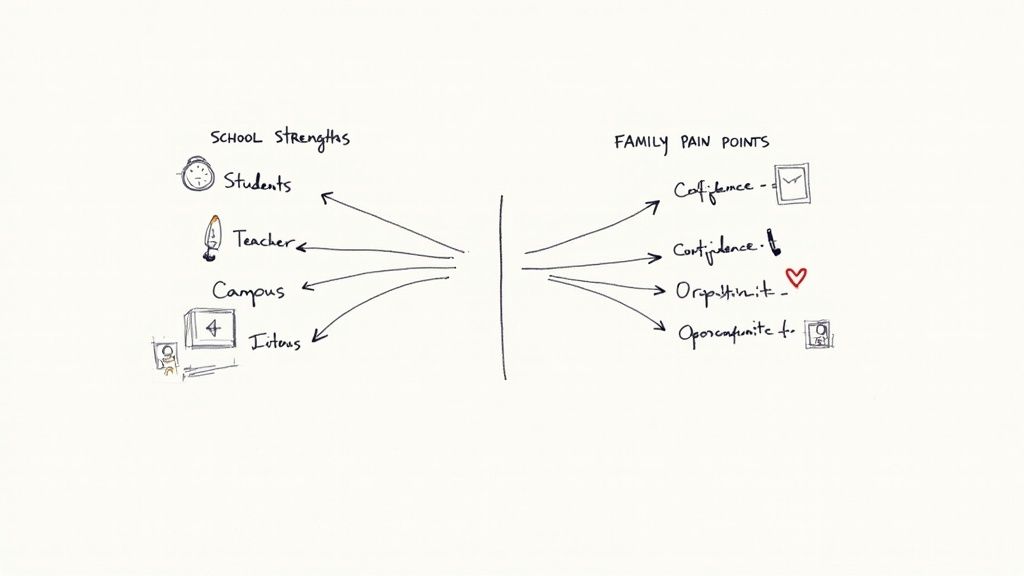
A powerful brand story isn't just a marketing slogan. It's the emotional bridge that connects your school's unique strengths directly to a family's deepest hopes and anxieties for their child's future.
Your job is to translate what you have (your features) into what families get (the benefits). This isn’t about just listing your programs; it's about showing a family you have the solution to the problem that keeps them up at night.
Developing a Persona-Based Messaging Framework
To make sure your messaging always hits the mark, I highly recommend creating a messaging framework. Think of it as a playbook that maps your school’s core values directly to the specific goals and challenges of each family persona you've built. This simple exercise forces you to stop talking at families and start speaking to their specific needs.
For example, a "state-of-the-art science lab" is just a feature. But for the parent of a potential 'Academic Achiever,' that lab becomes the place their child gets a leg up on the competition for top-tier university STEM programs. For the 'Whole-Child Advocate' parent, you might frame that same lab as a space for collaborative discovery that builds resilience and confidence.
Your messaging shouldn’t be a megaphone shouting about your school’s greatness. It should be a thoughtful conversation that starts with, "We understand what you're looking for, and here's how we help."
Once you build this framework, you'll have a go-to resource for your entire team. Your admissions counselors, social media manager, and even parent ambassadors will know exactly how to tailor their conversations and content for different audiences, ensuring a consistent and powerful message every time.
Here's a simplified example of what this looks like in practice. Notice how a single school value is translated differently for each parent persona.
Persona-Based Messaging Framework
| School Value | Persona A: 'The Academic Achiever' Parent | Persona B: 'The Whole-Child Advocate' Parent | Persona C: 'The Community-Seeker' Parent |
|---|---|---|---|
| Small Class Sizes | "Our 12:1 student-teacher ratio ensures personalized academic attention and advanced learning opportunities." | "With more one-on-one time, we can focus on your child’s social-emotional growth and build their confidence." | "Our intimate classroom setting helps every child feel known and connected, creating a true family atmosphere." |
| Project-Based Learning | "Students build a competitive portfolio of real-world projects, preparing them for top university programs." | "Our hands-on approach encourages curiosity and teaches critical thinking, not just memorization for tests." | "Collaborative projects teach students to work together, building the communication and leadership skills they need." |
| Dedicated Faculty | "Our teachers are subject-matter experts who challenge students to reach their highest academic potential." | "Our faculty are mentors who support each student's unique journey, both inside and outside the classroom." | "Teachers know every student by name and work closely with families to create a supportive network." |
This framework isn't just a theoretical exercise; it's a practical tool that will guide everything from your website copy to your open house presentations.
Lean into Authentic Storytelling
Facts and figures are important, but stories are what families remember. People make decisions with their hearts and justify them with their heads. Your brand story needs to forge that essential emotional connection. Done right, it's a total game-changer, and you can see some excellent brand storytelling examples for inspiration.
Instead of just saying you have a tight-knit community, tell the story of how the seniors organized a fundraiser for a middle schooler's passion project. Don't just claim to have dedicated teachers; share a 60-second video of Mr. Smith explaining what truly sparks his passion for history.
Here are a few ways to bring your stories to life:
- Student Spotlights: Forget just grades and test scores. Profile a student's personal growth journey, a cool project they launched, or how a teacher helped them overcome a specific hurdle.
- "Day in the Life" Content: Use Instagram Stories or short TikTok videos to give families an unpolished, authentic peek into daily life on campus. Let them feel the buzz in the hallways and see the collaboration in the classrooms.
- Alumni Success Stories: Show parents the long-term ROI of your education. Feature graduates in diverse career fields who can directly connect their current success to their time at your school.
Make Sure Your Brand is Consistent Everywhere
Even the most beautifully crafted story will fall apart if it’s not consistent. Every single interaction a family has with your school—from their first Google search to their campus tour—has to reinforce the same core message.
This consistency is what builds trust and makes your school feel genuine. A disjointed experience, where your website talks about a warm, inclusive community but the front office staff is dismissive, can destroy a family’s confidence in an instant.
Take a moment to do a quick audit of your most critical touchpoints:
- Website: Does your homepage instantly communicate your unique value?
- Social Media: Do your posts reflect your actual campus culture, or do they feel like stock photos?
- Open House: Are your presentations and tours bringing your brand story to life, or are they just a list of facts?
- Admissions Emails: Do your communications use a consistent tone of voice and messaging tailored to the recipient?
Every touchpoint is a chance to tell your story. By keeping it consistent, you create a seamless and persuasive experience that guides a family from initial curiosity to enthusiastic enrollment.
Choosing High-Impact Recruitment Channels
A killer brand story is useless if it never reaches the right families. Now that you've nailed down your core messaging and know exactly who you're talking to, it's time to build a multi-channel plan that gets that story in front of them. This isn't about throwing spaghetti at the wall to see what sticks. It's about being strategic—showing up in the right places, consistently and with purpose.
The real magic happens when you create a smart marketing mix. You need the broad reach of digital channels blended with the deep, personal connection of community engagement. This one-two punch ensures you’re building awareness and nurturing real relationships at the same time, getting the most out of every dollar and every hour you spend.
Prioritizing Your Digital Marketing Channels
Let's be honest, the school search journey almost always kicks off online. Your website and digital presence have become your new front door. You have to make sure it's not just open, but welcoming and easy for families to find. The digital world can feel overwhelming, but a few key channels consistently deliver the goods for K-12 schools.
If you're just starting or need to refocus, pour your energy into these digital tactics first:
- Local Search Engine Optimization (SEO): This is absolutely non-negotiable. When a parent types "best private schools near me" into Google, your school has to be on that list. This means getting serious about optimizing your website with local keywords, meticulously managing your Google Business Profile, and actively encouraging your current happy parents to leave positive reviews.
- Targeted Social Media Advertising: Stop wasting money by randomly "boosting" posts. Platforms like Facebook and Instagram offer incredibly powerful targeting tools. You can get your ads in front of families based on their zip code, whether they're parents, the ages of their children, and even their interests. This is how you make sure your ad about that amazing new STEM lab is seen by parents whose kids are into robotics, not parents of toddlers.
- Authentic Content Marketing: This is where you let your school's personality shine. Start a blog, a video series, or even a podcast that answers the real questions your ideal families are asking. Think less about promotional fluff and more about helpful content—behind-the-scenes classroom videos, testimonials from current parents, or a candid Q&A with your head of school.
The data backs this up. For a growing number of schools, sophisticated SEO and targeted social ads are no longer just part of the strategy—they're the primary drivers of new inquiries. It's all about meeting families where they already are: on their phones and laptops. To really dig into this, check out our complete guide on running targeted social media ads for schools.
Mastering Community-Based Recruitment
While a strong digital game is crucial, don't ever underestimate the power of a handshake and a real conversation. For schools, community-level engagement is where you build genuine trust. Honestly, for many families, these in-person moments are what tip the scales.
Digital marketing gets their attention, but community marketing wins their hearts. It’s the handshake, the campus tour, and the conversation with a current parent that often seals the deal.
Your goal here is to create experiences—not just presentations. You want prospective families to walk away with a true feeling for your school's culture and community. It’s about making them feel like they belong before they've even applied.
Turning Your Community into a Recruitment Engine
Guess what? Your most powerful marketing assets are already walking your hallways every single day. Activating your current parents, students, and staff to become ambassadors for your school is one of the most authentic and budget-friendly recruitment tactics you have.
Here’s how to put your community to work:
- Host Unforgettable Open Houses: It's time to kill the boring, lecture-hall-style open house. Turn it into an interactive experience. Set up hands-on activity stations in classrooms, let your student ambassadors lead small group tours, and create a casual coffee corner where prospective parents can chat with current ones.
- Launch a Parent Ambassador Program: Make it official. Create a volunteer group of your most enthusiastic parents. Give them some key talking points and branded gear, then empower them to help at recruitment events, make welcome calls to newly accepted families, or even host small get-togethers for interested families in their own neighborhoods.
- Build Local Partnerships: Get to know the local realtors, pediatricians, and business owners who are often the first point of contact for new families moving to town. Give them a stack of your viewbooks and make sure they know who to call when they meet a family that's a perfect fit for your school.
- Engage with Feeder Schools: Don't wait for them to find you. Build strong relationships with the preschools and middle schools in your area. You could offer to have one of your science teachers run a fun workshop for their students, or have your head of school speak at their next parent association meeting.
By weaving a precise digital strategy together with this kind of high-touch community engagement, you create a system that works. You’re not only making your school visible to a huge audience online, but you’re also building the deep, meaningful connections that turn curious parents into enrolled families.
Measuring The Metrics That Actually Matter
A recruitment strategy without the right data is just guesswork. If you're not carefully tracking what’s working and what’s falling flat, you're almost certainly wasting precious time and budget on activities that don't actually bring in new families. It's time to stop just tracking activity and start measuring real impact.
This is where your actions connect directly to outcomes. The aim here is to build a system that tells the complete story of your recruitment journey, from the moment a family first hears your school's name to the day they happily submit their enrollment deposit. This data-driven mindset is what transforms random campaigns into a predictable engine for growth.
Defining Your Key Performance Indicators
Not all metrics are created equal. It's easy to get lost in a sea of data, but true clarity comes from focusing on a handful of Key Performance Indicators (KPIs) that genuinely reflect the health of your recruitment pipeline. These are the numbers you should live and breathe, telling you at a glance if you're on track to hit your enrollment targets.
Think of your recruitment process like a funnel with clear stages. Each stage has its own set of vital signs you need to monitor.
- Top of Funnel (Awareness): This is all about getting on the radar of your ideal families. The main KPI here is inquiry volume—how many families are raising their hands to learn more? You should also keep a close eye on website traffic and social media engagement to see if your message is resonating.
- Middle of Funnel (Consideration): At this point, families are actively sizing you up. The most critical KPIs are campus tour/open house attendance and application starts. These metrics are a strong signal of genuine interest.
- Bottom of Funnel (Decision): This is where it all comes together. The non-negotiable KPIs are your application completion rate, your yield rate (the percentage of accepted students who actually enroll), and of course, your cost per enrolled student.
Tracking these core KPIs isn't optional. They weave together the narrative of your recruitment cycle, celebrating your wins and shining a spotlight on the exact parts of your funnel that need a little more love.
Building Your Recruitment Dashboard
Once you know what to measure, you need a simple way to see it all. This doesn't have to be some complex, expensive software; a well-structured spreadsheet or a basic CRM like HubSpot can do the job beautifully. The trick is consistency—updating it weekly or bi-weekly is key to spotting trends before they become problems.
Your dashboard should be more than a list of numbers; it's a diagnostic tool. Seeing a high volume of inquiries but a low number of tour sign-ups? That could point to a weak spot in your follow-up process. Lots of started applications but few completions? Maybe your online application form is too clunky or confusing.
The flow chart below gives you a bird's-eye view of how different channels feed into these metrics, from broad digital campaigns to more personal community and ambassador efforts.

This visual shows why a blended strategy is so effective. You need the scale of digital marketing paired with the power of personal connection to build a healthy pipeline that consistently converts prospects into enrolled students.
To help you get started, here's a breakdown of the KPIs you should be watching at each stage of your recruitment funnel.
Key Performance Indicators (KPIs) for Recruitment Funnel Stages
| Funnel Stage | Primary KPI | Secondary Metrics | Example Goal |
|---|---|---|---|
| Awareness (Top) | New Inquiries | Website Visitors, Social Engagement, Email Open Rate, Cost Per Inquiry | Increase unique website visitors by 15% YoY. |
| Consideration (Middle) | Tour/Event Attendance | Application Start Rate, Campus Visit Show-Up Rate, Email CTR | Achieve a 60% show-up rate for scheduled campus tours. |
| Decision (Bottom) | New Enrollments | Application Completion Rate, Acceptance Rate, Yield Rate | Improve yield from 70% to 75% for the upcoming school year. |
| Overall | Cost Per Enrolled Student | Funnel Conversion Rates (by stage), Lead-to-Enrollment Time | Decrease the overall cost per enrolled student by 10%. |
This table isn't just a checklist; it's a road map. By setting clear goals for each metric, you give your team a target to aim for and make it easy to see where you're knocking it out of the park and where you need to adjust your game plan.
Using Data to Optimize and Iterate
The real magic of tracking metrics isn't just about creating fancy reports—it's about making smarter decisions tomorrow. Your data should constantly spark questions that lead to meaningful adjustments in your student recruitment strategy. According to recent RNL data, eight in ten colleges are now using some form of AI in admissions, showing a massive industry shift toward data-informed operations.
For example, if you discover that families who attend a small Q&A with a faculty member are 3x more likely to apply than those who attend a large, generic open house, what does that tell you? It's a flashing neon sign to pour more resources into creating those smaller, high-impact events.
This continuous cycle of measuring, analyzing, and adjusting is what truly separates good recruitment teams from great ones. It empowers you to double down on what’s working, pivot away from what isn’t, and get a little bit better year after year. When data becomes your co-pilot, you can navigate the twists and turns of enrollment with confidence.
Troubleshooting Your Recruitment Strategy
Let’s be honest: even the best-laid recruitment plans will face turbulence. The world of K-12 education never sits still. Local demographics shift, new technologies emerge, and what families look for in a school is always evolving.
This is where we get into the nitty-gritty. Think of this section as your field guide for solving the tough, practical problems that keep school marketers up at night. We’ll tackle everything from proving your value to the board to finding that sweet spot between high-tech tools and a genuinely human touch.
How Do We Adapt to Shifting Local Demographics?
This is one of the biggest external factors that can make or break your strategy. A new housing development pops up, bringing a wave of young families. Or maybe the local population is aging, shrinking your applicant pool. The trick is to get ahead of these changes, not just react to them.
You have to treat demographic data as an essential, ongoing part of your market research.
- Become a Local Trends Expert: Keep a close watch on census data, new building permits, and local business reports. Is your community growing? Changing?
- Revisit Your Personas: Do your parent personas still accurately reflect the families in your area? A demographic shift might demand a brand new persona to connect with an emerging group.
- Fine-Tune Your Messaging: If new families are moving in from the city, their priorities might be totally different from your traditional audience. You may need to shift your messaging from, say, a "close-knit community feel" to highlighting your "advanced robotics program."
Imagine a major tech firm opens a new office down the road. Suddenly, your "Future-Focused Innovator Parent" persona isn't just a small segment—it's your prime audience. That’s your cue to go all-in on marketing your STEM labs and 1:1 technology program. Staying nimble here turns a potential threat into a massive opportunity.
How Can We Prove Marketing ROI to Leadership?
Ah, the million-dollar question. Your Head of School and board need to see marketing as a powerful investment, not just another line-item expense. The only way to do that is by drawing a straight, undeniable line from your marketing activities to actual enrollment numbers.
Vague updates on "brand awareness" or "social media impressions" are not going to cut it. To win over leadership and secure the budget you need, you have to tell a clear, data-driven story that connects specific campaigns to students in seats.
Your north star metric here should be your Cost Per Enrolled Student.
- Track Every Single Source: The moment a new family inquires, the first question out of your mouth (or on your form) should be, "How did you hear about us?" Log everything in your CRM or even a simple spreadsheet—Google search, Facebook ad, direct mail, a friend's recommendation.
- Calculate Costs by Channel: Add up what you spent on each specific marketing channel. How much did that Google Ads campaign cost in total?
- Follow the Funnel: Trace those inquiries all the way through to enrollment. Of the families who came from that Google Ads campaign, how many actually enrolled their child?
- Paint a Clear Picture: Put it all together in a simple report. For example: "We spent $5,000 on Google Ads, which generated 50 qualified inquiries and resulted in 5 new enrollments. Our cost per enrollment for this channel was $1,000."
Presenting this kind of concrete data completely changes budget conversations. It moves the discussion from, "Is our marketing working?" to the far more strategic question of, "Which channels are giving us the best return, and how can we double down on them?"
How Do We Use New Tech Without Losing Our Personal Touch?
You can't ignore the rise of AI and automation in school admissions. Recent data shows that eight in ten colleges are already using some form of AI in their recruitment. While these tools promise incredible efficiency, many of us worry they’ll make our school feel cold and impersonal.
The key is to use technology to fuel human connection, not to replace it.
- Automate the Annoying Stuff: Use AI chatbots or automated email drips to handle the frequently asked questions instantly. This frees up your admissions team for the real, meaningful conversations that matter.
- Personalize at Scale: A good CRM is your best friend here. It can help you send a personalized video message or a quick text that references a specific family's interest in the arts program, showing them you were actually listening.
- Supercharge the Campus Visit: Use tech to handle the logistics—registration, reminders, and follow-up surveys. That way, your team can be fully present, focusing on creating that warm, welcoming experience for families the moment they step on campus.
Let technology handle the logistics so your team can handle the relationships. This balanced approach gives you the best of both worlds: the efficiency of modern tools and the authentic, personal connection that truly convinces a family that your school is the right place for their child.
Ready to elevate your school's marketing and connect with a community of peers tackling these same challenges? The MarCom Society provides the expert-led workshops, downloadable resources, and collaborative support you need to build a sustainable and effective student recruitment strategy. Join a network of professionals dedicated to K-12 growth and innovation.









